
TAURUS
The greatest moderation

ON OCTOBER 19th China reported that its economy grew by 6.7% in the third quarter. It would have been an unsurprising, reassuring headline, except that China had reported exactly the same figure for the previous quarter—and for the quarter before that. This freakish consistency invited the scorn of China’s many “data doubters”, who have long argued that it fudges its figures. China has expanded at the same pace from one quarter to the next on numerous occasions. But it has never before claimed to grow at exactly the same rate for three quarters in a row.
Has anywhere? This growth “three-peat” is not entirely without precedent. Seven other countries have reported the same growth rate for three quarters in a row, according to a database spanning 83 countries since 1993, compiled by the Economist Intelligence Unit, our sister company. The list includes emerging economies like Brazil, Croatia, Indonesia, Malaysia and Vietnam, but also two mature economies: Austria and Spain. Indeed, Spain has performed this miracle of consistency twice. It grew by 3.1% (year-on-year) in the first three quarters of 2003 and by 4.2% in the first…Continue reading
Brazilian firms emerge from the gloom
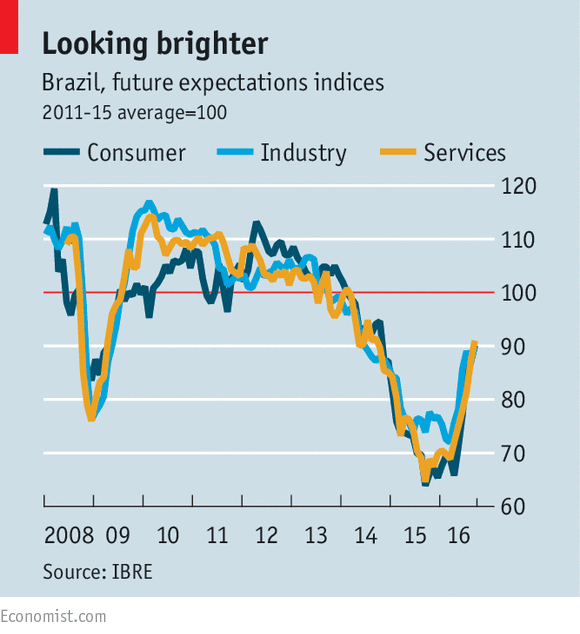
“BRAZIL is back in business,” proclaimed Abílio Diniz, chairman of BRF, a Brazilian pork and poultry giant, at a recent investor shindig. Really? The economy, mired in recession since mid-2014, is not expected to stir before the end of the year—and then only sluggishly. After rebounding in the first half of 2016, industrial production plummeted again in August. Retail sales fell by more than forecast. Firms expect to hire just 100,000 temporary workers in the run-up to Christmas, 3% fewer than last year’s already low tally. BRF’s own domestic operations are hardly a picture of health. Sales dropped by 5% in the second quarter, year on year (though this was offset by rising global revenues).
For all that, Mr Diniz is not alone in his optimism. Surveys point to rising confidence among bosses and consumers alike (see chart). Investors’ spirits are up—and with them the São Paulo stockmarket, which has returned to levels last seen in 2012. The real has strengthened by a third against the dollar since January.
The collective mood swing has less to do with the real economy, and more with realpolitik. In August the…Continue reading
Known unknown

COMPETITION between currencies is the stuff libertarian dreams are made on—and central bankers’ nightmares too. Already digital monies, in particular Bitcoin and Ethereum, are rivals. On October 28th a new crypto-currency will join the fray: Zcash. Many such “altcoins” are dubious affairs and don’t add much. But this one brings important innovations.
Zcash is based on Bitcoin’s code, but its creators, a bunch of cryptography researchers, have tweaked it. The new digital cash is minted more quickly and the system can handle more transactions. This makes for more liquidity and shorter transaction times, says Zooko Wilcox, who leads the project.
The newcomer also differs in the way it is governed. The incumbent started—and is still run—as an open-source project: a small group of volunteer developers decides which changes are made. Zcash’s code is also open-source, but its inventors have formed a company and accepted money from investors. In addition, 10% of the 21m coins to be issued are earmarked for founders, investors, employees and a putative Zcash foundation. All this, says Mr Wilcox, is to align incentives for all…Continue reading
New York deflates Airbnb
 No rules broken here
IN 2007, Brian Chesky and Joe Gebbia came up with a wheeze to rent out two air beds in their San Francisco apartment, because a conference had left the local hotels full-to-overflowing. Thus, Airbed & Breakfast was born. Since then, the firm’s only contraction has been its name. Today, Airbnb’s website lists over 2m properties for short-term let in 191 countries. Piper Jaffray, an investment bank, estimates that bookings through the firm will reach $14.4bn in 2016, compared with $52m in 2010. Analysts think the upstart might fetch $30bn were it to be taken public. That would make Airbnb worth more than Marriott, the world’s largest hotel chain.
But legislation signed in New York state on October 21st has taken some of the puff out of Airbnb’s mattress. New York City is the firm’s largest market in America, with around 35,000 properties available for rent. But many of the hosts offer their apartments illegally. In 2010, the state passed a law banning rentals of whole units in residential blocks for less than 30 days. (It is legal to do so if the tenant is living there at the same time.) To…Continue reading
Steel trap

BESIDES being dirty and dangerous, making steel in China has been a good way to burn through money over the past few years. But in recent months, the fires from the country’s blast-furnaces have started to emit the warm glow of profits. Steel prices have risen by nearly 50% this year. Production, which fell in 2015 for the first time in decades, is also up. Smelters are set for a strong recovery after losing $10bn last year. And it is not just the steelmakers who will be pleased. Asia’s central bankers can also take some comfort in the rising prices: they suggest that the threat of deflation might be receding.
Once seen in Asia as a peculiarly Japanese phenomenon, deflation spread throughout the region’s factories in the past half-decade. The prices that consumers see in shops have on the whole continued to increase, albeit more gently than before. But the prices that companies charge for goods as they leave their factories’ gates have dipped lower and lower. Virtually all big Asian economies, including South Korea, India, the Philippines, Taiwan and Thailand, have experienced prolonged bouts of falling producer…Continue reading
Wind and solar advance in the power war against coal
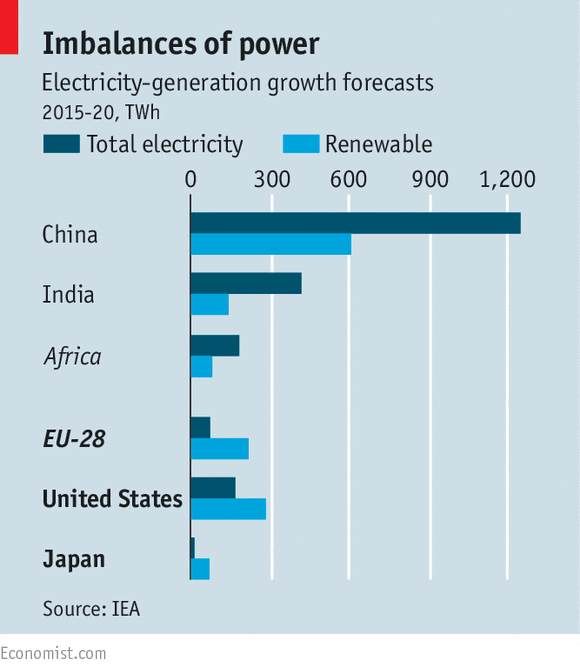
THE battle between clean energy and dirty coal has entered a new phase. The International Energy Agency (IEA), an industry forecaster, this week reported that in 2015 for the first time renewable energy passed coal as the world’s biggest source of power-generating capacity.
The IEA, whose projections for wind and solar energy have in the past been criticised as too low, accepted that renewables are transforming electricity markets. Last year 500,000 solar panels were installed every day around the world. In China alone, home to a whopping 40% of the 153 gigawatts (GW) of global growth in renewable-energy installations, two wind turbines were erected every hour. Based on existing policies, it forecasts that from 2015-21, 825GW of new renewable capacity will be added globally, 13% more than it projected just last year.
All those new wind and solar plants will not generate electricity all the time. Unlike coal, which burns around the clock, renewables are intermittent. But the IEA expects the share of renewables in total power generation to rise to almost 28% from 21%. Government policies to curb global warming and reduce air…Continue reading
Angling for the future of TV

IMAGINE a television which, as in the old days, has only a handful of channels to choose from instead of hundreds, as a typical cable set-up might offer today. In a decade or so TVs will once again have only a few channels, but each will run miles deep, with content that can be viewed on demand. Netflix might be one such offering; Amazon another. Both firms are spending billions of dollars making and buying TV shows and films to sell directly to viewers to watch when they like, and on devices other than the box in the corner of the room. And other rich tech firms may join them.
It is this vision that is now driving the direction of television and media. Broadcasters are willing to pay more to show live sporting events, and to invest more in producing TV shows, to make their networks the must-see choice for viewers. This trend has spurred the largest-ever merger of a telecommunications company with a media firm. AT&T, America’s wireless and pay-TV giant, announced on October 22nd an offer for Time Warner, the owner of HBO, CNN and Warner Brothers studio, worth $109bn. In doing so AT&T is betting that a few vertically integrated platforms will…Continue reading
Passing the buck

IN 2007 financial dangers, piled up like so much tinder, ignited at last and caused a swathe of destruction across the global economy. The blaze also engulfed governments, which faced intense public pressure to prevent such calamities from recurring. Much has happened on the regulatory front since then. Few believe, however, that the problem of financial instability has been solved. To regulators’ frustration, in a world of global financial flows, efforts to safeguard one country often endanger others.
This bothersome tendency has become harder to ignore as cross-border capital flows have swollen. Annual gross financial flows in rich countries soared from roughly 5% of GDP in 1980 to around 25% of GDP on the eve of the financial crisis. This worldwide torrent of money has its benefits. Investors can more easily diversify their portfolios. Investors in slow-growing rich countries gain access to higher-yielding investments in poorer, capital-starved economies, and those poorer economies gain access to desperately needed capital relatively cheaply.
Yet there are costs as well. Emerging economies with less sophisticated financial markets and…Continue reading
No Trumps!

TRADITION suggests that Wall Street should favour the Republican Party. America’s conservatives usually back low taxes, free trade and a reduction in regulation. But the 2016 election seems to be an exception. A Bank of America Merrill Lynch poll of fund managers in October found that a Republican victory was seen as one of the biggest risks facing financial markets, along with the disintegration of the EU.
A study* by Justin Wolfers of the University of Michigan and Eric Zitzewitz of Dartmouth College found that in the wake of the first debate, there was a six-percentage-point rise in the probability of a Hillary Clinton victory on betting markets. In reaction, stockmarkets rose, and gold and Treasury bonds (two assets that benefit when investors become risk-averse) fell. “Financial markets expect a generally healthier domestic and international economy under a President Clinton than under a President Trump,” the authors concluded.
What makes this election different for investors is the nature of the Republican candidate—Donald Trump is a long way from the party’s mainstream. A Trump victory would throw up all kinds of uncertainty…Continue reading
Rebooting

JUST outside Stanford University’s campus sits the headquarters of Symphony, one of the myriad tech companies that sprout like weeds in Silicon Valley. After a lunch break exercising in a nearby park, a dozen fit-looking employees, still in workout clothes, help themselves from buckets of fruit, energy bars and the food of the day (Indian), before plopping themselves in front of monitors in an airy room bathed in natural light. For the sought-after engineers making up most of the company’s 200-strong workforce, this sort of environment is the norm. Work is supposed to be healthy and relaxed—a far cry from the terrors of a New York bank with its incessant pressure to sell and complex internal politics, not to mention often unappetising, pricey food.
Across the continent, in a newly opened tower within the World Trade Centre, Kensho, a three-year-old company, has a similar feel. Like Symphony but a bit smaller, it is stuffed with talented engineers. In a New York approximation of the West Coast, it boasts “vertical gardens”—rectangular patches of vegetation like framed paintings—and a pool table.
Symphony is a messaging platform,…Continue reading