
Economía
El BPI aprueba la opa de CaixaBank, pero sugiere elevar el pago por acción
El banco portugués despedirá a un millar de empleados, el 15% de su plantilla
Bankia afirma que Hacienda nunca descubrió las tarjetas ‘black’ de Caja Madrid
Un exdirectivo dice que el uso de la visa opaca era habitual y parte del contrato
Los grupos parlamentarios, menos PP y Ciudadanos, piden subir un 1,2% las pensiones
La proposición de ley sumaría el apoyo de la mayoría del Congreso, 178 diputados
Ikea abrirá dos tiendas ‘pop up’ en el Rastro de Madrid y el Born de Barcelona
La cadena sueca de decoración venderá artículos exclusivos de la tradición sueca en dos establecimientos que solo abrirán entre el 21 y el 30 de octubre
Stumpfed
 Retired hurt
WHEN you consider the hundreds of billions of dollars of losses and fines that the banking industry has made or incurred over the past decade, the affair that has just ended the career of John Stumpf, the boss of Wells Fargo, may at first seem innocuous. In September Wells admitted that its retail-banking sales people had been too pushy, and agreed to pay regulators a $185m fine, a tiny sum by recent standards (Deutsche Bank is presently in negotiations to pay a fine of perhaps $5 billion to American regulators). Mr Stumpf probably thought that he had a couple more happy years to go as the head of the world’s most valuable bank.
But on October 12th, he stepped down after being roasted alive for weeks in an inferno of criticism. Wells’s transgressions have caught the public mood far more than esoteric abuses in the mortgage-backed-security market ever did. The bank admitted that its staff created up to 2m bogus accounts, without customers’ permission, in order to meet aggressive sales targets. To many Americans fed up with banks’ red tape and lousy service that seemed reckless, unforgivable and possibly…Continue reading
Feel the force flow

YOU would expect strong job growth to be accompanied by falling unemployment, but America is proving that one does not always entail the other. Over the past year, employment is up by fully 3m but the unemployment rate has stayed around 5%. In fact, a few more workers are unemployed than a year ago (see chart). The reason is that more Americans are seeking jobs. Over the past 12 months the labour-force participation rate of so-called “prime-age” workers—those between 25 and 54—is up by just under one percentage point, the fastest growth recorded since January 1989. Economists trying to spot inflation on the horizon want to know how long this trend can continue.
The recent surge in prime-age participation follows a long decline from its peak, 84.6%, scaled in January 1999. Between then and September 2015, it tumbled by an average of about a fifth of a percentage point a year. Among men, it had been falling since the mid-1960s. The long slide accelerated after the financial crisis, as laid-off workers quit the labour force in droves.
Hence the refrain of some that low unemployment is a mirage: stronger economic growth,…Continue reading
Retailers and issuers are still battling over payment –card fees
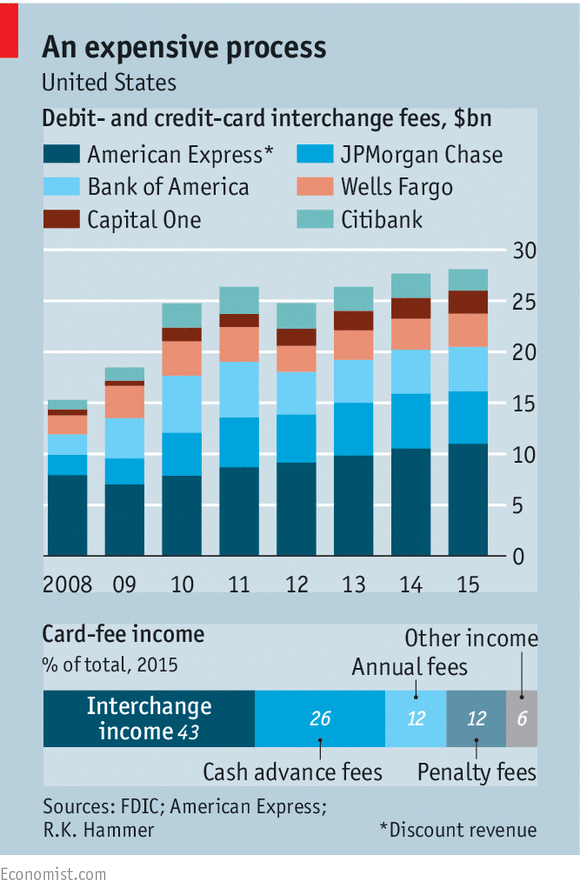
IN 1966 a medical journal identified a condition it dubbed “credit-carditis”: lower-back ache, with pain radiating down the leg—caused by a back-pocket wallet stuffed with plastic. Payment cards still inflict pain of a different sort. American merchants paid more than $40 billion to process debit- and credit-card transactions in 2015. Despite a reform by the Federal Reserve in 2011 aimed at reducing these costs, revenue from these so-called “interchange fees” has more than doubled since the financial crisis. Retailers are still in revolt; banks are still resisting. That is not surprising, since they rely on the fees for a large and growing share of their income.
American consumers favour debit and credit cards over cash by more than two to one. But this convenience comes at a cost. The seller is charged a fee for every card purchase: in America, typically 0.5% to 3% of its value. These fees are set by payment-card networks, such as Visa and MasterCard and collected by card issuers, such as Wells Fargo and JPMorgan Chase. Some portion of these fees is borne by consumers, including those who pay by cash, in the form of higher…Continue reading
Adventure tourism

VISITORS to Lisbon, Portugal’s hilly capital, usually seek its nightlife, its sweet custard tarts (pasteis de nata) or its gothic architecture. But no guidebook could help two visitors on October 10th. The pair of analysts, from Dominion Bond Rating Service (DBRS), a Canadian credit-ratings agency, went to assess the creditworthiness of the Portuguese government.
Markets are waiting anxiously for October 21st, when DBRS will update its rating of Portuguese sovereign debt. Hints from DBRS have been playing havoc with the ten-year bond yield: in August a gloomy comment from Fergus McCormick, DBRS’s chief economist, saw it climb 14 basis points (hundredths of a percentage point). This week, word that DBRS was “totally comfortable” with the government’s fiscal position saw it dip by ten basis points.
This unusual attention to a little-known ratings agency is due to the eligibility rules for the European Central Bank’s (ECB) quantitative-easing scheme. The ECB will buy only sovereign debt that is rated as investment grade by at least one of four approved ratings agencies: Fitch, Moody’s,…Continue reading
When a bubble is not a bubble

ESTATE agents in China, as elsewhere in the world, are normally a smooth-talking, self-assured bunch. But Liu Zhendong, a salesman at a large development in the northern reaches of Shanghai, is afflicted by doubts. He had expected business to be solid and steady this year. Instead, it has been manic, with clients jostling to see show apartments. Some had hoped to wait for the market to cool, but capitulated and bought as prices climbed higher week after week. Flats in the area, the once-rural village of Malu, still dotted with fields and scruffy wholesale food markets, now cost 90% more than a year ago. “It feels a bit like a bubble,” he says.
Mr Liu is in good company. Even the head of the central bank’s research bureau, usually cautious in his choice of language, has said a property bubble must be stopped before it gets too big. House prices have climbed by 16% nationwide over the past year, and double or even triple that in big cities. So in the past two weeks more than 20 municipalities have tried to calm the market down—for example, by requiring higher down-payments or limiting purchases by residents of other cities.
As the past…Continue reading