
Finanzas
Why carmakers need to get bigger

CARS are getting bigger. Motorists worldwide have for years been abandoning four-door saloons in favour of bulkier SUVs. Carmakers have become bigger, too. Four car firms now make around 10m vehicles a year in order to reap economies of scale, particularly in the mass-market bit of the business where profit margins can be painfully thin.
Many executives also believe that size is the only protection against the technological upheaval sweeping the industry. But bulking up fast is easier said than done. Lots of different constituents have to be won over. And most car bosses are still reticent about taking the plunge on mergers because many have been catastrophes. Daimler’s acquisition of Chrysler in 1998, for example, was a notable disaster. The list of past crashes is lengthy. Indeed, one recent deal—General Motors’ sale of Opel, its European arm, to France’s PSA Group for €1.3bn ($1.4bn)—seems to go directly against the imperative to bulk up.
In fact, that deal has had the effect of spurring more talk of consolidation. Speculation centred at first on a possible mega-merger between GM and Fiat Chrysler Automobiles (FCA), itself the result of a deal in 2014 (FCA’s…Continue reading
The University of Chicago worries about a lack of competition

ONE sign that monopolies are a problem in America is that the University of Chicago has just held a summit on the threat that they may pose to the world’s biggest economy. Until recently, convening a conference supporting antitrust concerns in the Windy City was like holding a symposium on sobriety in New Orleans. In the 1970s economists from the “Chicago school” argued that big firms were not a threat to growth and prosperity. Their views went mainstream, which led courts and regulators to adopt a relaxed attitude towards antitrust laws for decades.
But the mood is changing. There is an emerging consensus among economists that competition in the economy has weakened significantly. That is bad news: it means that incumbent firms may not need to innovate as much, and that inequality may increase if companies can hoard profits and spend less on investment and wages. It may yet be premature to talk about a new Chicago school, but investors and bosses should pay attention to the intellectual shift, which may change American business.
The fear that big firms might come to dominate the economy and political life has its roots in the era of the robber barons of the…Continue reading
Rescuing Myanmar’s farmers from the debt trap
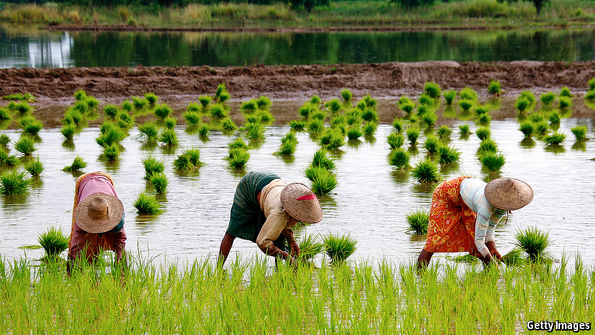 Living on borrowed rice
WHEN Myo Than was a young man, his family had 12 hectares of farmland in Dala, a rural township just across the river from Yangon, Myanmar’s biggest city. His mother sold most of it after his father died. Mr Myo Than grows rice on what’s left, but water shortages mean he reaps just one harvest each year. He borrows money from the Myanmar Agricultural Development Bank (MADB)—1.5m kyats ($1,100) this year, at an annual rate of 8%—to cover planting costs. But rice is a low-return crop. To repay the bank he borrows from local moneylenders at a rate of around 4% each month. Mr Myo Than owes them $7,300. He has given his land deeds to a moneylender as security.
Mr Myo Than’s predicament is not unusual: poor crop returns and usurious loan terms have kept Myanmar’s farmers trapped in poverty and debt. Around 60% of Myanmar’s population are engaged in agriculture. Most are poor, and farm small plots of land using age-old manual techniques. Farmers scythe rice fields; water buffaloes pull wooden ploughs; hay-laden bullock-carts trundle down narrow roads.
Many farmers borrow to cover planting costs, buy equipment…Continue reading
The EFTA countries show how hard Brexit will be for Britain

NORWAY offers much to envy. The food is tasty, public services are great and the people are impossibly good-looking. Its trade policy looks equally desirable. Though it trades heavily with the EU, Norway can also strike trade deals all over the world, either operating in concert with the three other members of the European Free Trade Association (Iceland, Liechtenstein and Switzerland) or on its own. Members of EFTA have dozens of deals, including two with China, with which the EU cannot even start negotiations.
After it leaves the EU, Britain will look much like an EFTA country: a rich economy with close links to Europe, but also seeking trade deals elsewhere. It is superficially an attractive prospect. Yet EFTA’s half-in-half-out relationship with the EU hinders its trade as much as it helps.
EFTA’s flexibility in trade stems from its odd relationship with the EU. Switzerland has a series of bilateral agreements, whereas Norway, Iceland and Liechtenstein are part of the single market through the European Economic Area (though with opt-outs for agriculture and fisheries). Crucially, however, all are outside the EU’s customs union, an agreement which regulates…Continue reading
A different approach to mobile money in Africa
WITH her phone in one hand and a live chicken in the other, Brenda Deeomba comes for her money. Her husband is a builder in Lusaka, the Zambian capital, and sends his wages home through Zoona, a money-transfer company. She receives them at a roadside booth in Chongwe, a nearby town, using a PIN number sent to her phone. It is a safe way to get the money, says Ms Deeomba, above muffled squawks.
Money-transfer businesses are proliferating in Africa. But Zoona is unusual. Unlike M-PESA, the best-known, in Kenya, it is not run by a phone company. Nor is it owned by a bank. Instead, Zoona has built a business from scratch. It processed $200m in transactions last year and bubbles with ambition: Mike Quinn, its (Canadian) chief executive, talks of reaching 1bn customers.
Zoona was founded in Zambia in 2009 by two brothers, Brad and Brett Magrath. As a startup, they were at a disadvantage, having to recruit their own agents. Zoona did so by seeing them as its core customers, giving them credit and training to set up their own franchises. Some are impressively successful. In central Lusaka, Misozi Mkandawire presides over an empire of kiosks. She started with Zoona while at college. Her profits can now reach 50,000 kwacha ($5,200) a month. That is exceptional. Last year the average agent made $548 in monthly commission, before costs. Globally, nearly half of…Continue reading
Mitos, verdades y mentiras en el impuesto sobre sucesiones
Se atribuye al tributo un supuesto alud de cambios de residencia. El aumento de la renuncia de herencias no se debe al impuesto
El ahorro en los hogares de la eurozona bajó en el cuarto trimestre de 2016
La tasa desciende hasta el 12%, tres décimas menos que de julio a septiembre, según Eurostat
Estudios, enfermedad y familia, los motivos de los jóvenes para no buscar empleo
Durante la crisis se multiplicó el número de personas menores de 30 años que estaban inactivos para continuar con su formación
Qué le espera al accionista de Popular: Deutsche y Unicredit dan pistas
El gigante italiano y el alemán han ampliado con descuentos del 40%
Sufrieron antes el castigo bursátil y anunciaron ajustes
Crece la brecha en I+D
El Gobierno debe invertir en investigación para salir del furgón de cola de Europa