
Finanzas
Montoro dice que solo presentará los Presupuestos si hay acuerdo
El ministro vincula la aprobación de las cuentas para 2017 al comienzo de la negociación de la financiación autonómica
Draghi mantiene intacto el estímulo “por las incertidumbres globales”
El BCE anuncia que solo subirá los tipos de interés cuando la recuperación se afiance
Lee Jae-yong dodges arrest on charges of bribery

THE deal which did most to secure Lee Jae-yong’s control over South Korea’s biggest conglomerate threatened this week to ruin him. On January 16th special prosecutors accused Mr Lee, the only son of Samsung’s chairman, Lee Kun-hee, of bribery, embezzlement and perjury. But three days later a court rejected a request to arrest him, as a suspect in an investigation into a vast influence-peddling case that led last month to the South Korean president’s impeachment. It saw “no reasonable grounds” to detain him while prosecutors pursue their probe.
For now, the result is a victory for Samsung. Prosecutors had accused Mr Lee of paying 43bn won ($36m) into sports and cultural organisations controlled by Choi Soon-sil, a former confidante of Park Geun-hye, the president: the biggest-ever sum in a South Korean bribery charge. In return for that grant, they allege, Samsung secured government support for a controversial $8bn merger of two affiliates—Cheil Industries, the group’s de facto holding company, and Samsung C&T, its construction arm—in July 2015. That support, they say, came from a vote cast by the state-run National Pension Service…Continue reading
Italy presents the European Union’s new bank-rescue rules with their first big test
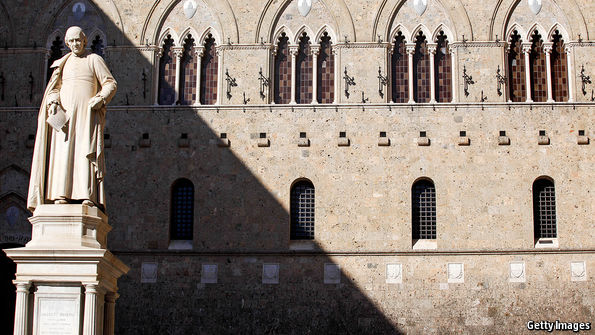
ANOTHER blow to national pride: on January 13th DBRS, a Canadian rating agency, downgraded Italy’s sovereign debt, stripping the country of its last A rating. Government bond-yields rose; so will the cost of funding for Italian banks. Erik Nielsen, chief economist of UniCredit, Italy’s biggest lender, calls the extra €5bn ($5.3bn) or so banks will have to put up as collateral for their loans from the European Central Bank (ECB) “immaterial”. Still, it is a burden they could do without.
Weighing heaviest on bankers’ minds is a planned state rescue of Monte dei Paschi di Siena, now Italy’s fourth-largest lender. A private recapitalisation scheme collapsed in December, prompting it to seek government help. Days earlier, anticipating the plan’s demise, the state had created a €20bn fund to support ailing banks.
Next month Monte dei Paschi’s chief executive, Marco Morelli, will present a new business plan. On January 18th he confirmed to a Senate committee that 500 branches and 2,450 jobs will go within three years. Soon the bank is expected to issue a state-backed bond, for perhaps €1.5bn, to shore up liquidity; it…Continue reading
A big fine for Rolls-Royce is not its only worry

FOR those who still associate Rolls-Royce with its past as a posh carmaker, its home on a scruffy industrial estate comes as a shock. Yet it is there the engine-maker assembles the Trent XWB, the second-biggest commercial jet engine in the world. Some components are made to a tolerance of 50 microns—the width of a human hair. The job of running the firm is a bit messier.
On January 16th, in a deal with American, British and Brazilian regulators, Rolls agreed to cough up £671m ($809m) to settle allegations that it had in the past secured sales with bribery. The fine is the largest-ever imposed by Britain on a firm for criminal conduct. But given the wrongdoing the deferred prosecution agreement outlines, the firm got off lightly (the co-operation of the company’s more recent management helped). It admitted a dozen counts of corruption and bribery in seven countries, spanning decades. This included giving officials money, hotel stays and even a luxury Rolls-Royce car to secure engine sales. Rolls has since cut its use of the freewheeling third-party consultants who got the company in trouble, and promises better oversight of all staff. If it errs…Continue reading
How the City of London hopes to navigate a hard Brexit

THERESA MAY’S speech on January 17th set Britain definitively on a path to a “hard” Brexit, in which it will leave not just the EU but the European single market. This was not what the City of London wanted to hear. The prime minister did at least pick out finance, along with carmaking, as an industry for which “elements of current single-market arrangements” might remain in place as part of a future trade deal. The City is holding out hope that a bespoke deal built on the existing legal concept of “equivalence” could still accord it a fair degree of access to Europe.
“Passporting”, which allows financial firms in one EU member state automatically to serve customers in the other 27 without setting up local operations, was always going to be difficult after Brexit. Outside the single market, says Damian Carolan of Allen & Overy, a law firm, the “passport as we know it is dead.” Already, two big banks, HSBC and UBS, this week each confirmed plans to move 1,000 jobs from London.
Financial companies all have to firm up their contingency plans. For the City, these focus on so-called “equivalence” provisions, allowing third-country financial…Continue reading
Autónomos y asesores cuestionan la solución de Hacienda a los aplazamientos
Dudan de que la vía elegida por el fisco para flexibilizar el régimen sea legal
Otra barrera a los trucos de los bancos
La demostración de que algunas cláusulas suelo fuesen legales se somete a múltiples pruebas
A merger is the latest sign of Big Tobacco’s resilience

BRITISH AMERICAN TOBACCO (BAT) announced on January 17th a final deal to buy Reynolds American for $49bn. BAT already owns 42% of Reynolds; buying the rest of it will create the world’s largest listed tobacco company by sales and profits. It will peddle brands such as Dunhill, Camel and Newport. The casual observer might imagine the deal to be a frantic bid to revive an ailing industry. On the contrary. Cigarettes may kill you, but the big companies that make them are rather healthy.
That is despite a decline in smoking rates. In 2015 just over a fifth of adults smoked, estimates the World Health Organisation, down from almost a quarter ten years earlier. This drop hardly helps companies, but it isn’t ruinous either.

Smoking is still popular in certain spots. More than three-quarters of men light up in Indonesia, for example. The habit is becoming more common among men in Africa and the eastern…Continue reading
La banca podrá negarse a devolver la cláusula suelo si cree que no es opaca
Las entidades informarán a todos los clientes que tengan estas condiciones para que conozcan el proceso de reclamación