
Finanzas
The great divergence

ONE of Joseph Schumpeter’s best-known observations was that successful businesses stand on ground that is “crumbling beneath their feet”. A danger is that standing still and resting on your laurels can precipitate a swift tumble. Rivals, meanwhile, can draw on the available stock of knowledge and technology to catch up with the leaders. To stay ahead, front-runners must keep inventing new things. This means that capitalism is inherently unforgiving: today’s leader is tomorrow’s failure. But it also means that it is inherently progressive, since clever ideas are quickly spread through the economy.
Some striking new research suggests that this Schumpeterian mechanism may have broken down. The leaders are staying ahead much longer than is desirable. A group of researchers at the OECD, a club of mostly rich countries, examined the performance of a representative set of companies in 24 of its 35 member countries between 2001 and 2013. They discovered that the top 5% of them, dubbed “frontier firms”, have continued to increase their productivity while the other 95% (the laggards) have been stagnant in this regard.
Plenty of economists…Continue reading
African potholes
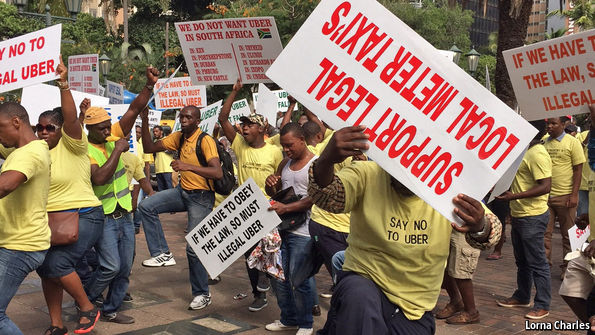
“I WAS lucky my customers were three big white guys,” says Themba, an Uber driver in Johannesburg recounting a close call with taxi-drivers who tried to block him from collecting passengers at the airport that serves South Africa’s economic hub. “They pushed them out the way and we managed to drive off.”
The ride-hailing app has made a splashy if slow start in Africa. Of the 529 cities in which Uber connects riders with drivers, just 14 are on the continent. Yet Africa is fertile ground for a firm offering cheap and safe transport. Most passengers have to spring for overpriced cabs or catch a white-knuckled ride on the back of a motorcycle taxi.
In Abuja, locals have long used a low-tech version of ride-sharing. Many folk simply stick out a hand at the roadside to hail any passing car before negotiating a fare. Yet locals warn that fake taxis cruise the streets with robbers hiding in the boot, ready to jump out at a traffic light. In Lagos some taxi-drivers are even thought to be in cahoots with kidnappers. Not surprisingly, Uber seems to be growing quickly in the few cities where it has launched. In many places rides cost less…Continue reading
A long road to recovery

THERE are two ways of dealing with a worrying problem in a car engine. One is a complete overhaul; the other is to tinker under the bonnet and hope the trouble goes away. Volkswagen’s efforts to deal with an emissions-cheating scandal that emerged in September 2015 are of the tinkering type. The German carmaker is desperate to draw a line under its ill-fated decision to fit software to 11m diesel cars that detected emissions tests and artificially reduced the amount of nitrogen oxide pumped out. But the disconcerting rumbles continue.
The latest setback came on November 6th, when VW said that a German investigation of market manipulation was examining the role of Hans Dieter Pötsch, chairman of its supervisory board. The probe, which began in June, is looking at whether Martin Winterkorn, VW’s former chief executive, and Herbert Diess, who oversees the core VW brand, should have disclosed the emissions cheating before the company publicly admitted wrongdoing. This is deeply uncomfortable for both VW and Mr Pötsch, who used to be the chief financial officer and was nominated to become chairman on the day the crisis began. It is also a reminder…Continue reading
The big sort

“THE vultures all start circling, they’re whispering, ‘You’re out of time’…but I still rise!” Those lyrics, from a song by Katy Perry, an American pop star, sounded often at Hillary Clinton’s campaign rallies but will shortly ring out over a less serious event: a late-night party in Shenzhen to kick off “Singles’ Day”, an online shopping extravaganza that takes place in China on November 11th every year.
The event was not dreamt up by Alibaba, but the e-commerce giant dominates it. Shoppers spent $14.3bn through its portals during last year’s event. That figure, a rise of 60% on a year earlier, was over double the sales racked up on America’s two main retail dates, Black Friday and Cyber Monday, put together. Chinese consumers are still confident, so sales on this Singles’ Day should again break records.
It points to an intriguing question: how will all of those purchases get to consumers? Around 540m delivery orders were generated during the 24-hour spree last year. That is nearly ten times the average daily volume, but even a slow shopping day in China generates an enormous number. By the reckoning of…Continue reading
Fighting fit

CONTROVERSY over the relationship between BAE Systems, Europe’s largest defence company, and one of its main customers, Saudi Arabia, was raging when Ian King, its chief executive, started his job in 2008. BAE’s link to Saudi Arabia was forged 30 years ago with the first “al-Yamamah” arms deal. It saved the firm amid a difficult business environment, but embroiled it in a long-running corruption scandal that even led to Mr King’s immediate predecessor, Mike Turner, being briefly detained by America’s Department of Justice just before he stepped down.
The new boss’s mandate eight years ago was to banish BAE’s old, buccaneering ways and make it the acme of squeaky-clean corporate governance. Now, as Mr King prepares to leave and hand over to a successor, the firm is once again under fire for its ties to the house of Saud, this time for supplying its wares to support the kingdom’s war in neighbouring Yemen. A rising chorus accuses the Saudi-led coalition of using its Western-supplied and maintained air power indiscriminately in its campaign against Iranian-backed Houthi rebels.
Human-rights activists are trying to use…Continue reading
Botín cuestiona la utilidad de los bajos tipos impuesta por el BCE
La presidenta del Santander cree que esta política no funciona porque no ha hecho subir los créditos
Guindos cree que la política expansiva del BCE “está en sus límites”
El ministro de Economía alerta del peligro que supone el alto endeudamiento público y privado de España
Meet the new boss

ALTHOUGH he styles himself as a chief executive who can turn the country around, Donald Trump is an outsider in the world of American business. His commercial operation is tiny by the standards of the country’s mega-firms and few of their bosses have ever viewed the president-elect as an equal or ally. He has “no friends” among the business elite, sniffed a private-equity baron a few weeks ago, who will doubtless now join a queue of executives waiting at Trump Tower to curry favour and to assess the new man’s priorities before he assumes office.
Those supplicants will soon discover that Mr Trump’s attitude towards business has three contradictory strands. He is passionate about unleashing the might of the private sector in order to revive growth. There is certainly plenty of scope: last year listed American companies invested a mediocre 46% of their total cashflow. Yet he is also a populist who thinks the economy is rigged in favour of big business and crony capitalists, and he is a protectionist. In the coming months these three different strands will respectively excite, worry and scare the business world.
Start, first, with the…Continue reading
Coming up Trumps

THOUGH many outside America are dismayed at the prospect of Donald Trump as president, not everyone is despondent. When the news of Mr Trump’s victory reached the floor of the Duma, Russia’s lower house of parliament, the assembled politicians burst into applause. Such enthusiasm in Russia is in part a reflection of the bromance between Mr Trump and Vladimir Putin, Russia’s president. But it is also because Russia may be one of the few economies that might benefit from—or at least, be indifferent to—a Trump presidency.
It helps that Russia’s economy has endured a rough time recently and that some kind of rebound is probably due. Its GDP fell by 3.7% last year and will shrink again this year, according to the IMF. Russia has one of the cheapest currencies in The Economist’s Big Mac Index, which compares the relative cost of burgers across the globe. By this measure, the rouble is around 60% undervalued against the dollar. Inflation, which rose to over 16% in early 2015 after a big fall in the rouble, has fallen to around 6%. That has allowed Russia’s central bank gradually to reduce interest rates from a peak of 17% to…Continue reading
Markets hoping for Bush 3

CONVENTIONAL wisdom gets turned on its head pretty quickly in the financial markets. Although many on Wall Street were gloomy about the prospects under a Trump presidency, the markets have switched round pretty quickly after the overnight decline on election day.
So many people (including us) had warned of the crazy policies of Mr Trump that there was always going to be a market for contrarians to say that he won’t be that bad after all. Especially among white, prosperous financial commentators there is a willingness to «normalise» Trump – to tell the groups he has insulted and threatened to get over their fears. What Trump does in office will be different from what he says on the campaign, they think.
What investors clearly hope is that Trump will get to implement some of his policies but not all – in particular the tax cuts for the wealthy and for business, increased military spending and financial deregulation. An early sign that this may not be that «revolt against the elite» that some commentators are claiming is a surge in bank…Continue reading