
Finanzas
Tech firms shell out to hire and hoard talent

LARGE technology firms used to hold on to their high-flying employees by agreeing not to poach them from each other. “If you hire a single one of these people, that means war,” Steve Jobs, Apple’s then boss, warned Sergey Brin, a founder of Google, in 2005. That was an illegal arrangement, and in 2015 Apple, Google, Adobe and Intel paid a $415m settlement to engineers whose pay had been held down as a result.
Today wage suppression in Silicon Valley is even more of a distant memory than dial-up internet and mainframe computers. Last year technology companies in America recorded expenses of more than $40bn in stock-based compensation. Exact comparisons are difficult, but to put that sum in perspective it is roughly 60% more than the bonus pool paid to the New York employees of Wall Street banks.
The money tech firms throw at employees has ballooned as competition to hire and hang on to top talent in engineering, data science, artificial intelligence and digital marketing has soared. Even entry-level engineers can easily earn $120,000 a year, more than most people their age can make on Wall Street; mid-career executives with technical…Continue reading
The niche in phones that are different
 You’ll have to speak up, I’m on my niche phone
ON JANUARY 9th 2007 Steve Jobs stood before an audience of some 45,000 people in San Francisco and announced a “revolutionary and magical product”: a slight slab of expansive black touchscreen with just a single button. Compared with the ugly, cluttered devices of the day, the iPhone was revolutionary. It was also hugely influential. A technicolour pageant of rival designs—the clamshell, the slide, the banana, the candybar and the BlackBerry—resolved into a uniform black mirror. And nearly every smartphone on the planet still looks like the device which Jobs revealed that day.
Nor is that similarity to be found just in hardware design. Nearly a fifth of smartphones sold last year operate on Apple’s iOS software. The rest run variations of Android, an open-source operating system provided by Google. Just two companies—Apple and Samsung—accounted for over 40% of smartphones sold in 2015, according to CCS Insight, a research firm. Huawei came in a distant third with 8%.
In this bland and uniform market some producers spy an opportunity. One of those is…Continue reading
Los Angeles booms as a startup hub
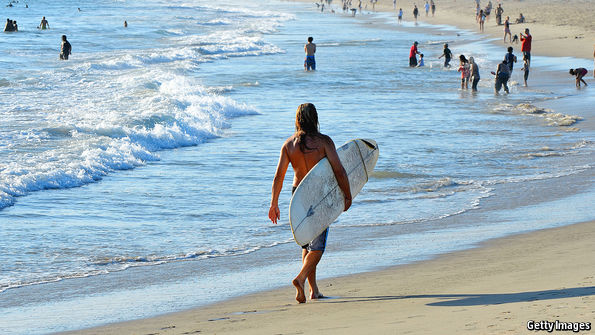 Better than surfing down Sand Hill Road
HOLLYWOOD has produced plenty of films about underdogs rising to claim the limelight. Now Los Angeles is experiencing its own real-life Cinderella story, as the area’s technology scene has been transformed from backwater to boomtown in just a few years. Hordes of venture capitalists from northern California, once long dismissive of their southern neighbour, now regularly commute in search of deals in a less heavily hunted spot than the Bay Area. In 2016 the city’s startups received around $3bn in funding, around six times more than in 2012, according to CB Insights, a research firm.
Evan Spiegel went to Stanford University in the heart of Silicon Valley, but he wanted to live and work close to the sea. So he based his new company one block from the Pacific in Venice Beach, which is better known in Los Angeles for its silicone-enhanced bodies than the silicon chips that gave the Valley its name. Mr Spiegel’s firm, Snap, is best known for its ephemeral Snapchat social-media messages and is now valued at a whopping $18bn. Other successful technology firms are thriving nearby, including…Continue reading
Political business
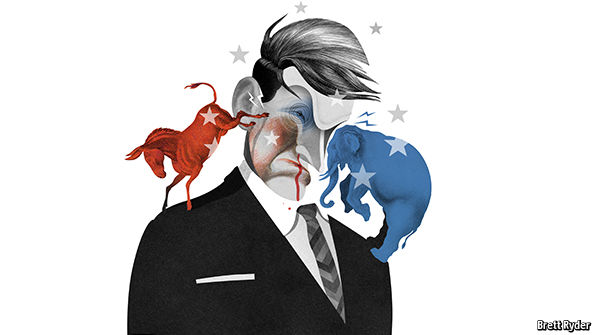
AS AMERICA’S presidential election approaches the country’s business class is in its weakest political position for decades. Twenty years ago both parties competed to be the most pro-business. Today they compete to denounce the malefactors of great wealth. The most startling change is that business has lost control of its ancestral party, the Republicans. Donald Trump may well embody many an American business type: somebody who inherits a fortune and goes on to make it even bigger. But he has taken over the Republican Party by channelling blue-collar anger against all elites.
Mr Trump has trashed free trade, liberal immigration rules and other corporate non-negotiables. Big companies have shied away from donating to his campaign. Meg Whitman, the boss of Hewlett Packard Enterprise, has called him “reckless and uninformed”. Tom Donohue, head of the United States Chamber of Commerce, has described his policies as “pretty sort of stupid”.
All this has driven lots of business people to cross the political aisle: an Ipsos poll shows that 53% of those earning $250,000 or more (the top 5% of households) plan to vote for Hillary Clinton,…Continue reading
La incertidumbre sobre las elecciones de EE UU lastra las Bolsas
El Ibex pierde más de un 1%, más que el resto de europeas, ante la remontada de Trump en las encuestas
La Reserva Federal de EEUU mantiene los tipos hasta después de las elecciones
El banco central indica que la nueva subida del precio del dinero en Estados Unidos llegará en diciembre si las condiciones acompañan
Francia crecerá menos este año por los atentados y las huelgas
El Gobierno reconoce por vez primera que el aumento del PIB será “más débil” que el previsto
Las ventas de Alibaba aumentan un 55% en el tercer trimestre
El crecimiento del negocio de comercio electrónico se mantiene sólido, mientras se consolida la apuesta por la computación en nube
Will the dollar rise or fall on a Trump victory?

YESTERDAY’s decline in the American stockmarket, on news of a narrowing in the poll gap between Hillary Clinton and Donald Trump (under two points according to Real Clear Politics), confirms the argument made in last week’s column. A combination of Mr Trump’s adverse policy proposals on trade, foreign policy and the Fed, and uncertainty about how much of this agenda would get through Congress, would hit equities hard were he to be elected.
But what about the dollar? The picture is far from clear. Over the last 24 hours, the US currency has lost ground against the Swiss franc, euro, yen and sterling but gained against emerging market currencies like the Mexican peso and Brazilian real. That makes some sense. A Trump victory would make international investors less confident about the direction of US economic policy. This in turn might lead to the Fed being less willing to tighten…Continue reading
La incertidumbre sobre las elecciones de EE UU lastra las Bolsas a la espera de la Reserva Federal
El Ibex pierde más de un 1%, algo más que el resto de europeas, ante la remontada de Trump en las encuestas