
Noticias
El paro cae por debajo del 20% después de seis años gracias al empleo temporal
Durante los meses de verano se han creado 226.500 puestos de trabajo
¿Es el momento de comprar una casa o es mejor vivir de alquiler?
Incluso cuando la situación económica permite acceder a una vivienda en propiedad, arrendarla también ofrece ventajas
El beneficio de Abanca creció hasta los 267 millones por un mejor control del gasto
Abanca obtuvo un beneficio neto de 267 millones de euros en los nueves primeros meses del año, un 0,4 % más que en el mismo periodo de 2015, ha informado la entidad en un comunicado. Leer
España quiere devolver otros 1.000 millones del rescate bancario el 11 de noviembre
La operación debe recibir el visto bueno de los socios de la eurozona. Leer
Sabadell logrará un resultado de 625 millones hasta septiembre, según los expertos
La integración del británico TSB, culminada en junio de 2015, condiciona la comparativa frente al pasado ejercicio. Leer
Popular ganará 94 millones con mayor esfuerzo en provisiones, según los analistas
Apenas generará beneficio, teniendo en cuenta las pérdidas esperadas pendientes de reconocer en el último trimestre. Leer
Los analistas prevén que el beneficio de CaixaBank alcance 897 millones, un 10% menos
Contabilizará gastos de explotación extraordinarios por 125 millones ligados al plan de bajas voluntarias que va a poner en marcha. Leer
Angling for the future of TV

IMAGINE a television which, as in the old days, has only a handful of channels to choose from instead of hundreds, as a typical cable set-up might offer today. In a decade or so TVs will once again have only a few channels, but each will run miles deep, with content that can be viewed on demand. Netflix might be one such offering; Amazon another. Both firms are spending billions of dollars making and buying TV shows and films to sell directly to viewers to watch when they like, and on devices other than the box in the corner of the room. And other rich tech firms may join them.
It is this vision that is now driving the direction of television and media. Broadcasters are willing to pay more to show live sporting events, and to invest more in producing TV shows, to make their networks the must-see choice for viewers. This trend has spurred the largest-ever merger of a telecommunications company with a media firm. AT&T, America’s wireless and pay-TV giant, announced on October 22nd an offer for Time Warner, the owner of HBO, CNN and Warner Brothers studio, worth $109bn. In doing so AT&T is betting that a few vertically integrated platforms will…Continue reading
Wind and solar advance in the power war against coal
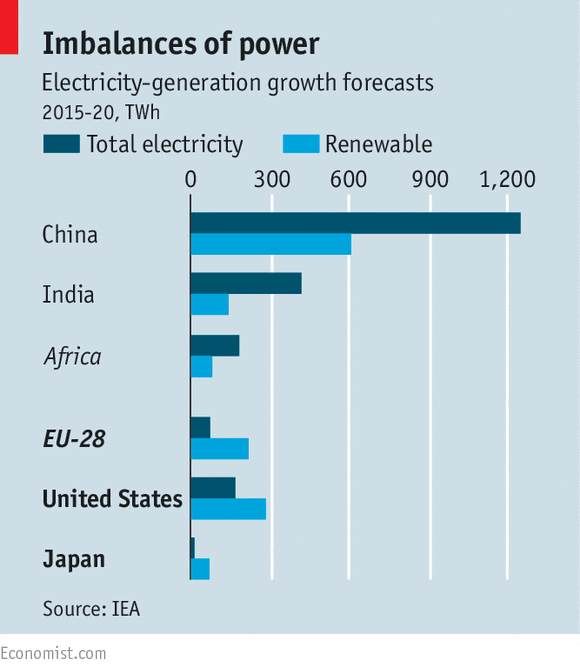
THE battle between clean energy and dirty coal has entered a new phase. The International Energy Agency (IEA), an industry forecaster, this week reported that in 2015 for the first time renewable energy passed coal as the world’s biggest source of power-generating capacity.
The IEA, whose projections for wind and solar energy have in the past been criticised as too low, accepted that renewables are transforming electricity markets. Last year 500,000 solar panels were installed every day around the world. In China alone, home to a whopping 40% of the 153 gigawatts (GW) of global growth in renewable-energy installations, two wind turbines were erected every hour. Based on existing policies, it forecasts that from 2015-21, 825GW of new renewable capacity will be added globally, 13% more than it projected just last year.
All those new wind and solar plants will not generate electricity all the time. Unlike coal, which burns around the clock, renewables are intermittent. But the IEA expects the share of renewables in total power generation to rise to almost 28% from 21%. Government policies to curb global warming and reduce air…Continue reading
Steel trap

BESIDES being dirty and dangerous, making steel in China has been a good way to burn through money over the past few years. But in recent months, the fires from the country’s blast-furnaces have started to emit the warm glow of profits. Steel prices have risen by nearly 50% this year. Production, which fell in 2015 for the first time in decades, is also up. Smelters are set for a strong recovery after losing $10bn last year. And it is not just the steelmakers who will be pleased. Asia’s central bankers can also take some comfort in the rising prices: they suggest that the threat of deflation might be receding.
Once seen in Asia as a peculiarly Japanese phenomenon, deflation spread throughout the region’s factories in the past half-decade. The prices that consumers see in shops have on the whole continued to increase, albeit more gently than before. But the prices that companies charge for goods as they leave their factories’ gates have dipped lower and lower. Virtually all big Asian economies, including South Korea, India, the Philippines, Taiwan and Thailand, have experienced prolonged bouts of falling producer…Continue reading