
Noticias
An emerging threat

WHEN the returns on cash and government bonds in the developed world are zero, or even negative, it is hardly surprising that investors are casting their nets more widely. In the process the “search for yield”, as it has been called, has inevitably turned its attention to emerging markets.
One or two decades ago, emerging-market sovereign debt might have been the only beneficiary of these flows. But government bonds do not offer such a juicy return these days; the yields on ten-year bonds issued by Malaysia and the Philippines, for example, are around 3.6%.
As a result, investors are taking a big extra risk and piling into emerging-market corporate debt. So far this year bond funds in that sector have received inflows of $11.5 billion, according to HSBC. Their enthusiasm has been rewarded. Bloomberg’s emerging-market corporate-bond index has returned 13.4% since January 1st, compared with a return of just 4.4% from American Treasury bonds (see chart). This rally has occurred despite early-year wobbles about the strength of the Chinese economy and the impact of higher American interest rates.
The improved…Continue reading
How the other tenth lives

WHAT is the most important number in global economics? Judging by the volume of commentary it excites, America’s monthly payrolls report (released on October 7th) might qualify. Other contenders include the oil price or the dollar’s exchange rate against the euro, yen or yuan. These numbers all reflect, and affect, the pace of economic activity, with immediate consequences for bond yields, share prices and global prosperity—which is what economics is ultimately all about.
But if global prosperity is the ruling concern of economics, then perhaps a more significant number was released on October 2nd by the World Bank. It reported that 767m people live in extreme poverty, subsisting on less than $1.90 a day, calculated at purchasing-power parity and 2011 prices. The figure is not up-to-the-minute: such is the difficulty in gathering the data that it is already over two years out of date. Nor did the announcement move any markets. But the number nonetheless matters. It represents the best attempt to measure gains in prosperity among the people most in need of them.
The latest figures should arouse mixed feelings. They are…Continue reading
Career breaks
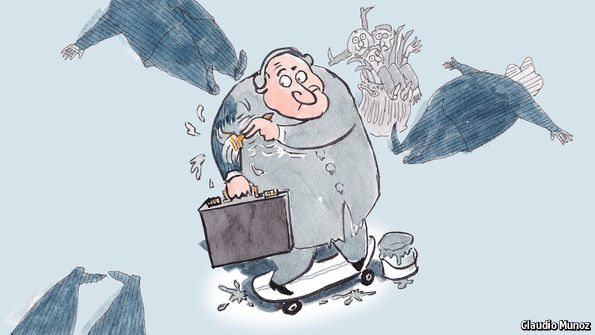
FRANK LLOYD WRIGHT quipped that “the modern city is a place for banking and prostitution and very little else.” Little did the early 20th-century architect know how banks would flourish, hoovering up much of the world’s talent by the early 2000s. But this golden age is ending: bankers’ jobs are at risk from the digital revolution on the one hand, and falling profits on the other.
Nowhere have bankers fallen from grace with such a bump as in Europe. This week ING, the Netherlands’ largest bank, announced that up to 7,000 jobs would be cut in the next five years. Commerzbank, Germany’s second-largest bank, had already reported it would cut its workforce by 9,600, nearly a fifth.
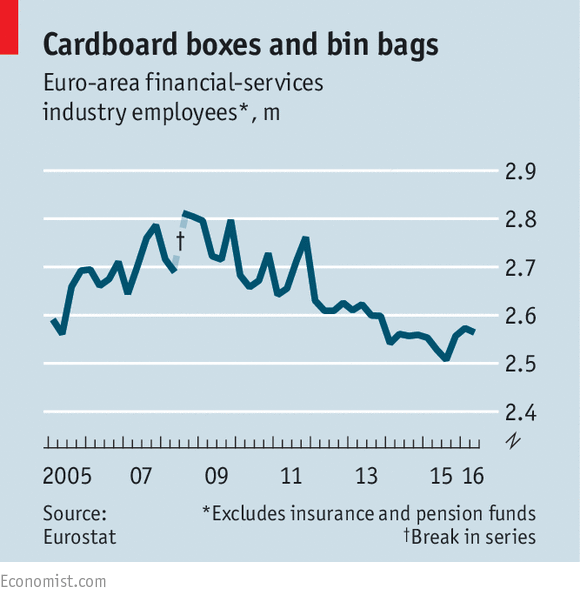
Across Europe, bankers are packing up. In Britain more than 10% of bank jobs were cut between 2011 and 2015; in Germany the workforce has shrunk by around 20% since 2001. Since the start of the year Credit Suisse has got rid of…Continue reading
Los acusados por las ‘black’ apuntan al exsecretario De la Torre como responsable de las tarjetas
La exconsejera de Caja Madrid Mercedes Rojo ha expuesto, al igual que gran parte de los exaltos cargos y directivos de Caja Madrid, que se sientan en el banquillo que fue el exsecretario general de la entidad Enrique De la Torre el que le entregó la Visa. Leer
Deutsche Bank recortará en Alemania 1.000 empleos más de los previstos
Se sumarán a los 3.000 puestos de trabajo que ya anunció el pasado mes de junio. Leer
Arturo Fernández defiende que Díaz Ferrán usara tarjeta en sus restaurantes
Dice que era un cliente «de toda la vida, que consumía en la cadena», donde hacía «muchas reuniones de trabajo», Leer
Arturo Fernández defiende que Díaz Ferrán usara tarjeta en sus restaurantes
Dice que era un cliente «de toda la vida, que consumía en la cadena», donde hacía «muchas reuniones de trabajo», Leer
Popular reducirá sus territoriales y cerrará 302 sucursales en su plan de ajuste
El banco también fusionará catorce Direcciones Regionales, dejando la cifra total en veinticinco. Leer
Exconsejeros de Caja Madrid alegan errores en el cómputo de gastos con tarjetas black
Argumentan que las hojas de cálculo contienen gastos duplicados y cargos efectuados con tarjetas clonadas. Leer
Bizum lanza el pago inmediato a través de móvil con 16 bancos españoles
El sistema no necesita que el cliente se descargue una app específica, sino que estará integrado en las aplicaciones de banca electrónica de cada entidad. Leer