
Noticias
Goirigolzarri: «La realidad del sistema bancario es mucho mejor que su imagen»
El presidente Bankia dice que es necesario «quitarse la mochila del pasado» y eso pasa por «reconocer los errores» y por establecer una línea de diferenciación entre el pasado y el presente. Leer
The yuan’s weakness is a dilemma for China’s central bank

YUAN forecasters have had it easy for the past decade. But for a few isolated days, China’s currency has been a one-way bet for years on end, whether appreciating against the dollar, pegged to it or, more recently, depreciating. The pace at which it has risen and fallen has also been predictable: the central bank always made it gradual. So Guan Qingyou, of Minsheng Securities, thought himself on solid ground when he predicted in early November that the yuan would stay above 6.82 per dollar for the rest of the year. Less than a week later he was proved wrong: the yuan fell to an eight-year low. Mr Guan published an apology: the art of knowing the yuan’s future with any precision, he conceded, had become rather tricky.
Most analysts, investors and companies believe that the Chinese currency has further to fall against the dollar, but can only guess as to how far and how quickly. Their uncertainty reflects a new reality. The government, long able to exercise tremendous control over the yuan, has started to lose its grip. A new exchange-rate mechanism, introduced last year, has made the currency more flexible but also more responsive to…Continue reading
Japanese golf courses hunt for a new driver
 Slow fade
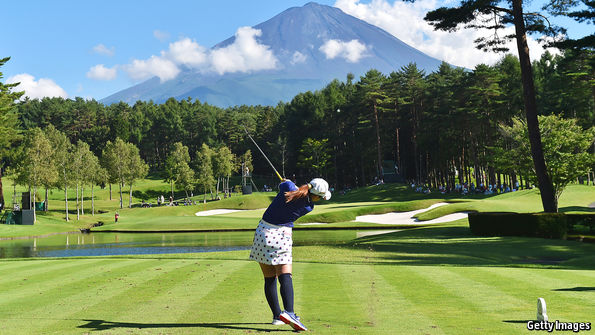
THE gold-coloured golf club priced at $4,700 that Japan’s prime minister, Shinzo Abe, gave to Donald Trump, America’s president-elect, in their first meeting last month may have been a piece of polished diplomacy. But it is unlikely to revive its posh Japanese maker, Honma, which calls itself “golf’s aristocracy”, presumably because it crafts the world’s most expensive clubs. It went bankrupt after Japan’s bubble-era splurge on new golf courses. Seven years ago a businessman from China bought the firm, hoping for an upswing.
Golf, long associated with extravagance in Japan, is flagging. Clubs have trimmed green fees as the level of golf-playing among Japanese has fallen by over 40% since a high in the early 1990s. As elsewhere, courses are in oversupply: Japan has over 2,300—half of Asia’s total.
More than 120 have closed since 2010. Entrepreneurial types have converted about 70 into solar-panel plants, encouraged by state subsidies for alternative-energy production following the disaster in March 2011 at the Fukushima Dai-ichi nuclear-power plant. A few others have been turned back into…Continue reading
Revising bank-capital standards
A STEEP climb awaited the Basel Committee on Banking Supervision in Santiago on November 28th and 29th. The central bankers and regulators hoped to agree on revisions to Basel 3, the post-crisis version of bank-capital standards. On November 30th Stefan Ingves, the group’s chairman and head of Sweden’s central bank, said that “the contours of an agreement are now clear”. But the climbers are still short of the summit.
The committee had proposed restricting the use of banks’ internal models for calculating risk-weighted assets—which in turn help determine how much capital banks must have at hand. Models varied too much, it said; low risk-weights were flattering some banks’ ratios. But European bankers and officials had complained for months that the proposals would penalise banks that have lots of (low-risk) corporate loans or mortgages (eg, in Germany or Sweden). They sniffed an American plot: American banks, holding fewer such assets, would be untouched.
Mr Ingves gave few details, but said that the new set-up would “largely retain” internal models, though with minimum values for important parameters (such as the probability of default). A “standardised” approach will replace alternatives based on banks’ models for estimating operational risk (big fines, say, or cyber-security breaches).
Not surprisingly, the thorniest topic…Continue reading
Sell-side share analysis is wrong
“SELL-SIDE” analysts, whose firms make money from trading and investment banking, are notoriously bullish. As one joke goes, stock analysts rated Enron as a “can’t miss” until it got into trouble, at which point it was lowered to a “sure thing”. Only when the company filed for bankruptcy did a few bold analysts dare to downgrade it to a “hot buy”.
Economic research shows that there is some truth to the ribbing. The latest figures from FactSet, a financial-data provider, show that 49% of firms in the S&P 500 index of leading companies are currently rated as “buy”, 45% are rated as “hold”, and just 6% are rated as “sell”. In the past year, 30% of S&P 500 companies yielded negative returns.

Profits forecasts made more than a few months ahead have a dismal record of inaccuracy. According to Morgan Stanley, a bank, forecasts for American firms’ total annual earnings per share made in the first half of the year had to be revised down in 34 of the past 40 years. Studying their forecasts over time reveals a predictable pattern (see chart 1).
In theory, a diligent share analyst should do his own…Continue reading
Donald Trump’s win has sent the shares of small American companies on a tear

THERE have been plenty of swings in financial markets since America’s election on November 8th. The Mexican peso has fallen against the dollar, reflecting worries about Donald Trump’s protectionist tendencies. Ten-year bond prices have tumbled as investors factor in the likelihood of much higher government borrowing. One particularly striking move has been a surge in the share prices of small firms. The Russell 2000 index of American midgets has leapt by 12%, compared with a 3% rise for the S&P 500 index of multinational leviathans (see chart).
Small companies are the backbone of America’s economy, employing about half of the private-sector workforce. But they have had a rotten decade. The Russell index had lagged the stockmarket until the election. The country’s 28m small firms—most of them unlisted—have never fully recovered from the financial crisis of 2008. As of October, confidence had yet to rise back to the level of 2006, according to an index of optimism that is based on surveys by the National Federation of Independent Business, a lobbying group. Giant firms, meanwhile, have been playing a bigger role: two-thirds…Continue reading
Africa’s stock exchanges meet but size holds them back
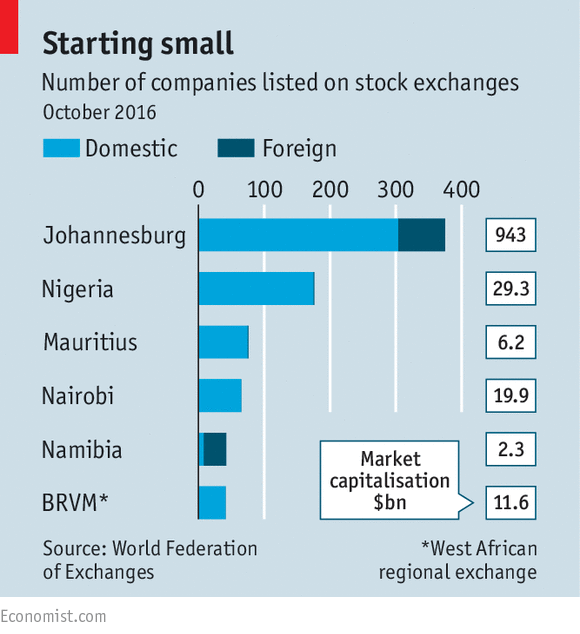
AS THE trading bell rings, a handful of brokers, in crisp scarlet jackets, gather around a whiteboard at the Rwanda Stock Exchange in Kigali. There are only seven listed companies, and it takes just a couple of minutes to write up the day’s bids. But Celestin Rwabukumba, its chief executive, is excited for the future. “If it works elsewhere, then why not here?” he asks.
Why not indeed? Johannesburg, with a market capitalisation of nearly $1trn, is in a league of its own. But sub-Saharan Africa has many small exchanges, lots of them created in the 1990s to help privatise state enterprises. Most struggle to attract new issues. Seven of the eight domestic listings on the Uganda Securities Exchange came from government divestments. Older exchanges, in Kenya and Nigeria, are dominated by big firms: a third of Nigeria’s market is the Dangote Group, a conglomerate with interests from cement to salt.
Stock-exchange leaders were in Kigali this week for the annual conference of the African Securities Exchanges Association. Much of the talk was about coaxing smaller, family-owned businesses to list. But many owners are loth…Continue reading
France’s nuclear-energy champion is in turmoil
 Under pressure
THESE are difficult times for Electricité de France (EDF), the country’s quasi-monopolistic electricity provider, serving 88% of homes. Outages at no fewer than 18 of the 58 EDF-owned nuclear reactors that provide three-quarters of France’s electricity have meant a slump in production: the company says annual nuclear output could fall to 378 terawatt hours (TWH), from 417 TWH last year. Eight reactors are currently lying idle and several may not restart for weeks or months. Power stations are burning coal at a rate not seen since the 1980s. As electricity imports and prices soar, officials are having to deny that a cold snap could bring blackouts.
The cause of the crisis—possibly faulty reactor parts throughout EDF’s fleet—suggests it may not be easily contained. France’s nuclear regulator, the Autorité de Sûreté Nucléaire (ASN), this summer ordered urgent tests of reactor parts, mostly bases of cylindrical steam generators. Inspectors are worried about high carbon levels found in steel forged by Creusot Forge, which is owned by Areva, another French firm, and by Japan Casting & Forging…Continue reading
Insurers grapple with cyber-attacks that spill over into physical damage

AS HACKERS wreak havoc with depressing regularity, the insurance industry finds itself forced to contemplate a whole new set of risks. They range from the theft of millions of credit-card numbers from American retailers to the disabling of the power grid, as happened in Ukraine last December. The dedicated “cyber-insurance” policies that companies offer against data breaches have become relatively routine. But the risks they insure under other policies are also affected by cyber-risks—and they are still struggling to understand this so-called “silent” cyber-exposure.
Insurance that protects firms who suffer data breaches has been on offer for around 15 years. It is much harder to put a precise value on, for example, stolen health records than on a property or car. Insurers sidestep the problem by covering only the direct costs that a company incurs from a hack. Typically, these include hiring a specialised forensics firm to work out exactly what was stolen, notifying affected customers (which 47 American states currently require), short-term business interruption and fines.
The industry will be shaken up by new EU data-protection…Continue reading