
Noticias
Just spend

ON NOVEMBER 11th, Alibaba, a Chinese e-commerce giant, posted nearly $18bn in sales for the day. This broke last year’s record for Singles’ Day, an anti-Valentine’s Day that has become a love affair with spending. The popularity of the company’s virtual credit-card, Huabei (roughly translating as “Just spend”), may have helped. Consumers who spend less than 1,000 yuan ($146) online a month spend 50% more once they get one, according to Ant Financial Services, an Alibaba affiliate. To older generations, taught to save, borrowing is shameful. But financial habits are changing: Chinese consumers are being encouraged to develop credit histories.
Last year, the government awarded eight companies consumer credit-rating licences. Their pilot programmes are an attempt to flesh out thin financial records and get people thinking about their credit scores. This is new for most Chinese, who do not use credit cards and have never had credit scores. As of 2014, the People’s Bank of China maintained credit histories for around 350m citizens—less than one-third of the adult population. In America 89% of adults have credit scores. Without a credit history,…Continue reading
That Eighties show
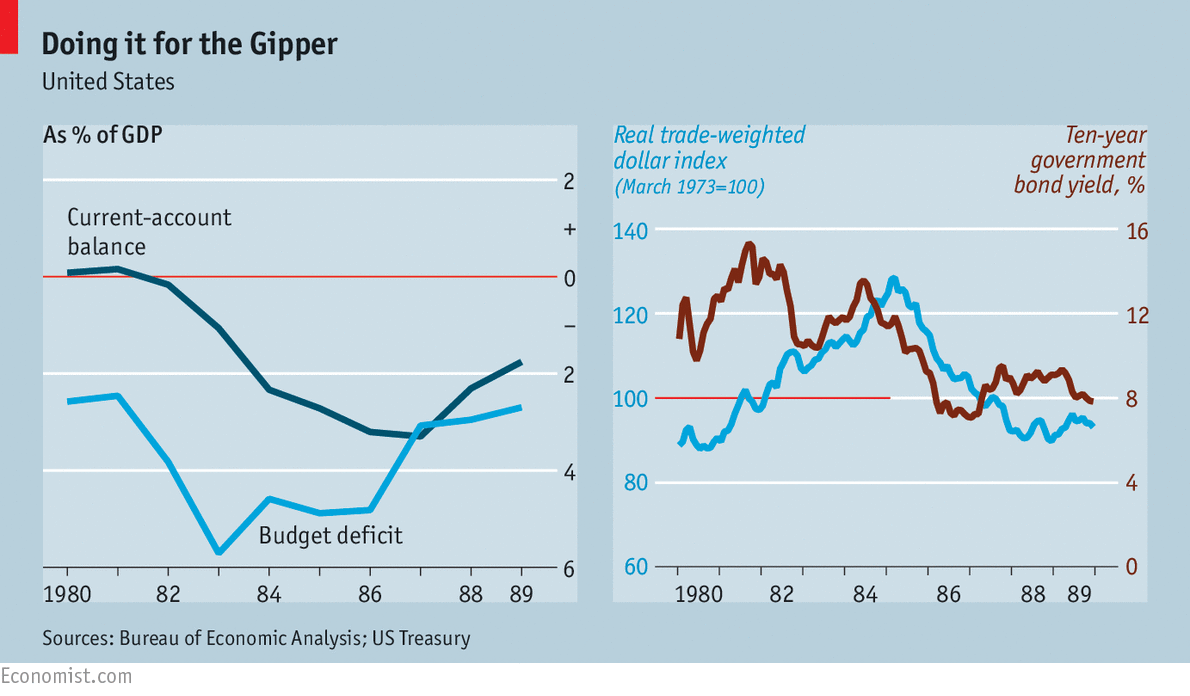
FOR the moment, the policy priorities of the Trump administration-in-waiting are a basket of unknowables. Plans to scrap Obamacare or re-deregulate America’s financial sector, though dear to Republican hearts, are easier to champion on the campaign stump than to implement. A step away from globalism—Donald Trump’s most consistent campaign theme—could make for an awkward opening gambit given pockets of Republican resistance to overt protectionism. Tax cuts and infrastructure spending, on the other hand, look like an easy and unifying win for the new administration. And indeed, market moves since Mr Trump’s victory seem to imply an expectation of a Ronald Reaganesque turn in American fiscal policy; government-bond yields have risen, seemingly in expectation of bigger deficits, faster growth and higher inflation. Yet any resemblance that Mr Trump’s plans may bear to Reaganomics is as much a cause for concern as for optimism.
The president-elect’s tax proposals are easily the boldest since Reagan’s. Mr Trump’s plan would slash the highest marginal income-tax rates, cut rates of tax on corporate income and on capital…Continue reading
Iberdrola eleva un 30% sus compras a proveedores en 2016, hasta 10.500 millones de euros
El presidente de Iberdrola, Ignacio Galán, ha indicado que los suministradores son fundamentales para llevar a cabo el plan de inversiones de más de 24.000 millones previsto por la empresa hasta 2020. Leer
La Fiscalía pide para Globalia una multa de 9,5 millones por el fraude en los vuelos a las islas
El Ministerio Público reclama esa sanción adicional a la devolución de los 29,7 millones de euros defraudados por la subvenciones para residentes
Barcelona ve indicios de delito penal en el fraude de FCC con la basura
El Ayuntamiento abre a raíz de las informaciones de EL PAÍS un expediente que podría acabar con una sanción, la rescisión del contrato o la inhabilitación de la empresa
Defensa recibe su primer A400M
La compañía Airbus ya ha suministrado otras 33 aeronaves a cinco países
EE UU descubre un yacimiento de petróleo gigante al oeste de Texas
Las primeras estimaciones señalan que contiene cerca de 20.000 millones de barriles que lo sitúan como el más grande de ese país
Rethinking central bank independence

CENTRAL bankers are under fire. In America, President-elect Donald Trump said that the Federal Reserve chair Janet Yellen should be «ashamed of herself» for keeping rates too low; in Britain, Mark Carney of the Bank of England has been criticised for his views on the economic risks of Brexit; and in Europe, Mario Draghi has faced attacks from critics in Germany (for being too lax) and Greece (for being too tight).
In a new paper Ed Balls, who played an influential role in making the Bank of England independent, has teamed up with James Howat and Anna Stansbury to try to think through the role and wider responsibilities of the central bank. It is very much worth a read and here are my first thoughts (colleagues will doubtless chip in later).
As the paper points out, central bank power has increased in the wake of the 2007-08 crisis, extending well beyond the narrow pre-crisis focus on using interest rate policy to meet inflation targets. But the worry is that
Absolutist interpretations of complete central bank independence may both…Continue reading