
Tag: Approved
Seeking asylum—and jobs
 Unskilled, unemployed and unhappy
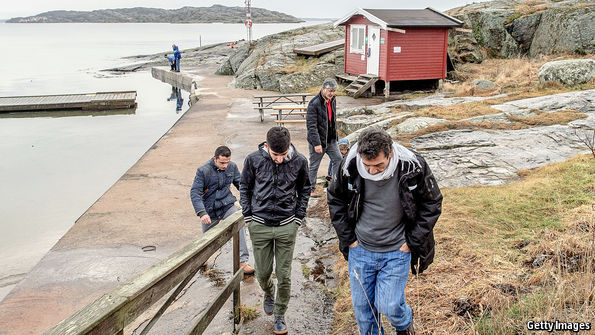
WHEN Ameen first arrived from Aleppo, he was thrilled to have made it to Sweden. Speaking as he takes a break from a protest near parliament, he says he thought there would be plenty of jobs. But none was available. Now that the government has made it harder for family members to join the refugees, some have taken to Stockholm’s cobbled streets. The rules on asylum-seeking in Europe mean refugees like him have to stay in their country of arrival. “If we could leave, many of us would,” he says.
A big reason refugees cause alarm across Europe is the fear that they will steal jobs. But a more serious problem may be their joblessness. France, Germany and Norway all have big employment gaps between native- and foreign-born workers. But the gap is widest in the Netherlands and Sweden—and these figures do not yet include the 163,000 asylum-seekers who arrived in Sweden last year (see chart).
 Continue reading
Angling for the future of TV

IMAGINE a television which, as in the old days, has only a handful of channels to choose from instead of hundreds, as a typical cable set-up might offer today. In a decade or so TVs will once again have only a few channels, but each will run miles deep, with content that can be viewed on demand. Netflix might be one such offering; Amazon another. Both firms are spending billions of dollars making and buying TV shows and films to sell directly to viewers to watch when they like, and on devices other than the box in the corner of the room. And other rich tech firms may join them.
It is this vision that is now driving the direction of television and media. Broadcasters are willing to pay more to show live sporting events, and to invest more in producing TV shows, to make their networks the must-see choice for viewers. This trend has spurred the largest-ever merger of a telecommunications company with a media firm. AT&T, America’s wireless and pay-TV giant, announced on October 22nd an offer for Time Warner, the owner of HBO, CNN and Warner Brothers studio, worth $109bn. In doing so AT&T is betting that a few vertically integrated platforms will…Continue reading
Wind and solar advance in the power war against coal
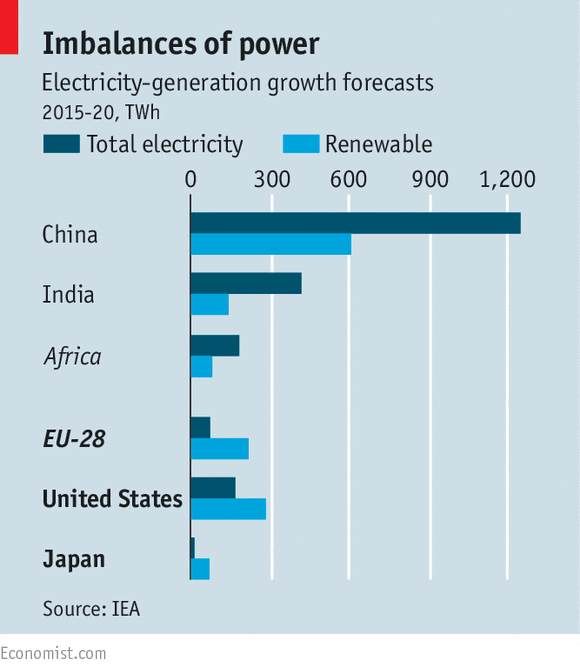
THE battle between clean energy and dirty coal has entered a new phase. The International Energy Agency (IEA), an industry forecaster, this week reported that in 2015 for the first time renewable energy passed coal as the world’s biggest source of power-generating capacity.
The IEA, whose projections for wind and solar energy have in the past been criticised as too low, accepted that renewables are transforming electricity markets. Last year 500,000 solar panels were installed every day around the world. In China alone, home to a whopping 40% of the 153 gigawatts (GW) of global growth in renewable-energy installations, two wind turbines were erected every hour. Based on existing policies, it forecasts that from 2015-21, 825GW of new renewable capacity will be added globally, 13% more than it projected just last year.
All those new wind and solar plants will not generate electricity all the time. Unlike coal, which burns around the clock, renewables are intermittent. But the IEA expects the share of renewables in total power generation to rise to almost 28% from 21%. Government policies to curb global warming and reduce air…Continue reading
Steel trap

BESIDES being dirty and dangerous, making steel in China has been a good way to burn through money over the past few years. But in recent months, the fires from the country’s blast-furnaces have started to emit the warm glow of profits. Steel prices have risen by nearly 50% this year. Production, which fell in 2015 for the first time in decades, is also up. Smelters are set for a strong recovery after losing $10bn last year. And it is not just the steelmakers who will be pleased. Asia’s central bankers can also take some comfort in the rising prices: they suggest that the threat of deflation might be receding.
Once seen in Asia as a peculiarly Japanese phenomenon, deflation spread throughout the region’s factories in the past half-decade. The prices that consumers see in shops have on the whole continued to increase, albeit more gently than before. But the prices that companies charge for goods as they leave their factories’ gates have dipped lower and lower. Virtually all big Asian economies, including South Korea, India, the Philippines, Taiwan and Thailand, have experienced prolonged bouts of falling producer…Continue reading
New York deflates Airbnb
 No rules broken here
IN 2007, Brian Chesky and Joe Gebbia came up with a wheeze to rent out two air beds in their San Francisco apartment, because a conference had left the local hotels full-to-overflowing. Thus, Airbed & Breakfast was born. Since then, the firm’s only contraction has been its name. Today, Airbnb’s website lists over 2m properties for short-term let in 191 countries. Piper Jaffray, an investment bank, estimates that bookings through the firm will reach $14.4bn in 2016, compared with $52m in 2010. Analysts think the upstart might fetch $30bn were it to be taken public. That would make Airbnb worth more than Marriott, the world’s largest hotel chain.
But legislation signed in New York state on October 21st has taken some of the puff out of Airbnb’s mattress. New York City is the firm’s largest market in America, with around 35,000 properties available for rent. But many of the hosts offer their apartments illegally. In 2010, the state passed a law banning rentals of whole units in residential blocks for less than 30 days. (It is legal to do so if the tenant is living there at the same time.) To…Continue reading
Known unknown

COMPETITION between currencies is the stuff libertarian dreams are made on—and central bankers’ nightmares too. Already digital monies, in particular Bitcoin and Ethereum, are rivals. On October 28th a new crypto-currency will join the fray: Zcash. Many such “altcoins” are dubious affairs and don’t add much. But this one brings important innovations.
Zcash is based on Bitcoin’s code, but its creators, a bunch of cryptography researchers, have tweaked it. The new digital cash is minted more quickly and the system can handle more transactions. This makes for more liquidity and shorter transaction times, says Zooko Wilcox, who leads the project.
The newcomer also differs in the way it is governed. The incumbent started—and is still run—as an open-source project: a small group of volunteer developers decides which changes are made. Zcash’s code is also open-source, but its inventors have formed a company and accepted money from investors. In addition, 10% of the 21m coins to be issued are earmarked for founders, investors, employees and a putative Zcash foundation. All this, says Mr Wilcox, is to align incentives for all…Continue reading
Brazilian firms emerge from the gloom
“BRAZIL is back in business,” proclaimed Abílio Diniz, chairman of BRF, a Brazilian pork and poultry giant, at a recent investor shindig. Really? The economy, mired in recession since mid-2014, is not expected to stir before the end of the year—and then only sluggishly. After rebounding in the first half of 2016, industrial production plummeted again in August. Retail sales fell by more than forecast. Firms expect to hire just 100,000 temporary workers in the run-up to Christmas, 3% fewer than last year’s already low tally. BRF’s own domestic operations are hardly a picture of health. Sales dropped by 5% in the second quarter, year on year (though this was offset by rising global revenues).
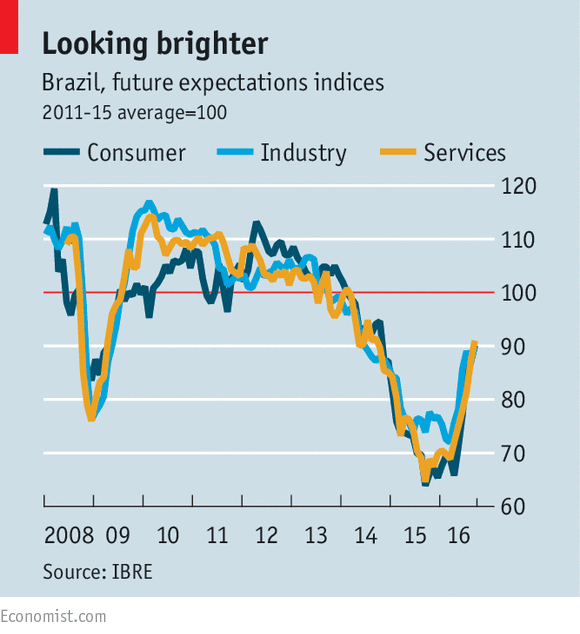
For all that, Mr Diniz is not alone in his optimism. Surveys point to rising confidence among bosses and consumers alike (see chart). Investors’ spirits are up—and with them the São Paulo stockmarket, which has returned to levels last seen in 2012. The real has strengthened by a third against the dollar since January.
The collective mood swing has less to do with the real economy, and more with realpolitik. In August the…Continue reading
The greatest moderation

ON OCTOBER 19th China reported that its economy grew by 6.7% in the third quarter. It would have been an unsurprising, reassuring headline, except that China had reported exactly the same figure for the previous quarter—and for the quarter before that. This freakish consistency invited the scorn of China’s many “data doubters”, who have long argued that it fudges its figures. China has expanded at the same pace from one quarter to the next on numerous occasions. But it has never before claimed to grow at exactly the same rate for three quarters in a row.
Has anywhere? This growth “three-peat” is not entirely without precedent. Seven other countries have reported the same growth rate for three quarters in a row, according to a database spanning 83 countries since 1993, compiled by the Economist Intelligence Unit, our sister company. The list includes emerging economies like Brazil, Croatia, Indonesia, Malaysia and Vietnam, but also two mature economies: Austria and Spain. Indeed, Spain has performed this miracle of consistency twice. It grew by 3.1% (year-on-year) in the first three quarters of 2003 and by 4.2% in the first…Continue reading
How to confront a dark corporate past
“WE THOUGHT we knew our story, and we knew it wasn’t great,” says Maurice Brenninkmeijer, chairman of COFRA Holding, which owns C&A, a 175-year-old Dutch clothing retailer with over 2,000 stores globally. Yet the full account of how the German branch of his family behaved in the second world war “tore through your heart when you heard it”, he adds. Mr Brenninkmeijer’s ancestors—considered to be genial, virtuous, Catholic and reserved—turned out to have been avid Nazi collaborators. Old letters revealed cosy, corrupt, ties to Hermann Goering. From 1942 onwards C&A and Siemens, a German engineering firm, together exploited forced Eastern European labourers in Germany, keeping them in such a wretched state that malnutrition killed several women and children. C&A profited from “Aryanisation”, grabbing business and property from terrified Jewish owners. Perhaps worst, it used Jewish tailors and leather-workers, corralled in Lodz, a dreadful ghetto in Poland. Of some 200,000 people trapped in inhumane conditions there, only 1,000 survived to liberation.
Such grim details are now public thanks to Mark Spoerer, a historian in Regensburg who specialises in archival research to assess companies’ dark pasts, putting “immoral business behaviour” into historical context. Remarkably, his new book “C&A: A family business in Germany, the…Continue reading
Big tobacco’s new ambitions
 Innovator at work
BIG Tobacco is about to get even bigger. On October 21st British American Tobacco (BAT) announced that it had bid $47bn for the 58% of Reynolds American that it does not already own. Though Brexit has weighed on some British companies, BAT is unencumbered, with most of its revenue earned overseas. Many investors expect the deal to go ahead, although BAT might need to puff up its offer. BAT would then become the world’s largest tobacco company by sales and profits.
As in other volume businesses, like beer, some of the merger logic is simply to cut costs. With consolidation, BAT reckons its deal would generate $400m of annual savings. However, it also underscores two big, long-term changes for cigarette-makers.
The first is that America has become an attractive market for tobacco firms and buying Reynolds, whose brands include Camel and Newport, is the easiest way for BAT to grow there. This is a reversal from the recent past. Not long ago America seemed stale and overrun by lawsuits, particularly compared with fast-growing economies. Cigarette firms quarantined their American businesses. In 2004…Continue reading