
Tag: Approved
Adventure tourism

VISITORS to Lisbon, Portugal’s hilly capital, usually seek its nightlife, its sweet custard tarts (pasteis de nata) or its gothic architecture. But no guidebook could help two visitors on October 10th. The pair of analysts, from Dominion Bond Rating Service (DBRS), a Canadian credit-ratings agency, went to assess the creditworthiness of the Portuguese government.
Markets are waiting anxiously for October 21st, when DBRS will update its rating of Portuguese sovereign debt. Hints from DBRS have been playing havoc with the ten-year bond yield: in August a gloomy comment from Fergus McCormick, DBRS’s chief economist, saw it climb 14 basis points (hundredths of a percentage point). This week, word that DBRS was “totally comfortable” with the government’s fiscal position saw it dip by ten basis points.
This unusual attention to a little-known ratings agency is due to the eligibility rules for the European Central Bank’s (ECB) quantitative-easing scheme. The ECB will buy only sovereign debt that is rated as investment grade by at least one of four approved ratings agencies: Fitch, Moody’s,…Continue reading
When a bubble is not a bubble

ESTATE agents in China, as elsewhere in the world, are normally a smooth-talking, self-assured bunch. But Liu Zhendong, a salesman at a large development in the northern reaches of Shanghai, is afflicted by doubts. He had expected business to be solid and steady this year. Instead, it has been manic, with clients jostling to see show apartments. Some had hoped to wait for the market to cool, but capitulated and bought as prices climbed higher week after week. Flats in the area, the once-rural village of Malu, still dotted with fields and scruffy wholesale food markets, now cost 90% more than a year ago. “It feels a bit like a bubble,” he says.
Mr Liu is in good company. Even the head of the central bank’s research bureau, usually cautious in his choice of language, has said a property bubble must be stopped before it gets too big. House prices have climbed by 16% nationwide over the past year, and double or even triple that in big cities. So in the past two weeks more than 20 municipalities have tried to calm the market down—for example, by requiring higher down-payments or limiting purchases by residents of other cities.
As the past…Continue reading
Why sterling suffered a “flash crash”

IF A country’s exchange rate represents international investors’ confidence in its government’s policies, the markets have given Britain the thumbs-down. So far this year, only the Nigerian naira among major currencies has put in a worse performance.
The decline seems to be accelerating. On October 7th the pound fell from $1.26 to $1.18 against the dollar within a few minutes, with one trade reported below $1.14. The shift occurred during Asian trading, when liquidity in sterling is likely to be thinnest. The most likely explanation for the plunge lies in the action of algorithmic trades—computer programs that automatically buy and sell assets, from currencies to commodities. Such programs may be designed to sell when an asset’s price falls below a certain level. These sales can be contagious, with one program’s trades setting off the sell signals of other algorithms.
The most famous “flash crash” occurred on Wall Street in May 2010, when the Dow Jones Industrial Average fell by almost 1,000 points in the middle of a trading day. On that occasion, the market righted itself before drifting lower in subsequent…Continue reading
Hard bargains

ECONOMICS can seem a rather bloodless science. In its simplest models, prices elegantly balance supply and demand, magically directing individuals’ pursuit of their own self-interest towards the greater good. In the real world, humans often undermine the greater good by grabbing whatever goodies their position allows them. The best economic theorising grapples with this reality, and brings us closer to understanding the role of power relationships in human interactions. This year’s Nobel prize for economic sciences—awarded to Oliver Hart and Bengt Holmström—celebrates their study of economic power, and the tricky business of harnessing it to useful economic ends.
Behind the dull-sounding “contract theory” for which the two were recognised lies an important truth: that when people want to work together, individual self-interest must be kept under control. For a chef and a restaurant-owner to work together productively, for example, the owner must promise not to use the power he has to change the locks in order to deny the chef his share of future profit. Mr Hart, a British economist working at Harvard University, tackled power dynamics while…Continue reading
Hide and seek

IT WAS one of the most spectacular robberies of modern times. In February thieves tried to steal nearly $1 billion from accounts held by Bangladesh Bank, the central bank, at the Federal Reserve Bank of New York. They were thwarted, but only after spiriting away $101m. Since then Bangladesh’s government has twice suppressed the publication of a report into the heist, most recently last month, on the ground that making it public would jeopardise efforts to retrieve from the Philippines $81m that is still missing. Interviews with officials and others in Dhaka lead to an obvious conclusion: the report will almost certainly never be made public.
The investigating panel’s remit was to establish why the central bank kept the theft secret for a month, whether bank officials were involved in it and how to avert a similar heist in future. Mohammed Farashuddin, a former central-bank governor, who led the probe and once advocated its publication, will not comment on its findings. The word in Dhaka is that the report is being buried because it exposed lapses at the central bank and implicated its officials or consultants. The government has consistently…Continue reading
The business of outrage

ONE of the gentler quips uttered by the writer and thinker H.L. Mencken was that nobody ever went broke underestimating the intelligence of the American public. By the same token, nobody ever went broke overestimating the anger of the American people. The country is in an unusually flammable mood. This being America, there are plenty of businesspeople around to monetise the fury—to foment it, manipulate it and spin it into profits. These are the entrepreneurs of outrage and barons of bigotry who have paved the way for Donald Trump’s rise.
The very first of them was Rush Limbaugh who, back in the 1980s, transformed himself from a disc jockey into a radio commentator. Mr Limbaugh shook up the ossified talk-show format by dispensing with the tedious call-ins and adding anarchic humour. Soon an army of “ditto-head” followers hung on his every word. He has 13m regular listeners and hundreds of imitators, ranging from national stars such as Sean Hannity to local ranters.
The second entrepreneur of outrage was Roger Ailes, a Republican operative who teamed up with Rupert Murdoch to build Fox News. Mr Ailes took talk radio and added TV…Continue reading
Change of tune
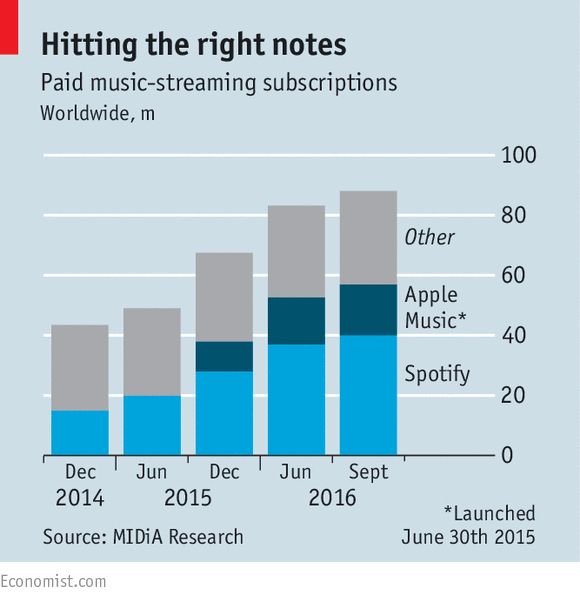
IT WAS an eventful summer in the business of streaming music. Taylor Swift and other artists attacked YouTube over rampant free streaming. Frank Ocean and Katy Perry cut exclusive deals with Apple Music, to the dismay of executives at Spotify, a Swedish rival. Behind the scenes, Pandora, a radio-like service, and Amazon, an e-commerce giant, stepped up their efforts to take on Spotify and Apple. Then last month Spotify began talks to buy SoundCloud, another streaming firm.
All this drama obscures two emerging realities. The first is that subscription streaming is now the future of the music business. The industry suffered a catastrophic collapse in sales from 1999 onwards before beginning to recover last year. Selling music to own, whether via iTunes downloads or CDs, is still a declining business globally.
But American record labels and music publishers are now on track for a second consecutive year of growth. Recent reports on sales of music from Europe, where some countries are experiencing double-digit increases in revenues, suggest that the recovery will also continue in other parts of the world.
Most…Continue reading
Techno parties

CAMPAIGNING is no longer the preserve of big organisations like political parties and trade unions. Online platforms have given voice to individuals around the world and increasingly, the firms behind those platforms are taking activist positions of their own. Facebook’s founder, Mark Zuckerberg, is on a mission “to connect the world”. Apple’s boss, Tim Cook, has vigorously defended customers’ privacy rights. This week the campaigning side of two other technology giants was on display.
On October 3rd Microsoft published a book that could easily be mistaken for a manifesto. Entitled “A Cloud for Global Good”, the 200-page volume offers no fewer than 78 “public-policy recommendations” in 15 “categories”, ranging from protecting privacy to preventing cybercrime. Most intriguing, Microsoft wants the computing clouds to be inclusive. They shouldn’t just benefit the rich and the able, says the firm. As income inequality widens, the book notes, “there are very real concerns about who will benefit.”
The next day 170,000 people descended on San Francisco to attend Dreamforce, a shindig organised by Salesforce, a big provider…Continue reading
A yen for cheapness
 Best-sellers from Tokyo to Texas
IT HAS become a staple story in the local American press: a Daiso store opening near you. Last month it was the turn of Plano, Texas, to get a branch of the Japanese chain of shops where everything costs ¥100. (In America it actually charges $1.50 per item, giving it a premium over the current exchange rate of 97 cents per ¥100.) The Plano store is the second of 44 shops planned for the state. To date California has 49 branches.
America is far from alone. As well as its 3,000-odd stores in Japan, Daiso has 1,500-plus outlets abroad. Its bargain range of products, from value-for-money bags to Japanese “kawaii” or “cute” figures, are sold around the world, from countries in Latin America to the Gulf states and throughout the rest of Asia. (As yet there are no ¥100 stores in Europe.)
This roll-out is orchestrated from a headquarters in the eastern suburbs of Hiroshima. The building looks bland from the outside. But its interior is decked out in Daiso’s trademark pink. One floor is abuzz with buyers examining packs of wet wipes and plastic toys;…Continue reading
Capital punishment

AMONG the proud titans humiliated in the financial crisis of 2007-08 was GE, forced to take a government bail-out in 2008. In response it swiftly slimmed down its lending arm, GE Capital. But the regulators were still not happy. In 2013 they labelled it a “systemically important financial institution” (SIFI), ie, one big enough to pose a global risk. That imposed costly regulatory burdens and encouraged GE’s boss, Jeffrey Immelt, to announce in April 2015 that he would wind down most of GE’s finance division within three years.
In a remarkable corporate transformation, he is ahead of schedule. The disposal to Wells Fargo this week of GE’s global inventory-financing business means that GE has sold $193 billion of “ending net investment”, or ENI (an adjusted asset figure), in the past 18 months, covering more than 25 lending units.
It has taken almost a decade. But GE is, almost, an ex-bank. As Mr Immelt promised last year, it is also much simpler. It shed its SIFI status in June. Lending, in ENI terms, is down by 85% from its peak in 2008 (see chart) and now focuses on its core industrial businesses. Its reliance…Continue reading