
Tag: Approved
What Natarajan Chandrasekaran must do next at Tata

FACED with complexity humans often resort to a heuristic, a rough mental template that gets the job done. That could come in handy at Tata Group, India’s largest business, whose dizzying mix of scale, palace politics and sense of moral purpose defy any categorisation. Tata’s boss, Natarajan Chandrasekaran, known as Chandra, has been in the job for a year. He spent 2017 pepping up morale and extinguishing fires. Now he must squeeze Tata into a new strategic framework that clarifies its structure and purpose.
Is it a 150-year-old national monument, a philanthropic vehicle or a conglomerate? In Schumpeter’s view Tata should instead be positioned as a holding company—like Berkshire Hathaway but minus the personality cult and with Indian characteristics.
Tata is a handful. It has 695,000 staff and is active in 17 industries. Its family of firms has a market value of $155bn. It mixes virtue with profits; Tata’s leaders are expected to exude decency and probity. The group was an…Continue reading
How a brothel owner created the world’s biggest industrial park

PAST the neon lights of Reno and the cookie-cutter homes of neighbouring Sparks, the I-80 highway winds through a thinly populated expanse of arid hills and lunar valleys in Storey County. On one side of the road flows the Truckee River; on the other bands of wild horses forage for parched grass. Signs of civilisation are restricted to electricity pylons and the odd rundown farmhouse. The Wild Horse Saloon, a dark and smoky room connected to a legal brothel, is the only sit-down restaurant for miles. It is not an area that immediately seems conducive to hosting a business park. Yet Storey County in Nevada is home to the world’s largest by some measures: the Reno Tahoe Industrial Centre (TRI). The park spans 104,000 acres in total—three times the size of San Francisco.
Near its eastern border hulks Tesla’s “gigafactory”, a gargantuan white structure where the company hopes to produce batteries for 500,000 electric cars a year….Continue reading
Airbus executives get swept away by a corruption investigation
“THE success of Airbus is intimately linked to the success of John,” says Eric Schulz, successor to John Leahy, who has been chief salesman for the planemaker since 1994. Mr Leahy’s aggressive strategy to gain orders expanded Airbus’s market share for civil jets from 18% in 1994 to over 50%. Salesmen at Boeing, Airbus’s rival, say they wish their bosses were as good. But this year’s Singapore Airshow, which began on February 6th, will be Mr Leahy’s last before retirement.
That is in itself a big change for Airbus, but staff turnover does not stop there. In December the firm said Tom Enders, its German-born chief executive, would step down in 2019; his French second-in-command, Fabrice Brégier, will leave this month. These changes follow the news that several countries, including Britain, France and America, are investigating allegations that in the past Airbus bribed officials to win contracts. That created divisions between French and German executives over how to respond.
The recent troubles began in 2014, when an internal review of supplier payments at Airbus exposed irregularities. It ended up reporting itself to Britain’s Serious Fraud Office and to France’s equivalent body for lying to export-credit agencies about bribes given by third-party consultants to secure sales. In October Airbus said it may have violated…Continue reading
Creditors call time on China’s HNA
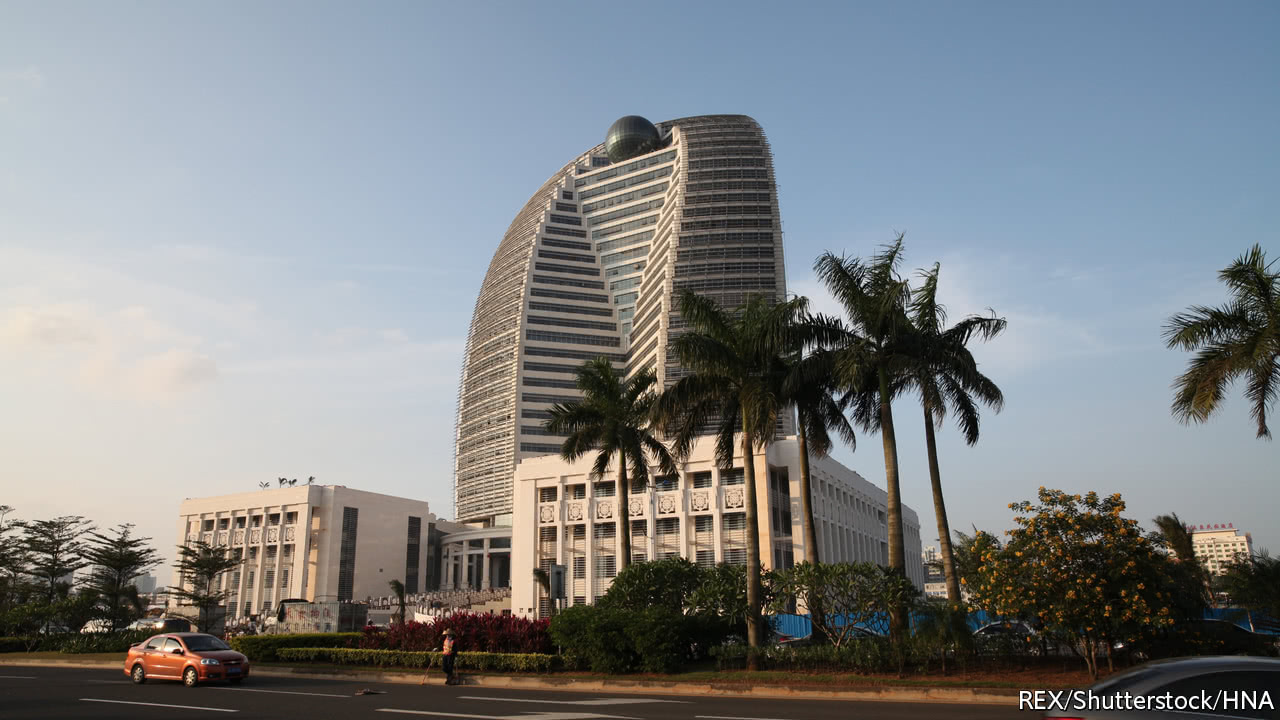
THE ascent of HNA, an aviation-to-financing giant, began on six wings and a prayer. It started out as Hainan Airlines, set up on China’s southern palm-fringed island in 1993 with three planes, in a joint venture between a Buddhist businessman, Chen Feng, and the local government of Hainan. In 2000 the firm became HNA Group and, from a Buddha-shaped headquarters, Mr Chen built his enterprise into an empire with more than $150bn in assets. Foreign trophies came next. The firm borrowed heavily to finance deals worth $50bn since 2015 over six continents, including a 25% stake in the Hilton hotel group and 9.92% of Deutsche Bank.
In recent weeks it has become clear that its gorging—which had continued apace even after HNA was among those firms singled out for scrutiny by China’s banking regulator last June for their risky debt-fuelled purchases—is over. In January HNA told creditors that it would face a probable cash shortfall of at least 15bn yuan ($2.4bn) in the first quarter of this year.
HNA has assured investors that this…Continue reading
Insider trading has been rife on Wall Street, academics conclude

INSIDER-TRADING prosecutions have netted plenty of small fry. But many grumble that the big fish swim off unharmed. That nagging fear has some new academic backing, from three studies. One argues that well-connected insiders profited even from the financial crisis.* The others go further still, suggesting the entire share-trading system is rigged.**
What is known about insider trading tends to come from prosecutions. But these require fortuitous tip-offs and extensive, expensive investigations, involving the examination of complex evidence from phone calls, e-mails or informants wired with recorders. The resulting haze of numbers may befuddle a jury unless they are leavened with a few spicy details—exotic code words, say, or (even better) suitcases filled with cash.
The papers make imaginative use of pattern analysis from data to find that insider trading is probably pervasive. The approach reflects a new way of analysing conduct in the…Continue reading
Bitcoin and its rivals offer no shelter from the storm
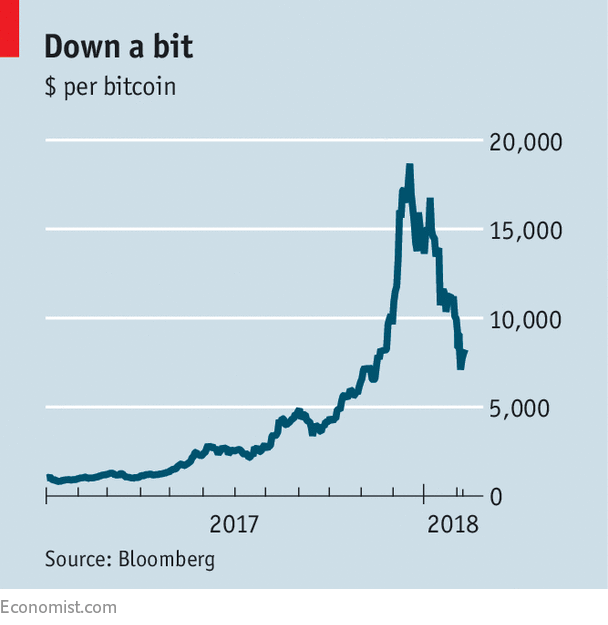
THE “biggest bubble in human history comes down crashing,” tweeted Nouriel Roubini, an economist, gleefully. After an exhilarating ride skywards in 2017, investors in crypto-currencies have been rudely reminded that prices can plunge earthwards, too. In mid-December the price of bitcoin was just shy of $20,000; by February 6th, it had fallen to $6,000, before recovering a little (see chart).
And bitcoin is not the only digital currency to have fallen. Figures from CoinMarketCap, a website, show that the total market capitalisation of crypto-currencies has fallen by more than half this year, to under $400bn. This slide has taken place amid a flurry of hacks, fraud allegations and a growing regulatory backlash.
Perhaps the most damaging allegations surround Tether, a company that issues a virtual currency of the same name. Tether allows users to move money across exchanges and crypto-currencies without converting it back into “fiat” (central-bank-backed) money first. In theory, each…Continue reading
South-to-South investment is rising sharply
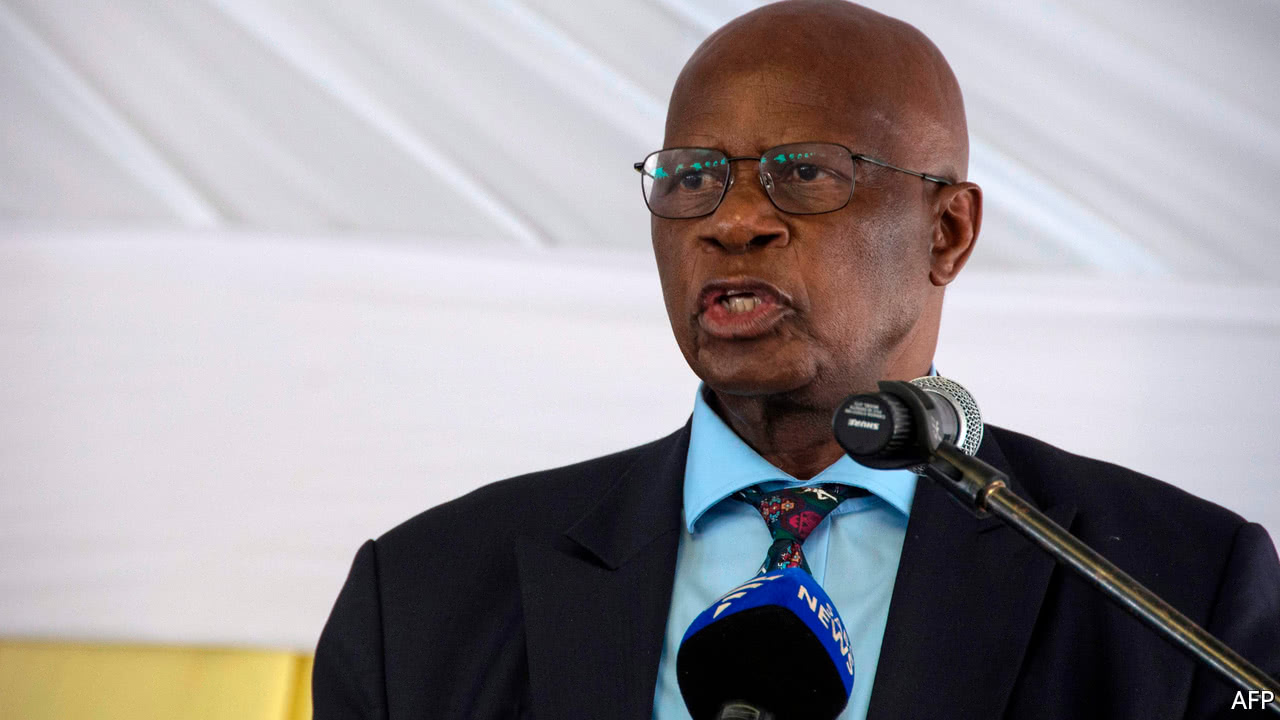
AT A meeting in Namibia last month Zimbabwe’s finance minister, Patrick Chinamasa, made a pitch to lure African investors to an economy ruined by Robert Mugabe. That he did so first in Windhoek, not London or New York, is telling. Although flows through tax havens muddy the data, 28% of new foreign direct investment (FDI) globally in 2016 was from firms in emerging markets—up from just 8% in 2000.
Chinese FDI, a big chunk of this, shrank in 2017 as Beijing restricted outflows and America and Europe screened acquisitions by foreigners more closely. But the trend of outbound investment is widespread. Almost all developing countries have companies with overseas affiliates. Most of their investment goes to the West. But in two-fifths of developing countries they make up at least half of incoming FDI. In 2015-16 the ten leading foreign investors in Africa, by number of new projects, included China, India, Kenya and South Africa.
A World Bank survey of more than 750 firms with FDI in developing countries found that those from…Continue reading
Wells Fargo suffers a rare punishment—a cap on assets
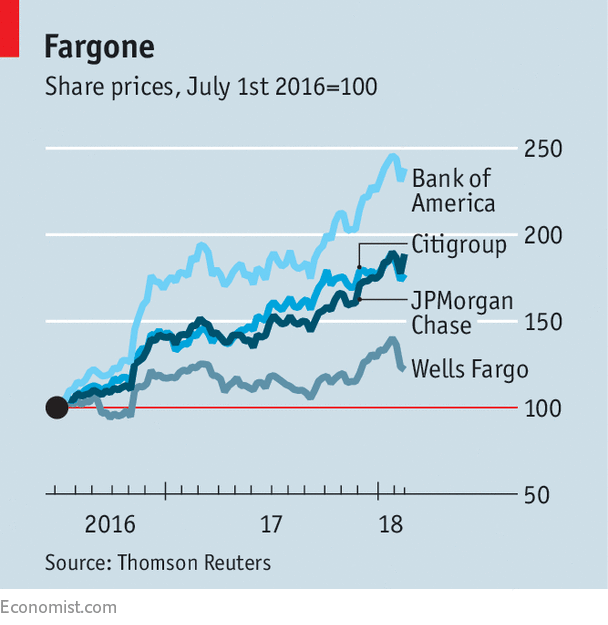
ON HER way out, Janet Yellen, who stood down as the Federal Reserve’s chair on February 2nd, paused to add yet another sanction to those already imposed on Wells Fargo for foisting unwanted insurance and banking products on clients. The latest punishment is a highly unusual one. Wells will be blocked from adding assets to the $2trn held on its balance-sheet at the end of 2017. Two other regulators had already imposed fines and penalties soon after the shenanigans began emerging in 2016. The bank has gone through a big reorganisation. The Fed’s belated response presumably took into account not only the errant conduct but also the political fallout. The government, as well as the bank, had been embarrassed.
At first glance, Wells is an odd target for such treatment. During the financial crisis it proved itself the best of the big banks, with relatively high underwriting standards and manageable losses. The scandal was huge—millions of clients were pushed into unwanted products. But the financial costs…Continue reading
Passive funds tracking an index lose out when its make-up changes

IS THERE hope for fund managers after all? Conventional “active” managers, who try to pick stocks that will beat the market, have been losing ground to “passive” funds, which simply own all assets in a given sector in proportion to their market value. The main advantage of the latter group is that they charge a lot less.
William Sharpe, a Nobel prizewinning economist, argued in 1991 that the “arithmetic of active management” means that the average fund manager is doomed to underperform. To understand why, assume that there are equal numbers of active and passive managers and, between them, they own all the market. The market returns 10%. How much will the passive managers earn? The answer must be 10%, before costs. The active managers own that bit of the market the passive managers don’t. But that proportion of the market must, thanks to simple arithmetic, also return 10%, before costs. Since the costs of active investors are higher, the average active manager must underperform. These…Continue reading
The release of Samsung’s boss leaves South Koreans exasperated
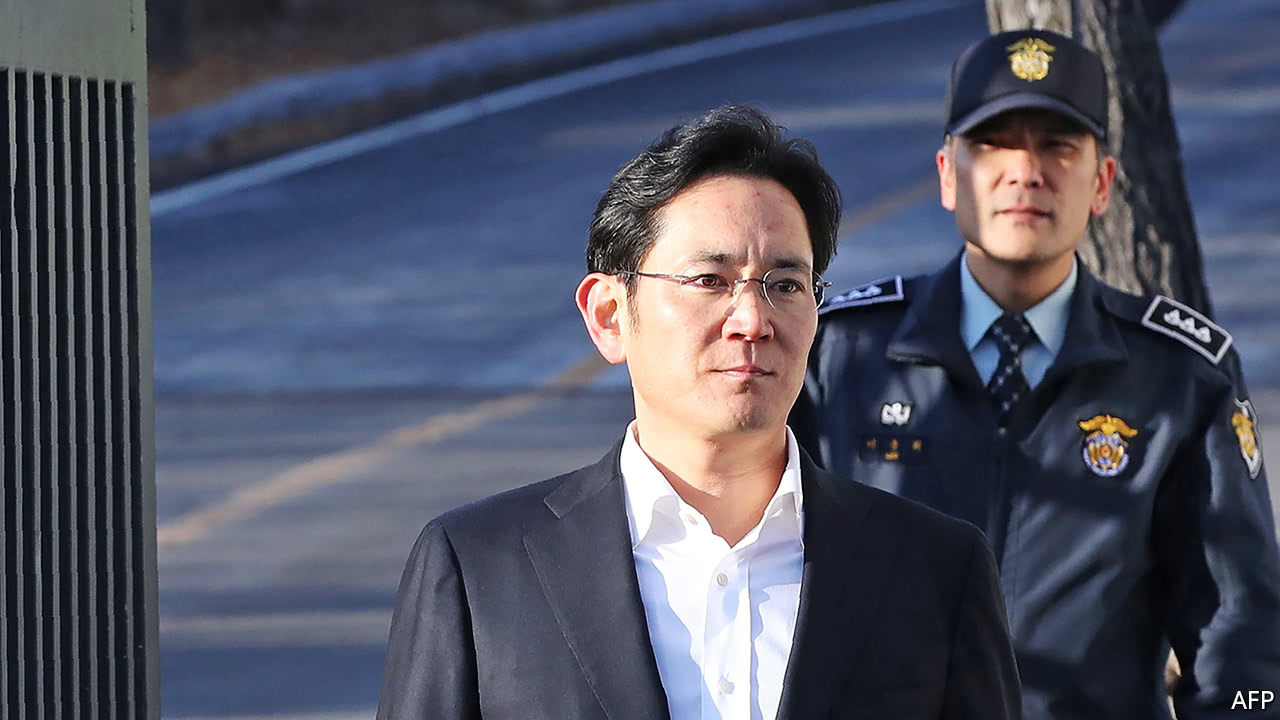
“INNOCENT if rich, guilty if poor” is a well-known adage in South Korea. It has been trending anew on social media since February 5th, when Lee Jae-yong, the vice-chairman of Samsung Electronics, was released from prison. The 49-year-old heir to South Korea’s biggest chaebol, or family-run conglomerate, had been found guilty of bribing a former president, Park Geun-hye, and her confidante, Choi Soon-sil. But Mr Lee’s initial five-year prison sentence was cut in half and suspended by an appeals court, allowing him to walk free after 353 days in jail. Other executives were also released on suspended sentences.
The ruling largely upheld Mr Lee’s insistence that he had been coerced by Ms Park into handing over the bribe. Prosecutors had charged him with paying 43bn won ($38m), which included buying horses for Ms Choi’s daughter and various donations to her sports foundations. In the end, only use of the horses was recognised as bribery, slashing the sum to 3.6bn won. Although Mr Lee…Continue reading