
Tag: Approved
As China gets tough on pollution, will its economy suffer?

LEO YAO thought he had nothing to fear from the environment ministry. Before, when its inspectors visited his cutlery factory, he says, they generated “loud thunder, little rain”. After warning him to clean up, they would, at worst, impose a negligible fine. Not so this time. In August dozens of inspectors swarmed over his workshop in Tianjin, just east of Beijing, and ordered production to be halted. His doors remain shut today. If he wants to go on making knives and forks, he has been told that he must move to more modern facilities in a less populated area.
Mr Yao’s company, which at its peak employed 80 people, is just one minor casualty in China’s sweeping campaign to reduce pollution. For years the government has vowed to go green, yet made little progress. It has flinched at reining in dirty industries, wary of the mass job losses that seemed likely to ensue. But in the past few months it has taken a harder line and pressed on with pollution controls, hitting coalminers,…Continue reading
America’s bank profits take a hit from tax reform

WHEN Donald Trump won America’s presidential election 14 months ago, banks’ share prices leapt. One reason for that was the prospect of lower corporate taxes, which would both benefit banks directly and (investors hoped) ginger up the economy. Like Mr Trump’s legislative agenda, their shares were becalmed for much of 2017, but they perked up late in the year when the Tax Cuts and Jobs Act looked likely to become law—as it duly did when the president signed it on December 22nd.
Yet several banks expect the act to make deep dents in fourth-quarter profits. On December 28th Goldman Sachs said it was braced for a $5bn hit. A week before, Bank of America (BofA) announced a $3bn write-down. Early in the month, on fairly accurate assumptions about the law’s final form, Citigroup put the cost at a whopping $20bn. Foreign banks are also assessing the damage: £1bn ($1.4bn), says Barclays; SFr2.3bn ($2.4bn), reckons Credit Suisse.
These one-off hits have two main causes….Continue reading
Many happy returns: new data reveal long-term investment trends

DATA-GATHERING is the least sexy part of economics, which is saying something. Yet it is also among the most important. The discipline is rife with elaborate theories built on assumptions that turned out to be false once someone took the time to pull together the relevant data. Accordingly, one of the most valuable papers produced in 2017 is an epic example of data-retrieval: a piece of research that spells out the rates of return on important asset classes, for 16 advanced economies, from 1870 to 2015. It is fascinating work, a rich seam for other economists to mine, and a source of insight into some of today’s great economic debates.
Rates of return both influence and are influenced by the way firms and households expect the future to unfold. They therefore find their way into all sorts of economic models. Yet data on asset returns are incomplete. The new research, published as an NBER working paper in December 2017, fills in quite a few gaps. It is the work of five economists: Òscar Jordà of the…Continue reading
A bond dispute threatens the future of Islamic finance
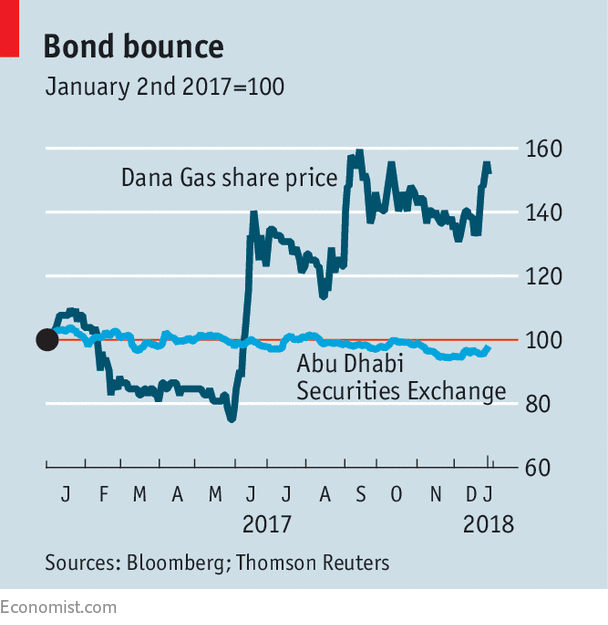
STOCKMARKETS in the Gulf do not observe Christian holidays, but still had a generally quiet day on December 25th. Shares in Dana Gas, an exploration business listed in Abu Dhabi, however, did make some noise, leaping by 13.2% on Christmas Day, to complete a buoyant six months for the stock (see chart). The surge may owe something to the company’s recent arbitration victory against the regional government of Iraqi Kurdistan, over $2bn it and its consortium partners are owed in overdue payments. But it also hints at shareholders’ belief that Dana will not be forced soon to satisfy its own creditors. They have been up in arms since the firm refused to honour a $700m Islamic bond, or sukuk, that matured in October.
Dana says it has received legal advice that the security no longer complies with sharia, the body of Koranic law, and so the bond is “unlawful” in the United Arab Emirates (UAE). In July, facing liquidity difficulties, it stopped redeeming…Continue reading
After a bumper 2017, will 2018 be kind to the financial markets?
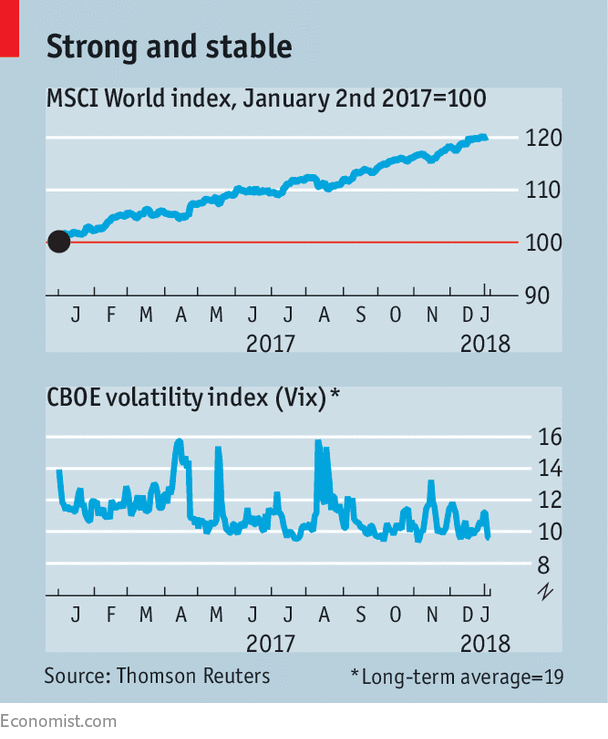
AFTER a bumper year for financial markets in 2017, can 2018 be anything like as good? Much will depend on the global economy. The rally in stockmarkets stretches back almost two years, to the point when worries about an era of “secular stagnation” started to diminish.
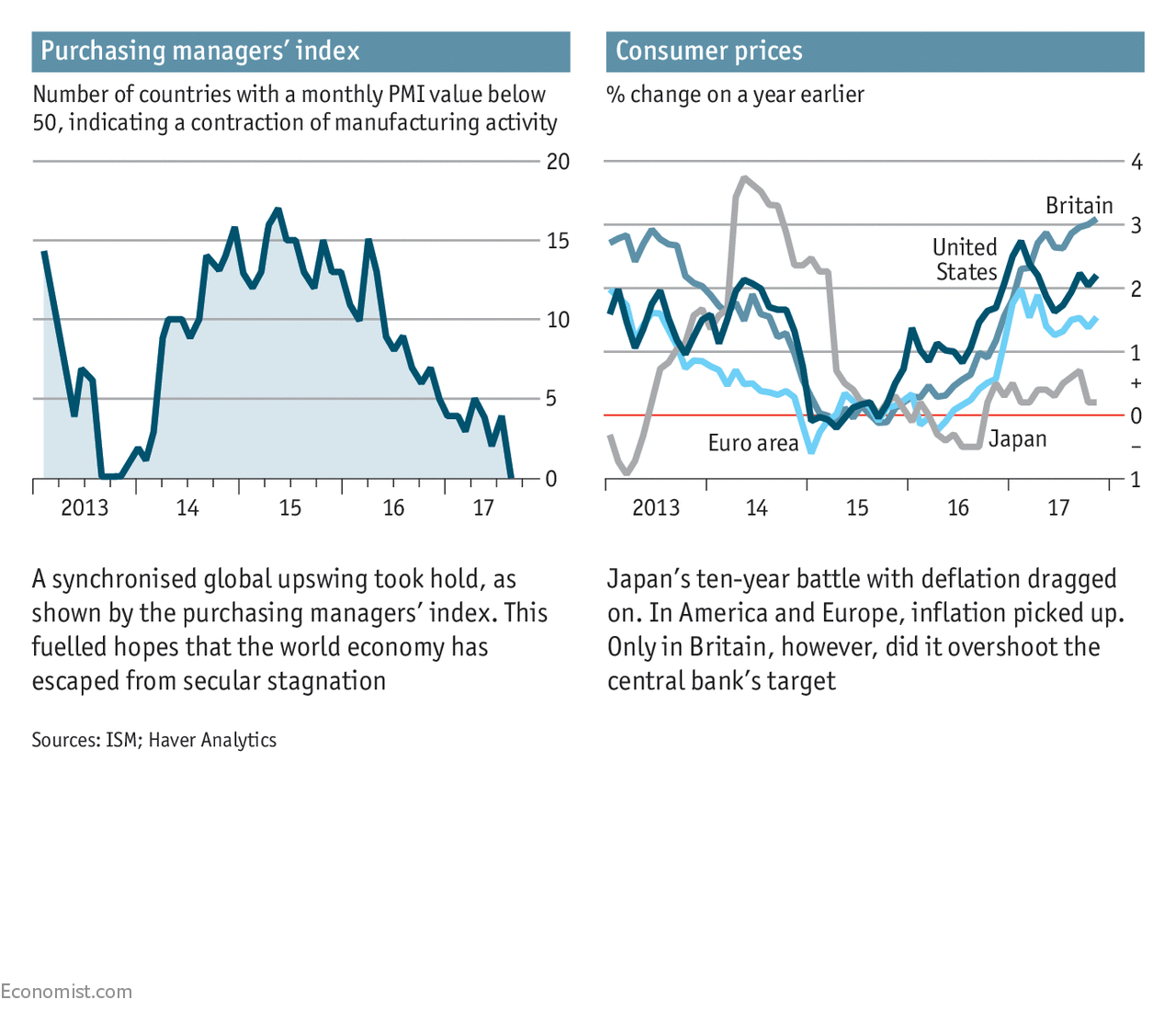
The first pieces of economic data to be published in January—the purchasing managers’ indices (PMI) for the manufacturing sector—were pretty upbeat. In the euro zone the index recorded its highest level since the survey began in 1997. China’s PMI was stronger than expected, and America’s index showed new orders at their highest level in nearly 14 years.
The obvious question is whether the markets have anticipated the good news about growth, and pushed share prices to a level from which returns can only be disappointing. The cyclically adjusted price-earnings ratio of the American market, which uses a ten-year average of profits, is 32.4; it has been higher only in September 1929 (just before the Wall Street crash)…Continue reading
2018 will be the year that large, incumbent companies take on big tech

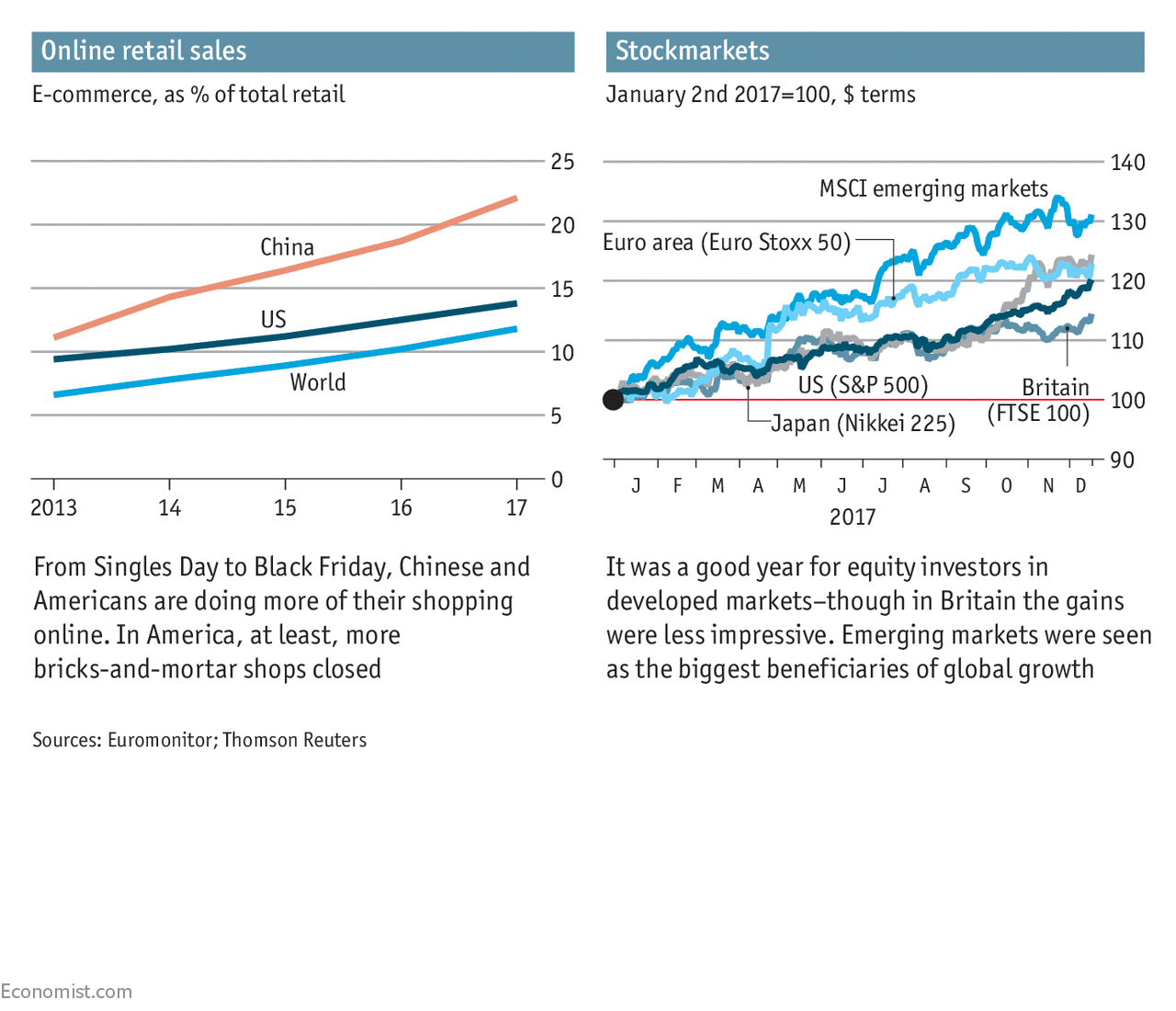
ACCORDING to Ginni Rometty, IBM’s boss, the digital revolution has two phases. In the first, Silicon Valley firms make all the running as they create new markets and eviscerate weak firms in sleepy industries. This has been the story until now. Tech firms have captured 42% of the rise in the value of America’s stockmarket since 2014 as investors forecast they will win an ever-bigger share of corporate profits. A new, terrifying phrase has entered the lexicon of business jargon: being “Amazoned”.
The second phase favours the incumbents, Ms Rometty believes, and is starting about now. They summon the will to adapt, innovate to create new, digital, products and increase efficiency. The schema is plainly self-serving. IBM is itself fighting for survival against cloud-based tech rivals and most of its clients are conventional firms. Yet she is correct that incumbents in many industries are at last getting their acts together on technology.
Enough time has elapsed for even…Continue reading
New research reveals simmering misunderstanding under the tree

IS THERE any other time of year when good intentions and materialism converge so tightly? The caring, the artistic and the diligent spend their days before Christmas wrapping gifts. Whatever lies inside, their love for the recipients will also be expressed through paper, tape, bows and ribbon.
Then it all goes horribly wrong. New research* into the unwrapping of presents by two professors at the Yale School of Management and one at the University of Miami bravely applies rigour where sentimentality has long ruled. Their paper draws on a half-century of studies by scores of economists and psychologists as well as fresh field trials using hundreds of people from three universities.
The result is, for wrappers, a distressing discovery. Americans spend $3.2bn a year on wrapping paper. Yet their work not only fails to enhance joy, it creates unrealistic expectations that lead to discontent. Gift wrappers may think they are transforming the mundane into the magnificent; recipients seem…Continue reading
Russia’s dysfunctional funeral business gets a makeover

THE calls began shortly after Yulia’s grandmother died. The undertaker offered help arranging the funeral, for 47,000 roubles ($800) in cash. She then travelled to Moscow’s Khovanskoe Cemetery, where she was offered a discount on a gravesite—150,000 roubles off—if she could bring cash within three hours and sign a receipt saying she had paid half that amount. Yulia (whose name has been changed) and her family gave in. “We knew we were paying a bribe, but what else could we do?”
To bury a loved one in Russia often means entering an underworld of corruption and red tape. The myriad goods and services needed, from preparing the body for burial to funeral arrangements to carving a headstone, all represent opportunities for extortion in a largely informal market. “Instead of a funeral as a commercial service, the consumer is offered a strange sort of quest,” writes Sergei Mokhov, editor of The Archaeology of…Continue reading

An experiment with in-home deliveries is under way


AFTER staying at home one afternoon for a delivery of discounted toilet disinfectant that never came, Valentin Romanov, a Stockholm IT manager, installed a special lock on his flat’s entrance. When no one is in, deliverymen unlock the door and slip packages inside. Four months on, Mr Romanov has doubled his spending online and says he cannot imagine life without in-home deliveries. These are sweet words for delivery firms and online retailers, Amazon included, that are setting up partnerships with lock manufacturers to overcome a big hurdle for e-commerce.
Conventional deliveries fail so often that a parcel is driven to a home an average of 1.5 times in the Nordic region, says Kenneth Verlage, head of business development at PostNord, a logistics giant operating in Denmark, Finland, Norway and Sweden. It is an expensive inefficiency made worse, he says, by the fact that recipients have still often had to wait for a failed delivery. Some couriers leave packages on doorsteps, but this invites theft….Continue reading