
Tag: Finance and economics
Latvia’s top banking official has been accused of taking a bribe

ILMARS RIMSEVICS, governor of Latvia’s central bank for the past 17 years, had been due to retire next year. Instead, he is facing calls to resign. On February 17th he was detained by Latvia’s anti-corruption authority on suspicion of taking a bribe of at least €100,000 ($123,000). The prime minister, Maris Kucinskis, says the allegations are so serious that Mr Rimsevics cannot possibly return to work. Mr Rimsevics, for his part, is staying put. Released on bail on February 19th, he denies the allegations, saying he was set up and is facing death threats.
Just a few days earlier, in an unrelated case, the US Treasury had proposed sanctions on ABLV, one of Latvia’s largest banks. It claimed ABLV had “institutionalised money laundering” and facilitated transactions with North Korea, which is under sanctions. In the days that followed €600m was withdrawn by the bank’s customers. On February 19th, seeking to stabilise the institution, the ECB froze payments by ABLV….Continue reading
Latvia’s top banking official is accused of demanding bribes
ILMARS RIMSEVICS, for 17 years the governor of Latvia’s central bank, had been due to retire next year. Instead, he is facing calls to resign. On February 17th Latvia’s anti-corruption authority detained him on suspicion of demanding bribes of at least €100,000 ($123,000). That sparked international concern. Mr Rimsevics is a member of the governing council of the European Central Bank (ECB) and privy to the most sensitive monetary-policy decisions.
The prime minister, Maris Kucinskis, says the allegations are so serious that Mr Rimsevics must stand down. But he is staying put. Released on bail on February 19th, the central bank chief says the allegations are a set-up to punish him for cracking down on lax practices. He also says he has received death threats.
Latvia’s outsized and ill-regulated offshore banking industry has been a headache since the country regained independence in 1991. During the global financial crisis ten years ago, Parex Bank, the largest…Continue reading
Recent tax reforms in America will hurt charities

DESPITE its oft-professed pro-market orthodoxy, America has always had an unusually large non-profit sector. Americans gave $390bn to charity in 2016, with the bulk of contributions coming from individual donors. Historically, revenues at non-profits tend to track GDP growth. The recent tax reforms imply that despite strong economic growth, charitable contributions in America are poised to fall for the first time since the financial crisis.
The most significant threat to charities comes from changes to income tax. American taxpayers can choose either to “itemise” specific expenses, such as charitable gifts or mortgage payments, or take a “standard deduction”. In an effort both to simplify the tax code and to lower overall tax rates, the Republican-led Congress almost doubled the standard deduction to $12,000 for individuals and $24,000 for married couples. This will make filing taxes a lot easier for many. But it also means that far fewer Americans will have a financial incentive…Continue reading
The markets still have plenty to fret about
BULL markets always climb a wall of worry, or so the saying goes. For much of 2017, the main concerns were political and the markets seemed to surmount them as easily as a robot dog opens doors (the latest internet sensation).
But February has shown that the market is still vulnerable. The immediate trigger seems to have been the fear that inflationary pressures would cause bond yields to rise and central banks to push up interest rates; this week’s surprisingly high American inflation numbers will only add to the worries. In a narrow sense, that makes bonds look cheaper, compared with equities. In a broader sense, it increases the discount rate investors apply to future profits, lowering the present value of shares. (A caveat is needed: if higher rates reflect stronger growth, then estimates of future profits should rise, offsetting the discount-rate effect.)
The immediate effect has been to create uncertainty for investors about the direction of central-bank policy, after many years in which it could reliably be assumed that rates would stay low. This translates into a more volatile market, as illustrated by the sharp jump in the Vix, or volatility index, in early February.
The danger is that many investors seem to have treated volatility as an asset class, and have organised their portfolios accordingly. Eric Lonergan of M&G, a…Continue reading
China’s stockmarket plunge: this time it’s different

A CHINESE new-year message from the American embassy in Beijing looked innocuous. It welcomed the Year of the Dog on Weibo, a microblog, with photos of the embassy staff’s pooches and a video greeting from the ambassador and his wife, each with a dog in hand. But it soon attracted 10,000 angry responses. The post had become an unlikely lightning rod for public discontent about the stockmarket.
A plunge on February 9th had left Chinese shares down by 10% on the week, their steepest fall in two years. Some punters found solace in blaming the American embassy for the rout, which started on Wall Street. For others it was a matter of convenience, because their real target, the Chinese securities regulator, knew to disable comments on its Weibo account on such a grim day for stocks.
Even so, their protests seem to have been heard. Before the market reopened this week, Chinese officials urged big shareholders to buy stocks to restore confidence. The Shanghai Stock Exchange warned…Continue reading
India’s state-owned banks endure a string of bad news
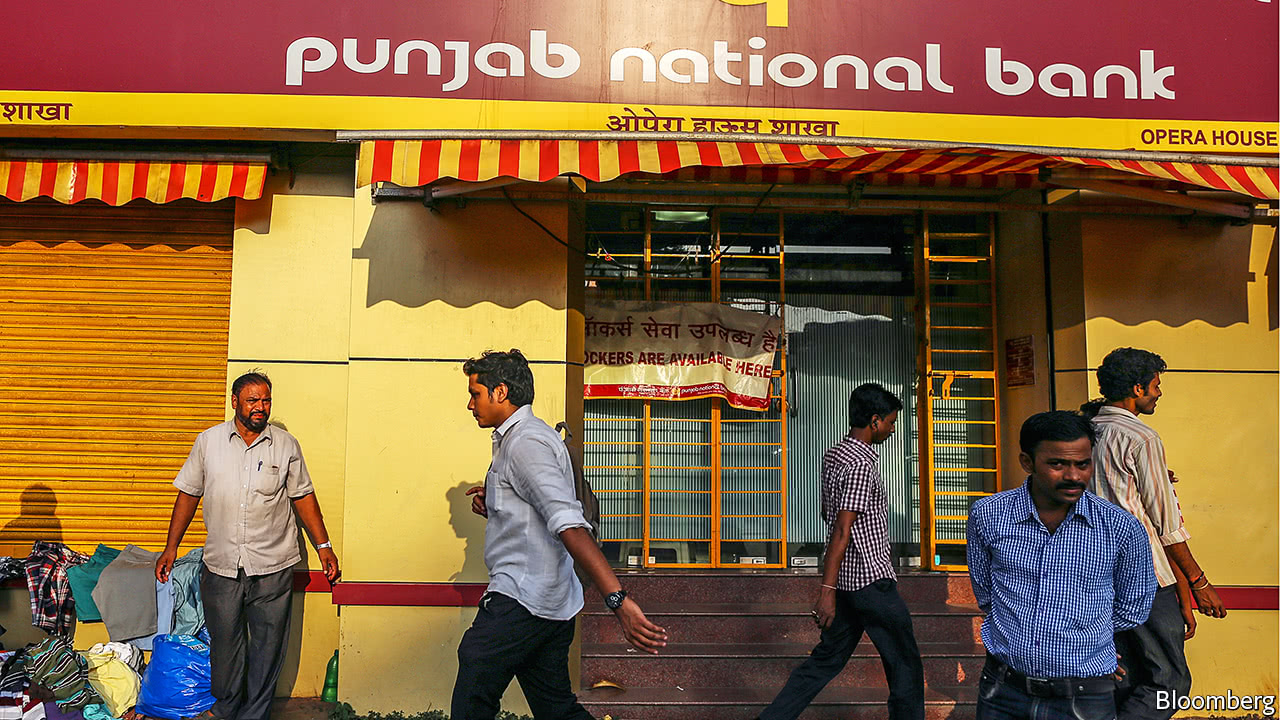
OF LATE Indian bankers have felt an unfamiliar sensation: optimism. A 1.3trn-rupees ($21bn) bail-out from the government seemed to have cleaned up the bad lending decisions of years gone by. A new bankruptcy law gave them an edge in long-standing battles with recalcitrant borrowers. It seemed a few Indian companies, having for years eschewed fresh investment, might even start borrowing again.
This week woes linked to mismanagement at India’s three biggest partially state-owned lenders plunged the bankers back to their habitual gloom. On February 14th Punjab National Bank (PNB) announced it was investigating a fraud worth 114bn rupees, equivalent to about a third of its market capitalisation. A few days earlier the State Bank of India (SBI) unveiled its first quarterly loss since 1999. And Bank of Baroda has hastily announced the closure of its South African operation, accused of having shady business associations there.
The Punjab heist is…Continue reading
Men and women in economics have different opinions
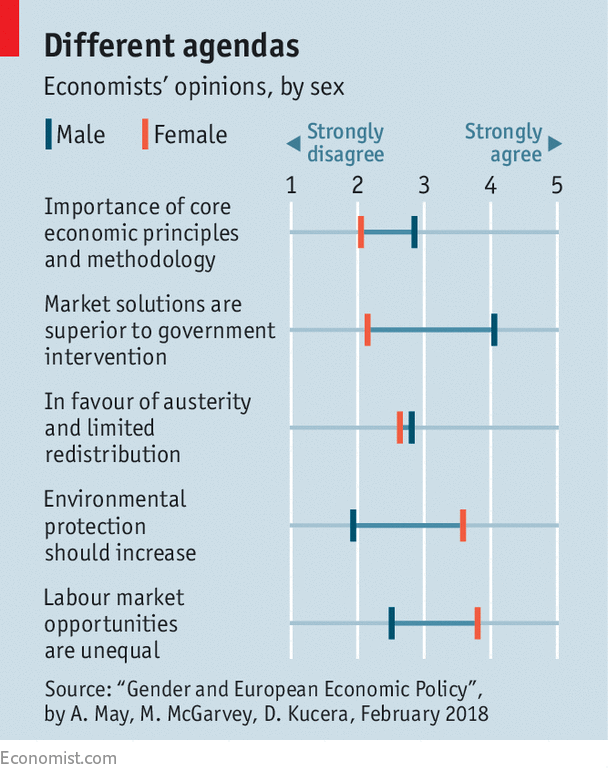
MEN may hail from Mars and women from Venus. But economists, surely, inhabit planet Earth, surveying it dispassionately. Alas, a new paper suggests that even dismal scientists divide on gender lines. Ann Mari May and Mary McGarvey of the University of Nebraska-Lincoln and David Kucera of the International Labour Organisation surveyed economists from 18 European countries, and found that differences in the wider population can survive even an economics education. Male economists are more likely than female ones to prefer market solutions to government intervention, are more sceptical of environmental protection, and are (slightly) less keen on redistribution (see chart).
A similar study of American economists by Ms May and others also found men more sceptical of government regulation, more comfortable with drilling in the Arctic National Wildlife Refuge, and more likely to believe that a higher minimum wage would cause unemployment. Women were 14 percentage points less likely to agree that Walmart…Continue reading
Tax reforms prompt upheaval in the private-equity industry
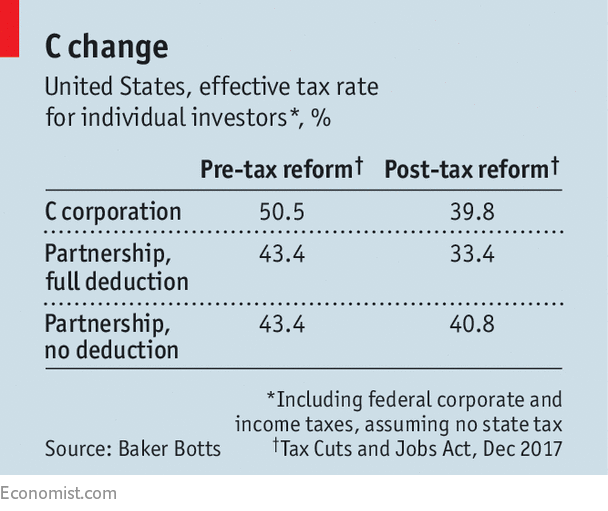
IN THE political cacophony surrounding America’s new tax law, the voice of the private-equity industry has been muted. This is perhaps unsurprising. The industry has managed in large measure to retain its favourable tax treatment, despite a threat from President Donald Trump to close the “carried interest” loophole on which it had grown fat.
So few expected the announcement on February 8th from KKR, a big private-equity firm, that the new law was prompting it to consider converting its status from that of a partnership to a “C corporation” (a corporate-tax-paying firm). As The Economist went to press, a competitor, Ares Management, was expected to make a similar announcement. The new law may have a lasting impact on private equity after all.
Tax has always been central to private-equity business models. The industry uses large amounts of debt, interest on which is tax-deductible, to acquire companies. So it has long been adept at minimising tax, both by…Continue reading
American banks pay depositors less than online accounts
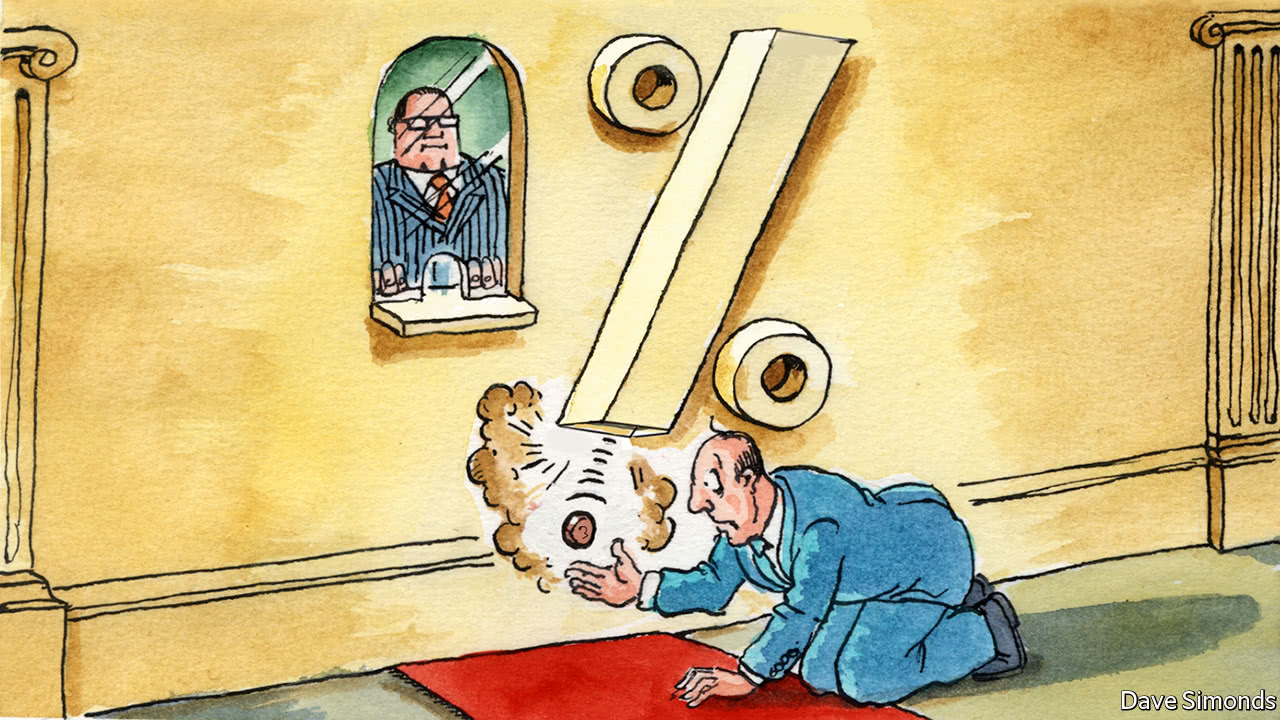
EVERYONE knows that interest rates are rising—except, perhaps, one group: American savers who have put $12trn in bank accounts. They have seen the government’s deposit guarantee, purportedly designed to protect them, become a ticket for banks to receive free money. For evidence, look no further than the ubiquitous bank branches dotting America’s high streets.
Those seeking a home for their money find that, unlike petrol stations or grocers, banks are not required to post their most important price, the interest rate. Ask and you will be referred to a specialised member of staff. After a wait, numbers are typed into a computer, followed by pauses for thought, a bit of throat clearing and, often, comments that the current rates on offer may not exceed inflation. Then come hints, doubtless filtered through a compliance department, of the higher returns available on the bank’s investment offerings, which, of course, carry risks (and fees).
Only then is the diligent customer told the…Continue reading
How to interpret America’s experiment with huge budget deficits
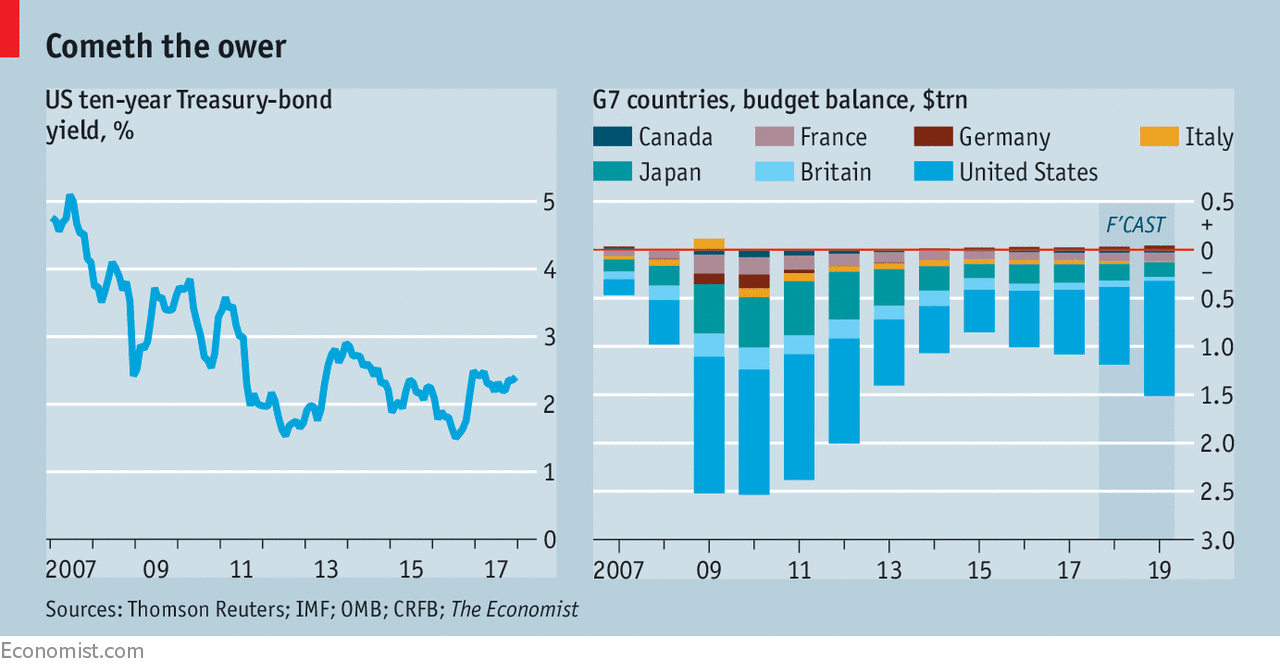
“DEFICITS don’t matter,” said Dick Cheney, then the vice-president, in 2004. He may have meant what he said, yet the administration he belonged to showed a decided lack of conviction when it came to borrowing, with the federal deficit never rising above 3.4% of GDP. Not so the current Republican government. In 2019 and 2020 the deficit is likely to rise to nearly 6% of GDP, the largest, outside of times of economic crisis, since the second world war. In his first term, Donald Trump’s deficits will be nearly as large, on average, as those run by Barack Obama during his presidency, according to analysis by JPMorgan. That is impressive given that Mr Obama faced the worst economic downturn since the Depression. In budgeting, as in so many areas, America is wandering into uncharted territory. What might it find there?
Orthodox economics suggests two ways in which things could go wrong. When an economy is running at close to full tilt, so that firms are borrowing and investing as much as banks are…Continue reading