
Tag: Finance and economics
A rash of bankruptcies hits Chinese lenders backed by state firms

THE Communist Party dominates China’s economy and uses state-run companies, which it controls with an iron fist, to enforce its diktats. Or so the theory goes. Reality is messier: the party often struggles to monitor state-owned enterprises (SOEs), let alone to get them to toe its line. As it convenes its five-yearly congress, one of the financial system’s dodgiest corners has served up a reminder of the limits to its power.
In the past two months at least seven online lenders backed by SOEs have collapsed. It was a business none should have been in, far removed from the industries they were supposed to focus on. The money potentially lost is trivial—roughly 1bn yuan ($150m), compared with government assets worth more than 100trn yuan. Still, these cases highlight how hard it is for the party to stamp its authority on the vast state sector.
The troubled SOEs include distant subsidiaries of the national nuclear company, an aviation company and a big energy…Continue reading
Workers are not switching jobs more often

EVERYBODY knows—or at least thinks he knows—that a millennial with one job must be after a new one. Today’s youngsters are thought to have little loyalty towards their employers and to be prone to “job-hop”. Millennials (ie, those born after about 1982) are indeed more likely to switch jobs than their older colleagues. But that is more a result of how old they are than of the era they were born in. In America at least, average job tenures have barely changed in recent decades.
Data from America’s Bureau of Labour Statistics show workers aged 25 and over now spend a median of 5.1 years with their employers, slightly more than in 1983 (see chart). Job tenure has declined for the lower end of that age group, but only slightly. Men between the ages of 25 and 34 now spend a median of 2.9 years with each employer, down from 3.2 years in 1983.
How should recessions be fought when interest rates are low?

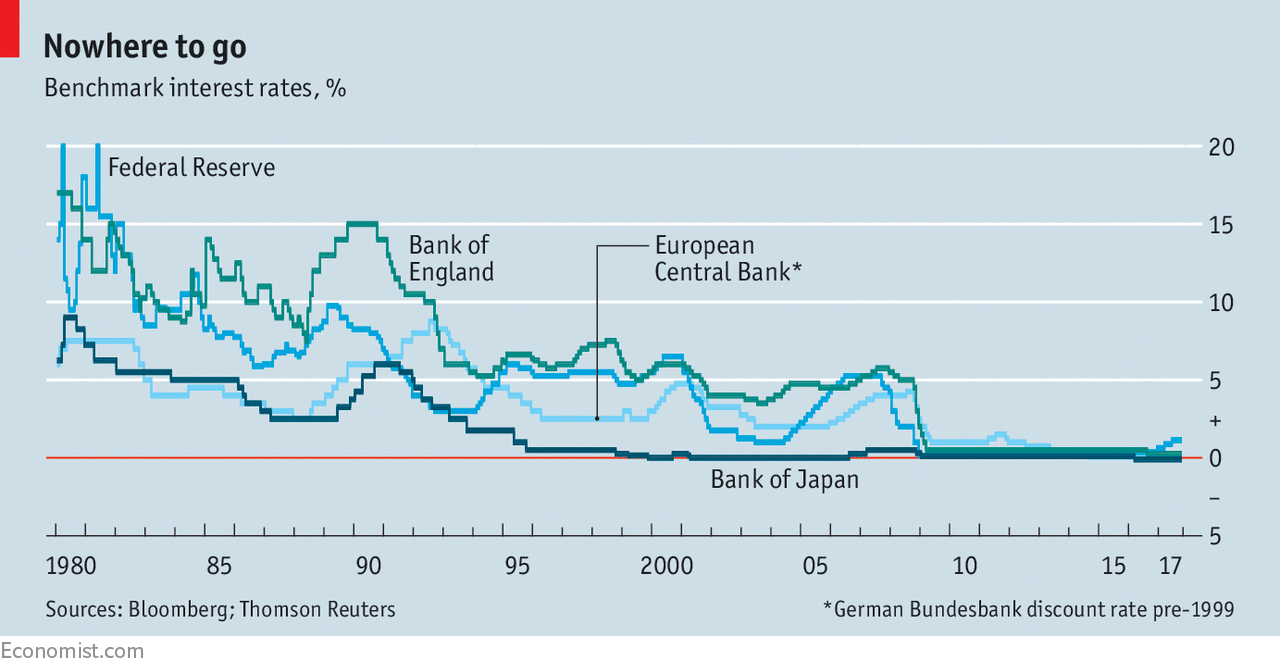
ONE day, perhaps quite soon, it will happen. Some gale of bad news will blow in: an oil-price spike, a market panic or a generalised formless dread. Governments will spot the danger too late. A new recession will begin. Once, the response would have been clear: central banks should swing into action, cutting interest rates to boost borrowing and investment. But during the financial crisis, and after four decades of falling interest rates and inflation, the inevitable occurred (see chart). The rates so deftly wielded by central banks hit zero, leaving policymakers grasping at untested alternatives. Ten years on, despite exhaustive debate, economists cannot agree on how to handle such a world.
Politics ensnares South Africa’s biggest asset manager

THE rot in South African politics, which has eaten away at state companies, is spreading. This week McKinsey, a consultancy, apologised for the “distress” it had caused the South African people. Political mud had already drowned Bell Pottinger, a British public-relations firm, and forced resignations at KPMG, an auditor. So the shenanigans at the government-owned Public Investment Corporation (PIC), have set off alarm bells. One concern is an apparent attempt to oust Dan Matjila, its boss. A linked worry is whether PIC funds will be used to prop up state businesses.
The PIC is a lucrative prize: it is Africa’s largest money manager, controlling 1.9trn rand ($140bn) of assets, mostly the pensions of state employees, and holding 11% of shares in South Africa’s biggest 25 companies. So anonymous allegations against Mr Matjila, including the claim that he had misdirected funds to his girlfriend’s business, naturally provoked a furore. On…Continue reading
Higher taxes can lower inequality without denting economic growth
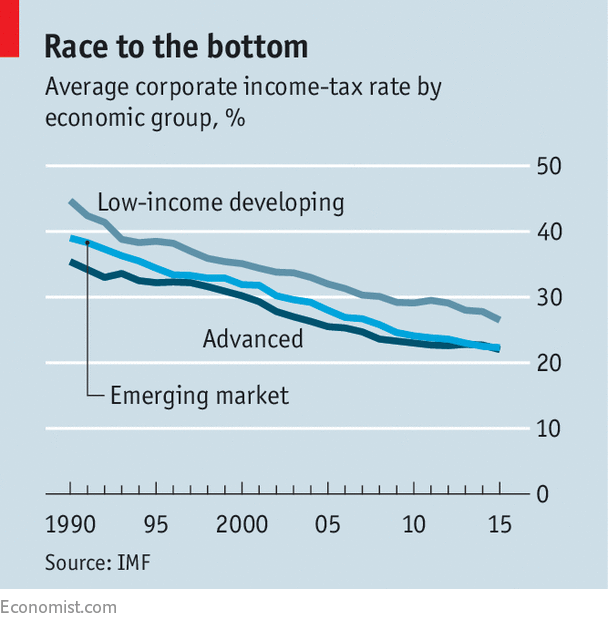
INEQUALITY is one of the big political issues of the 21st century, with many commentators citing it as a significant factor behind the rise of populism. After all, nothing could be more indicative of the triumph of the common man than the elevation of a property billionaire to the American presidency.
A new IMF report* looks at how fiscal policy can help tackle inequality. In advanced economies, taxation already has an impact. The Gini coefficient (a standard measure of income inequality) is around a third lower after taxes and transfers than it is before them. But whereas such policies offset around 60% of the change in market inequality between 1985 and 1995, they have had barely any impact since.
That is because of a change in policy direction. Across the West, taxes on higher incomes have generally fallen. This could be for a number of reasons, the IMF says. The tax take from high earners could have become more “elastic” (ie, sensitive to rate changes); in a mobile…Continue reading
On NAFTA, America, Canada and Mexico are miles apart

THESE are troubling times for Roberto Santana Flores, a Mexican maker of charro shirts, a modern take on the Mexican cowboy aesthetic. He recalls life before the North American Free-Trade Agreement (NAFTA), a trade deal linking Mexico with America and Canada. He remembers his shirts incurred a whopping 37.5% tariff if exported to America. Now they cross the border duty-free. But his dream of expanding his factory and his American customer base is under threat. He scours the newspapers daily for news of the NAFTA negotiations. They tell of conflict. Some even warn the deal may collapse. Since it covers trade worth more than $1trn a year, that is alarming for many more than Mr Flores.
On October 17th trade representatives of the three countries gathered to mark the end of the fourth round of talks. A collapse does not seem imminent. Robert Lighthizer, the United States Trade Representative (pictured, centre), denied that abandoning the deal was even being discussed,…Continue reading
The internationalisation of China’s currency has stalled
ON OCTOBER 18TH, President Xi Jinping will preside in Beijing over the most important political event in five years. At the Communist Party’s 19th congress much will be made of the triumphs achieved in nearly four decades of reform and opening up. So expect a glossing over of one part of that process where progress has largely stalled: the “internationalisation” of China’s currency, the yuan.
This seems odd. Just a year ago, the yuan became the fifth currency in the basket that forms the IMF’s Special Drawing Right (SDR). This marked, in the words of Zhou Xiaochuan, China’s central-bank governor, in a recent interview with Caijing, a financial magazine, “historic progress”. Symbolically, China’s monetary system had been awarded the IMF’s seal of approval. A further boost to prestige was the announcement in June this year that some Chinese shares would be included in two stockmarket benchmarks from MSCI.
Yet the yuan’s…Continue reading
In dirt-poor Myanmar, smartphones are transforming finance
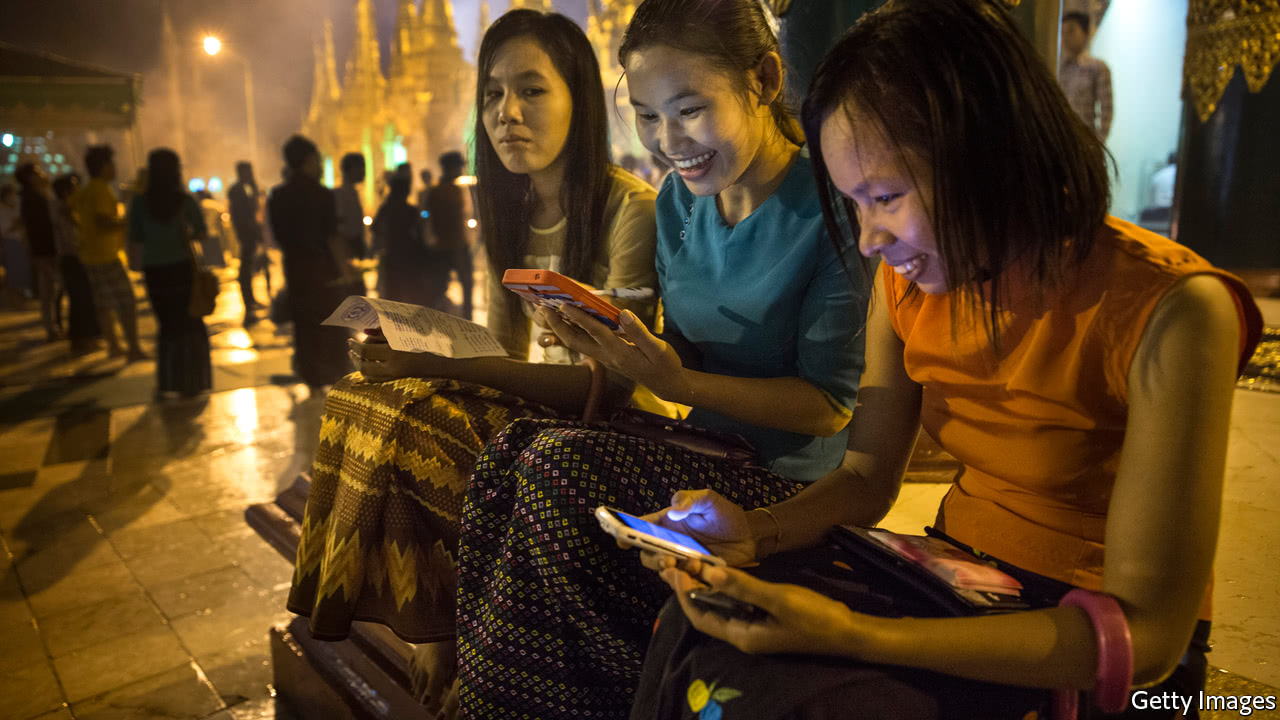
MYANMAR’S democratic transition sometimes seems marked as much by continuity as by change. Depressingly, the army continues its bloody persecution of Rohingya Muslims in the west, for example (see article). But elsewhere moves to open the country’s markets, started by the preceding military regimes, have gathered pace. New commercial and financial services are springing up.
Take Khin Hlaing, who owns Global Mobile Shop, a small store surrounded by tarpaulin-covered stalls selling fresh fruit in Hlaing Tharyar, an industrial area outside Yangon, the biggest city. He is one of almost 12,000 agents for Wave Money, Myanmar’s largest mobile-money transfer platform. Most days about 20 people use his shop to send funds to friends or family elsewhere in the country. One…Continue reading
BBVA, a Spanish bank, reinvents itself as a digital business
OUTSIDE, a patch of grass affording a spectacular view of the Sierra de Guadarrama is littered with cartridge casings. Inside the Club de Tiro de Madrid (Madrid Shooting Club), on the city’s northern edge, over 400 people are fixing their sights for the next three months. Their business is not shooting but banking. Teams sit at 27 tables working on specific projects—to improve the global mobile platform, say, or to share information about job applicants. At another 12 tables are data specialists, in-house lawyers and others whose expertise the teams will need. The targets are on the walls: white boards that are soon covered in yellow and pink Post-it notes, listing tasks for the weeks ahead.
BBVA, Spain’s second-largest bank, began quarterly planning sessions like this three years ago, in its Mexican subsidiary. This is the fourth global gathering. The idea, explains Derek White, head of global customer solutions, is to replicate the nimbleness of financial-technology startups (“fintechs”) at large scale. When a project is conceived, a small group is assembled to work on it within three days. A prototype is created in six weeks. The finished article should be “en las manos de los clientes”—in customers’ hands—within nine months. The quarterly cycle starts with a planning session to thrash out priorities. It ends…Continue reading
The finance industry ten years after the crisis
MANY people complain that the finance industry has barely suffered any adverse consequences from the crisis that it created, which began around ten years ago. But a report from New Financial, a think-tank, shows that is not completely true.
The additional capital that regulators demanded banks should take on to their balance-sheets has had an effect. Between 2006 and 2016, the return on capital of the world’s biggest banks has fallen by a third (by more in Britain and Europe). The balance of power has shifted away from the developed world and towards China, which had four of the largest five banks by assets in 2016; that compares with just one of the biggest 20 in 2006.
The swaggering beasts of the investment-banking industry have also been tamed. The industry’s revenues have dropped by 34% in real terms, with profits falling by 46%. Return on equity has declined by two-thirds. Staff are still lavishly remunerated, but pay is down by 52% in real terms. (Perhaps…Continue reading