
Tag: Finance and economics
The race to become Islamic banking’s fintech hub

FOR all the sophistication of some of its financial centres, and despite the ubiquity of smartphones, the Middle East has been a late adopter of financial technology, or fintech. Of more than $50bn in fintech investment globally since 2010, according to Accenture, a consultancy, only 1% has gone to the Middle East and north Africa.
Khalid Al Rumaihi, head of Bahrain’s Economic Development Board, blames institutional foot-dragging and a lack of infrastructure and venture capital. Yet he insists innovation is inherent to Islamic financial tradition. The modern cheque derives from an Arabic instrument, a written vow to pay for goods on delivery, to avoid carrying money on dangerous journeys. “In the 9th century”, he says, “a Muslim businessman could cash a cheque in China drawn on his bank in Baghdad.”
Several cities are now jockeying to establish themselves as fintech hubs. Last year Cairo launched two “accelerators”—schools to nurture startups. Abu…Continue reading
America’s community banks hope for lighter regulation

A FEW weeks ago Standard Financial, a bank with assets of just $488m and a mere nine branches, merged with Allegheny Valley Bancorp, a slightly smaller neighbour in the suburbs of Pittsburgh. The main reason for the deal, says Tim Zimmerman, Standard’s chief executive, was the rising cost of regulation—though competition from PNC, a $371bn colossus based in the city, also played a part. “Without the regulatory overreach…since the crisis,” Mr Zimmerman says, “we’d probably both have gone along on our own, I think.”
Standard is one of America’s 5,400 community banks: local lenders, funded chiefly by deposits, who pride themselves on knowing their turf by the inch and their customers by name. Their size can range up to $10bn in assets, but most are much smaller: over 5,000 banks and savings institutions have less than $1bn and more than 1,500 under $100m. They account for 92% of federally insured banks. Though they make only 16% of all loans, they provide 43% of…Continue reading
Will President Trump rescue failing pension funds?
TO THE exasperation of budget hawks, Donald Trump has long made clear that he will not reform Social Security (public pensions). But maintaining these entitlements does not fully protect workers’ retirement income. For many, pension promises from their employers are more important. These can shrink or vanish when firms fail. And, like Social Security, the programme that protects retirees against such losses—the Pension Benefit Guaranty Corporation—is going bust.
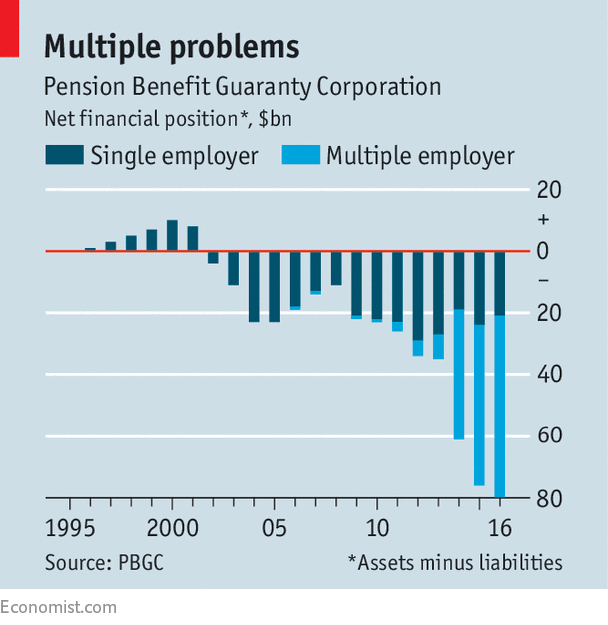
The PBGC levies premiums on defined-benefit pension plans in order to bail out those that fail (up to a maximum payout per worker). On current trends, one of its insurance schemes will probably run dry by 2025. The problem is so-called “multi-employer” funds (see chart). These involve multiple firms, usually under an agreement with an industry-wide union. They cover about 10m Americans, roughly 1m of whom are in a plan that admits it is probably broke. The biggest struggler is the Central States fund, which covers about 400,000…Continue reading
Eastern Bank: a 199-year-old lender becomes a tech pioneer

LIKE other local bankers, Bob Rivers is counting the cost of red tape. At the end of 2015 and 2016 Eastern Bank, a Boston lender of which he is the chief executive, held its balance-sheet below $10bn by briefly parking some deposits elsewhere. Now Eastern—America’s oldest and largest mutual bank, founded in 1818—has crossed the threshold. It will thus become subject to a limit on the debit-card fees retailers pay to bigger banks, and lose $9m of revenue, Mr Rivers says. Other rules will also kick in, costing $6m. The $15m total is one-sixth of Eastern’s pre-tax earnings.
At least, unlike America’s many much smaller lenders, Eastern has the wherewithal to tackle another costly burden: information technology. It is just small enough to be called a “community bank”, but also just big enough to invest in IT. Being a mutual is essential too, Mr Rivers says: he does not have to answer to shareholders about quarterly profits.
In 2014 Eastern set up an…Continue reading
Goldman Sachs is criticised for buying Venezuelan bonds

BONDS are bought and sold every second of every day without attracting attention. But it is not often that the seller is the central bank of a brutal, cash-strapped regime faced with protests; the buyer, a bulge-bracket American investment bank; and the size of the deal in the billions of dollars. A report in the Wall Street Journal on May 28th that Goldman Sachs had bought bonds with a face value of $2.8bn issued by Venezuela’s state-owned oil company, PDVSA, for 31 cents on the dollar (ie, for $865m) caused a stink.
Julio Borges, an opposition politician and president of the National Assembly, lambasted Goldman on May 29th in an open letter to its chief executive, Lloyd Blankfein, for its decision to “aid and abet Venezuela’s dictatorial regime”. For all its sins, that regime has met its obligations to bondholders. Mr Borges vowed to advise future Venezuelan governments not to repay the bonds in question. Protesters gathered outside Goldman’s…Continue reading
Sweden’s economy is thriving, so why is monetary policy so loose?
ON A recent balmy day, people thronged the parks and promenades of central Stockholm. Swedes have much to feel sunny about. Real economic growth, at a heady 3.2% in 2016, has averaged 2.8% annually since 2009, compared with the euro area’s 1.1% per year. In April, Swedish inflation was close to the target of 2% aimed at by the Riksbank, Sweden’s central bank. Yet it decided not only to maintain the main policy rate at -0.50%, where it has been since February 2016, but to increase the amount of asset purchases under quantitative easing (QE) by a further SKr15bn ($1.7bn) during the second half of 2017.
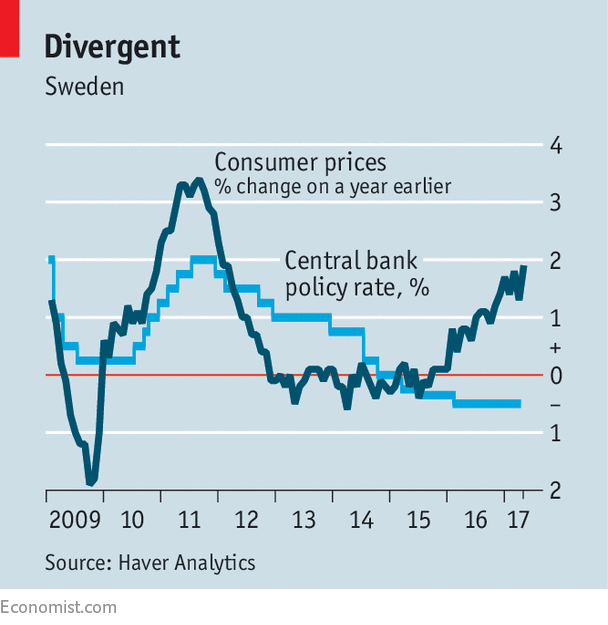
One explanation for keeping policy so loose is that the inflation figure is deceptive. Johan Javeus of SEB, a bank, points out that some of the increase was driven by one-off factors, such as rises in air fares and energy prices. After raising rates prematurely in 2010 and 2011, the Riksbank is loth to do so again.
But also, it is hemmed in by the European Central Bank (ECB). The…Continue reading
Global monetary policy is not tightening as expected
AT ITS outset, 2017 seemed likely to mark a turning-point for global monetary policy. The Federal Reserve had just raised its main interest rate by a quarter-point and was expected to add three such increases this year—or perhaps even more, if a new Republican Congress could agree on tax cuts with a new Republican president. In that case, low interest rates would no longer be the “only game in town” in terms of policy stimulus. The European Central Bank (ECB) would begin to wind down its programme of quantitative easing, or QE, probably by mid-year. The Bank of Japan would cut back on QE, too. In September it set a target yield for ten-year bonds, of 0.0%, which would probably require fewer asset purchases. Of the global giants, only China seemed likely to keep its policy settings as loose as in 2016.
In this context, the ECB’s meeting on June 7th and 8th was not long ago eyed as pivotal. The bank’s staff would produce new, upbeat economic forecasts. Many ECB-watchers (and maybe…Continue reading
Taiwan’s economy has defied the pessimists

TAIWAN’S president, Tsai Ing-wen, has had a tough first year in office. Her popularity has plummeted as she has struggled to find a path through thorny policy debates. Hope that she might have a staunch ally in Donald Trump has receded. China has ratcheted up pressure, leaving Taiwan more isolated internationally. Less noticed is that Ms Tsai has, for now, won over one important group: investors. Cash inflows from abroad have made Taiwan’s stockmarket and currency among Asia’s best performers. Foreign direct investment in the electronics industry has also surged.
The government, to be sure, cannot take too much credit. A revival in global trade is the main reason for Taiwan’s improved fortunes. Exports rose 15% in the first quarter, the fastest rate in six years. The big gains for Taiwan’s stockmarket—up 40% in dollar terms since Ms Tsai’s inauguration—are about the same as those in South Korea, another economy whose growth is…Continue reading
In Donald Trump’s America, the left rethinks its economics

DEMOCRATS thought they knew the boundaries of acceptable economic discourse. Then came Donald Trump, who trashed them, yet won the presidency. He upended Republican positions on trade, and exposed the vulnerability of the Democratic Party on its home economic turf: the well-being of American workers. He also seems to have liberated the left to think big ideas—and confront hard questions.
Since 1992 Democratic economic policy has been rooted in technocratic centrism, meant to smooth the rough edges of the market. “We reject both the do-nothing government of the last 12 years and the big-government theory that says we can hamstring business and tax and spend our way to prosperity,” read the party platform in 1992. “Instead we offer a third way.” This was a desperate effort to escape the political wilderness. Yet it also reflected intellectual trends in economics. Inflation and falling productivity in the 1970s seemed to bear out the views of economists such as Milton Friedman, that…Continue reading
Machine-learning promises to shake up large swathes of finance
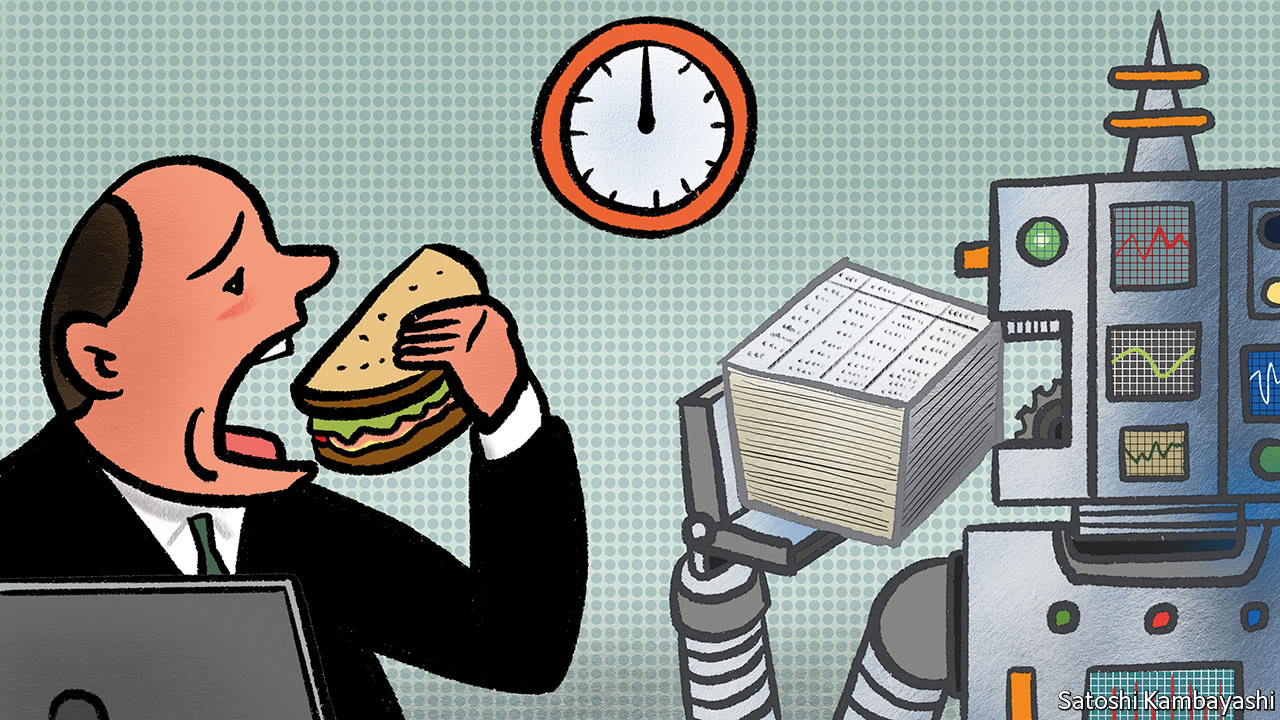
MACHINE-LEARNING is beginning to shake up finance. A subset of artificial intelligence (AI) that excels at finding patterns and making predictions, it used to be the preserve of technology firms. The financial industry has jumped on the bandwagon. To cite just a few examples, “heads of machine-learning” can be found at PwC, a consultancy and auditing firm, at JP Morgan Chase, a large bank, and at Man GLG, a hedge-fund manager. From 2019, anyone seeking to become a “chartered financial analyst”, a sought-after distinction in the industry, will need AI expertise to pass his exams.
Despite the scepticism of many, including, surprisingly, some “quant” hedge funds that specialise in algorithm-based trading, machine-learning is poised to have a big impact. Innovative fintech firms and a few nimble incumbents have started applying the technique to everything from fraud protection to finding new trading strategies—promising to up-end not just the humdrum drudgery of the back-office,…Continue reading