
Tag: FINANCE
A surge in the value of crypto-currencies provokes alarm
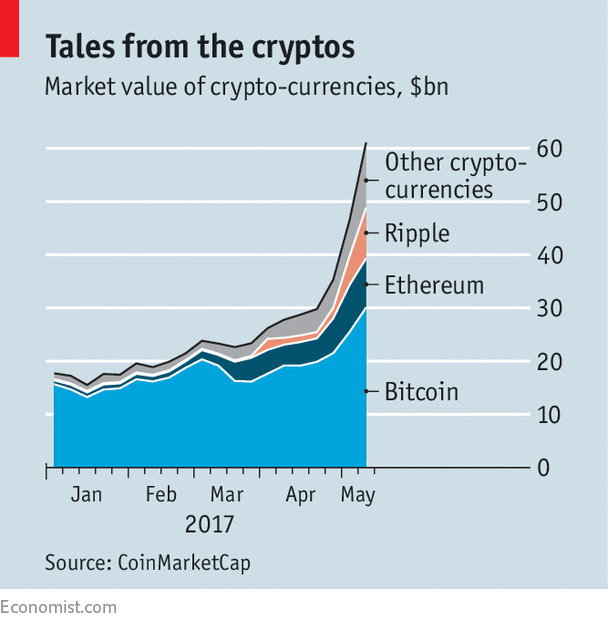
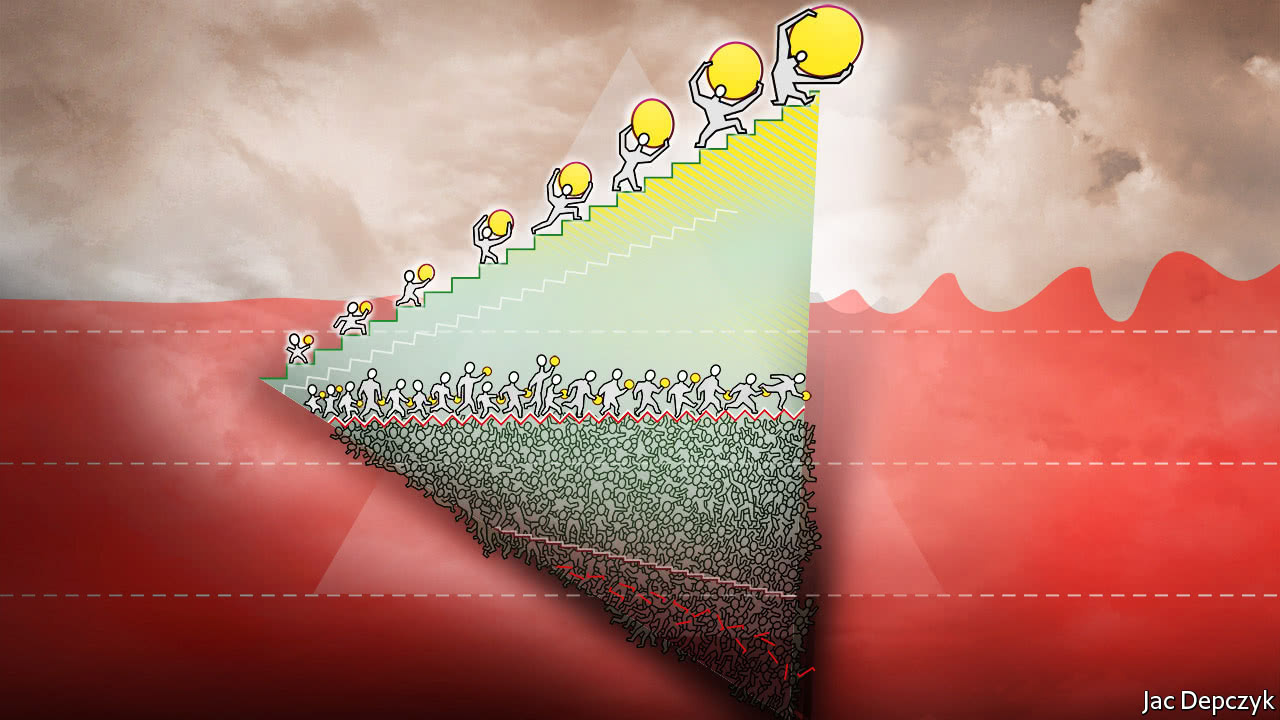
IT IS hard to predict when bubbles will pop, in particular when they are nested within each other. It helps to keep this image in mind when considering one of the biggest surges in asset values of recent years: the market value of all the world’s crypto-currencies has trebled since the beginning of the year, and is now worth more than $60bn (see chart).
Bitcoin is the best known of these currencies, especially after hackers this month instructed victims to pay ransoms in the anonymous digital cash in order to get their computer files decrypted. Not that many bitcoins exist: there are about 16.3m of them, with only 1,800 new ones minted every day. But growing demand has pushed bitcoin’s price to a record recent high of about $1,830, up from $450 a year ago.
Problems abide. Earlier this year some of the biggest exchanges, such as Bitfinex, experienced problems with their correspondent banks and were unable to pay out real-world currencies to account-holders. To get their money…Continue reading
Numismatics—acquiring old coins—outperforms other investments
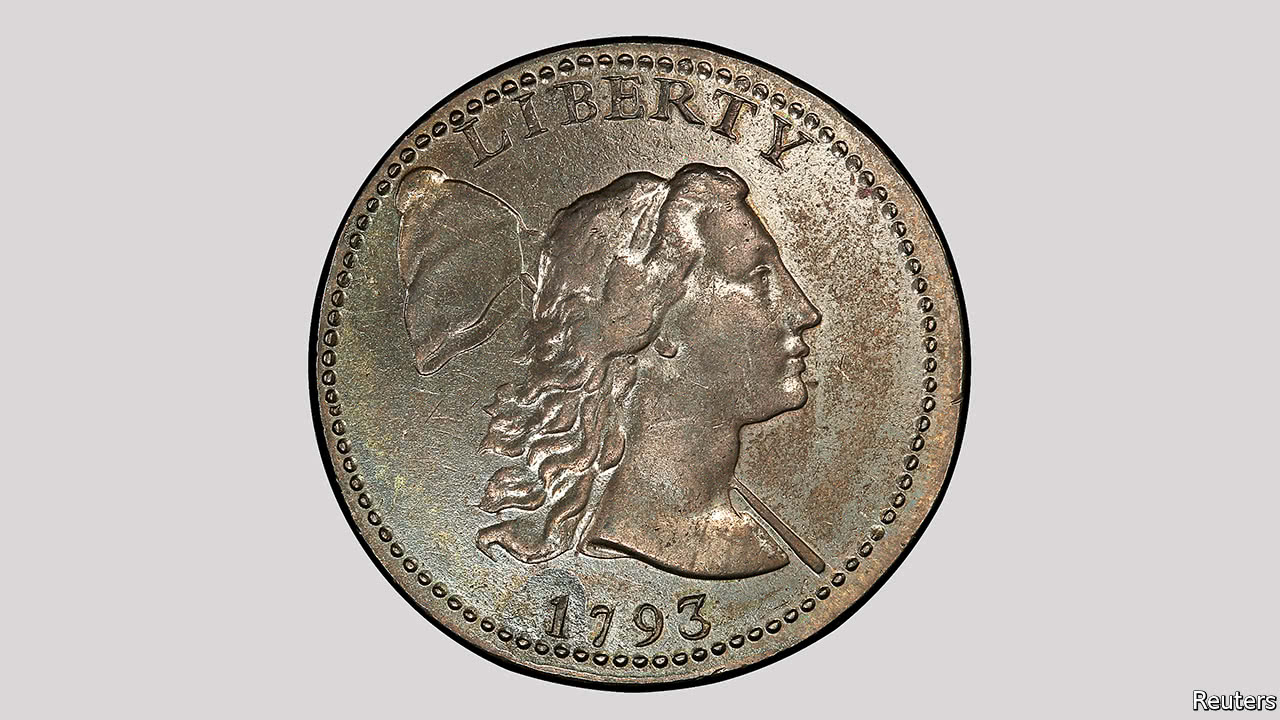
BEHIND the heavily fortified door of Stack’s Bowers, a gallery of rare coins in New York, smiling salesmen show off their precious wares neatly displayed in pristine glass cabinets. To the untutored eye, it looks like pocket change. Numismatists, who study the history and art of old money, see well-preserved coins as aesthetic masterpieces worth many times their face value. At an auction organised by Stack’s Bowers on March 31st, an American cent from 1793 (pictured) sold for $940,000, becoming the costliest penny ever.
An index of tangible alternative asset classes compiled by Knight Frank, a consultancy, shows that returns on rare coins over ten years to the end of 2016 were 195%, easily beating art (139%), stamps (133%), furniture (-31%) and the S&P 500 index (58%). Coins are more portable than paintings or furniture, and boast a higher value-to-volume ratio. Stamps may be lighter, but, come doomsday, cannot be melted…Continue reading
America’s trade policy has a new face, Robert Lighthizer
AS IS well known, Donald Trump wants the press to focus not on what he calls “fake” news about himself, but on his administration’s achievements. On May 12th he helpfully tweeted an example: “China just agreed that the US will be allowed to sell beef, and other major products, into China once again. This is REAL news!”
His first trade deal was real, if short of the “Herculean accomplishment” touted by his commerce secretary, Wilbur Ross. It promised American credit-rating agencies, payment companies and beef exporters new access to the Chinese market, and set a deadline for progress, of July 16th.
Parts of the deal lack detail, so it may yet disappoint. China has been offering since 2006 to open its market to American beef, but with hefty restrictions. The World Trade Organisation (WTO) had already ruled that China’s restrictions on foreign payment-card companies broke its rules. And the Chinese incumbent is so entrenched that American cards may still struggle to compete.
Maybe Mr Trump picked the wrong “real” news. More important for his trade agenda was the Senate’s confirmation on May 11th of Robert Lighthizer as the new United States Trade Representative (USTR). He will matter much more for economic relations with China than a hasty mini-deal. And now that he is in place, renegotiation of the North American Free-Trade…Continue reading
The markets are quiet. Too quiet?

HAN SOLO, a hero from the Star Wars movies, has a habit of saying, at tense moments, “I have a bad feeling about this.” Many commentators are echoing this sentiment after a recent fall in the Volatility Index, or Vix, below ten. Their fears deepened on May 17th, when the Vix lurched above 15 and American stockmarkets had their worst day in eight months. Incessant turmoil in the White House at last seemed to take its toll.
A low Vix reading is usually seen as a sign of investor complacency. The previous two occasions on which the index fell below ten were in 1993 and early 2007 (see chart). One preceded the bond market sell-off of 1994 and the other occurred just before the first stages of the credit crisis.
The value of the Vix relates to the cost of insuring against asset-price movements via the options market. An option gives the purchaser the right, but not the obligation, to buy (a call) or sell (a put) an asset at a given price before a given date. In return, like…Continue reading
The British government sells its last shares in Lloyds bank

IN OCTOBER 2008, amid post-Lehman pandemonium, Britain’s Treasury said it would pump £37bn (then $64.4bn) into three big banks: £20bn into the stricken Royal Bank of Scotland (RBS); the rest into Lloyds TSB and HBOS, a sickly rival that ministers had cajoled Lloyds into buying. After rights issues in 2009, in all the state paid £20.3bn for 43.4% of the merged Lloyds Banking Group. On May 17th Lloyds said the last state shares had been sold.
The government has recouped £21.2bn, including £400m-plus in dividends, since it started to unload its stake in 2013. The return may sound slim, but had big lenders imploded the costs of the financial crisis would surely have been far greater even than they were. (Not surprisingly, anyone holding Lloyds TSB or HBOS shares since before the crisis has made a heavy loss.)
The group is Britain’s biggest retail bank. Its brands—Lloyds Bank, with its “black horse” logo, Halifax and Bank of Scotland—boast around…Continue reading
The markets frustrate OPEC’s efforts to push up oil prices
BORROWING three words from Mario Draghi, the central banker who helped save the euro zone, Khalid al-Falih, Saudi Arabia’s energy minister, and his Russian counterpart, Alexander Novak, on May 15th promised to do “whatever it takes” to curb the glut in the global oil markets. Ahead of a May 25th meeting of OPEC, the oil producers’ cartel, they promised to extend cuts agreed last year by nine months, to March 2018, pushing oil prices up sharply, to around $50 a barrel. But to make the rally last, a more apt three-word phrase might be: “know thy enemy”.
In two and a half years of flip-flopping over how to deal with tumbling oil prices, OPEC has been consistent in one respect. It has underestimated the ability of shale-oil producers in America—its nemesis in the sheikhs-versus-shale battle—to use more efficient financial techniques to weather the storm of lower prices. A lifeline for American producers has been their ability to use capital markets to raise money, and to use…Continue reading
A new anthology of essays reconsiders Thomas Piketty’s “Capital”
“A MODERN Marx” was how The Economist described Thomas Piketty three years ago, when he was well on his way to selling more than 2m copies of “Capital in the Twenty-First Century”. It was meant as a compliment, mostly: as advice to take the analysis seriously, yet to treat the policy recommendations with caution. The book’s striking warning, of the creeping dominance of the very wealthy, looks as relevant as ever: as Donald Trump’s heirs mind his business empire, he works to repeal inheritance tax. But “Capital” changed the agenda of academic economics far less than it seemed it might. A new volume of essays reflecting on Mr Piketty’s book, published this month, prods economists to do better. It is not clear they can.
“After Piketty: The Agenda for Economics and Inequality”, edited by Heather Boushey, Bradford DeLong and Marshall Steinbaum, is a book by economists, for economists. In that it resembles “Capital” itself. Before he was an…Continue reading
2017 Marjorie Deane internship
Internship The Economist invites applications for the 2017 Marjorie Deane internship. Paid for by the Marjorie Deane Financial Journalism Foundation, the award is designed to provide work experience for a promising journalist or would-be journalist, who will spend three months at The Economist writing about economics and finance. Applicants are asked to write a covering letter and an original article of no more than 500 words suitable for publication in the Finance and economics section. Applications should be sent to deaneintern@economist.com by June 2nd. For more information, please visit www.marjoriedeane.com.
The EU ponders moving euro clearing from London after Brexit
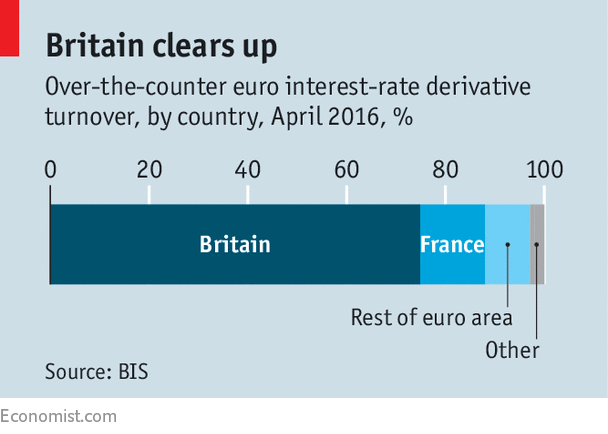
BREXIT has thrust a mundane, if crucial, bit of financial-market plumbing into the spotlight: the clearing of financial instruments. Clearing-houses sit in the middle of a securities or derivatives transaction, and ensure that deals are honoured even if one counterparty goes bust. In November a study commissioned by the London Stock Exchange (LSE) warned that if euro clearing was forced out of the City, 83,000 British jobs could be lost, and a further 232,000 affected. On May 4th the European Commission said it was looking into new rules for euro-denominated clearing. One option is relocation from London, an idea greeted in the City with a mixture of incredulity, disdain and fear.
In the wake of the financial crisis, the G20 group of big economies made it mandatory to settle most simple derivatives trades through clearing-houses. By 2016, 62% of the notional $544trn global over-the-counter derivatives market was settled in this way. Globally, London handles 37% of foreign-exchange derivatives…Continue reading
Africa’s informal economy is receding faster than Latin America’s
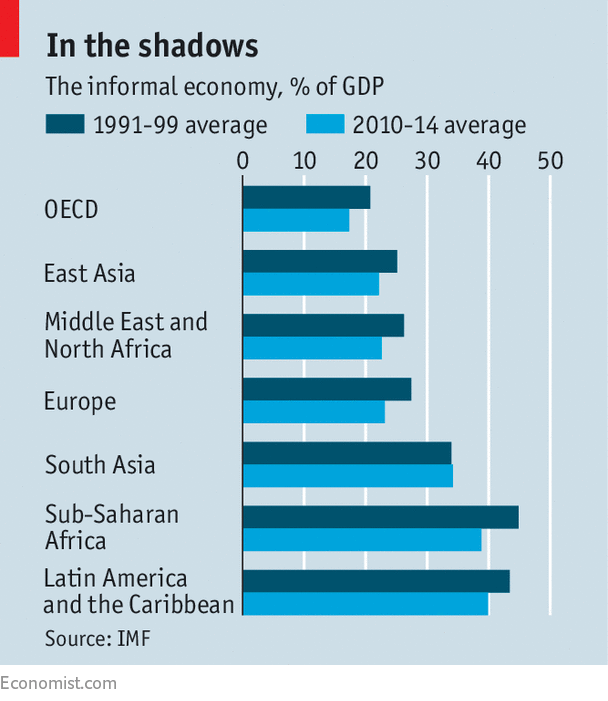
COMMON to all men, according to Adam Smith, is “the propensity to truck, barter and exchange”. Less common is a willingness to report all of this enterprise to the authorities (which have a propensity to register, regulate and tax). South Africa’s spaza shops (convenience stores often run from people’s homes), Kenya’s jua kali (a Swahili term referring to the “hot sun” under which craftsmen traditionally made and sold their wares) or Senegal’s tight-knit networks of Mouride street peddlers—all contribute to the informal economy. This shadow economy, which includes unregistered enterprises and off-the-books activity by registered firms, is difficult to measure, almost by definition. But this week the IMF released new estimates of its size.
The fund’s economists inferred the size of the informal economy indirectly, based on more visible indicators that either cause informality (heavy taxes, high unemployment and patchy rule of…Continue reading