
Tag: FINANCE
The progressive case for immigration

“WE CAN’T restore our civilisation with somebody else’s babies.” Steve King, a Republican congressman from Iowa, could hardly have been clearer in his meaning in a tweet this week supporting Geert Wilders, a Dutch politician with anti-immigrant views. Across the rich world, those of a similar mind have been emboldened by a nativist turn in politics. Some do push back: plenty of Americans rallied against Donald Trump’s plans to block refugees and migrants. Yet few rich-world politicians are willing to make the case for immigration that it deserves: it is a good thing and there should be much more of it.
Defenders of immigration often fight on nativist turf, citing data to respond to claims about migrants’ damaging effects on wages or public services. Those data are indeed on migrants’ side. Though some research suggests that native workers with skill levels similar to those of arriving migrants take a hit to their wages because of increased migration, most analyses find that they are not harmed, and that many eventually earn more as competition nudges them to specialise in more demanding occupations. But as a slogan, “The data…Continue reading
Foreign buyers push up global house prices

MANY Americans were taken aback when news broke in January that Peter Thiel, an internet billionaire and adviser to Donald Trump, had New Zealand citizenship. For five years this backer of an “America first” president had kept his Kiwi passport quiet. Then the government released details of his $10m-lakeside estate (pictured).
A growing horde of rich foreigners see New Zealand as a safe haven. In 2016 overseas investors bought just 3% of all properties. But their purchases were concentrated at the expensive end of the market, which is growing fast: sales involving homes worth more than NZ$1m ($690,000) increased by 21%. That helped push prices in the country up by 13% over the past year, to lead The Economist’s latest tally of global house-price inflation (see table).
New Zealand is one of several countries where the impact of foreign money on housing is under scrutiny. Prices have also risen rapidly in Australia and Canada. Central bankers fret about the dangers fickle capital flows pose to financial stability. London’s mayor has ordered a study on foreign ownership in the capital after property prices…Continue reading
The retreat of globalisation threatens the Dutch economy

AS ANY football fan knows, little delights the Dutch more than beating the Germans. So, as the country prepares for an election on March 15th, it should be cheering an economy that, after lagging behind Germany’s for years, is at last outpacing it. GDP grew by 2.1% last year, which was the fastest rate since 2007 and a stronger performance than its neighbours, including Germany. Unemployment has fallen to 5.3% and more people are in work than before the crisis in 2007-08.
After years of belt-tightening, households are spending again, thanks to a strong housing-market recovery and rising wages. Government finances are sound. This year the budget may be in balance—perhaps even in surplus—and public debt may drop below 60% of GDP. Yet this sunny outlook has not brightened the mood of a tetchy election campaign.
That is not so surprising. Marieke Blom, the chief economist at ING, a bank, attributes the positive forecast mostly to tough government reforms over the past few years—particularly raising the retirement age to 67 (from 2021) and reforming the financing of the health-care system. Years of reform, austerity and…Continue reading
Green finance for dirty ships
 Smokestack lightening
SHIPPING may seem like a clean form of transport. Carrying more than 90% of the world’s trade, ocean-going vessels produce just 3% of its greenhouse-gas emissions. But the industry is dirtier than that makes it sound. By burning heavy fuel oil, just 15 of the biggest ships emit more oxides of nitrogen and sulphur—gases much worse for global warming than carbon dioxide—than all the world’s cars put together. So it is no surprise that shipowners are being forced to clean up their act. But in an industry awash in overcapacity and debt, few have access to the finance they need to improve their vessels. Innovative thinking is trying to change that.
A new report from the Carbon War Room (CWR), an international NGO, and UMAS, a consultancy, highlights the threat that new environmental regulations pose to the industry. The International Maritime Organisation, the UN’s regulatory agency for shipping, has agreed to cap emissions of sulphur from 2020. Last month the European Parliament voted to include shipping in the EU’s emissions-trading scheme from 2021. Without any retrofitting of ships to meet the…Continue reading
Economists argue about the impact of Chinese imports on America
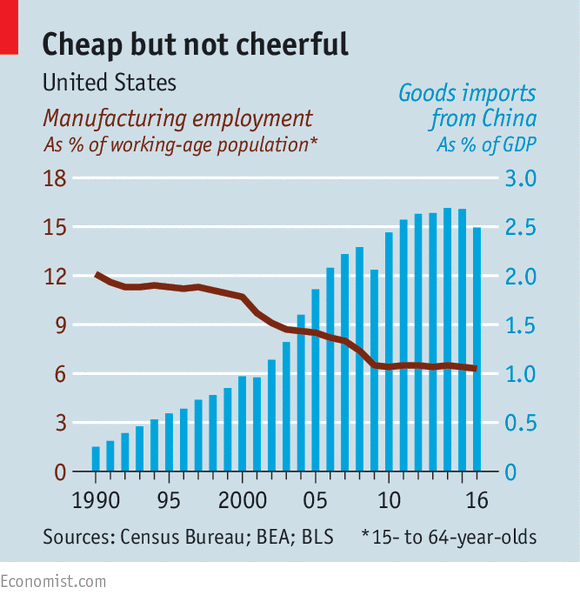
COMPETITION from Chinese imports may have cost some Americans jobs, but economists have done pretty well out of it. Since 2013 David Autor, David Dorn and Gordon Hanson have published nine separate studies digging into the costs of trade. They have found that, of the fall in manufacturing jobs between 1990 and 2007, one-quarter could be attributed to a surge in imports from China. Other sectors failed to soak up the extra workers. Their research also suggested that the China shock has cut the supply of marriageable men and opened the door of the White House to Donald Trump.
In recent weeks a dispute has erupted over their results. Jonathan Rothwell, an economist at Gallup, a pollster, alleged “serious flaws” in one paper, prompting a fierce eight-page response from the authors, and an acrimonious public tiff.
The row centres on how the effect of the China shock is measured. The trio wanted to isolate the effects of extra Chinese supply, rather than of something happening in America, so they checked that imports of particular Chinese products were surging in other rich countries, too. They then compared places in America…Continue reading
Deutsche Bank raises capital, and changes course
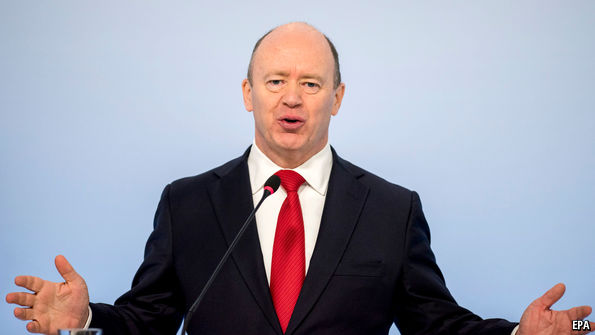
THREE times since the financial crisis, Deutsche Bank’s bosses have turned to its shareholders for cash: €10.2bn ($13.6bn) in 2010, €3bn in 2013 and €8.5bn in 2014. Since becoming chief executive in 2015, John Cryan has had no plans to ask for more. Deutsche still needed to thicken its equity cushion, but disposals, cost cuts and earnings (if any: it has made losses for the past two years) would provide the stuffing.
Well, plans change. On March 5th Mr Cryan announced an €8bn rights issue. Some comfort for investors: the price, €11.65 a share, is 39% below the previous close; and Mr Cryan, who had suspended the dividend, promises a return to “competitive” payouts next year. In another reversal, Deutsche will keep rather than sell Postbank, a mass-market retail business that was once part of the post office. Deutsche has owned it since 2010.
Postbank and the posher “blue” Deutsche Bank brand will be more closely integrated—notably, sharing computer systems. Mr Cryan is also selling a slice of Deutsche’s asset-management division and some lesser assets. And he is reorganising its corporate and investment bank to…Continue reading
The subdued mood in Singapore’s financial industry

SINGAPORE owes its existence, and its prosperity, to its place at the heart of intra-Asian trade. In more than 50 years of independence, the city-state has striven mightily to attract investment from all over the world. Such has been its success, indeed, that others hope to imitate its open, low-tax model. In Britain, for example, there has been talk of the country turning into a “European Singapore” once withdrawal from the EU is complete. (It would be a nice start if London’s Tube operated with anything like the same efficiency as Singapore’s subway network.)
The current mood in Singapore, however, is far less buoyant than you might imagine. Singapore has survived and thrived by steering a middle course between America and China. It has been alarmed both by the isolationist rhetoric of President Donald Trump and by recent, highly unusual, public spats with China.
Global trade growth has slowed in recent years. Despite signs of a pickup, this has had a big effect in a city that has the world’s second-busiest port and that (according to Barclays, a bank) is the country most exposed to the global value chains created by multinational…Continue reading
A big merger in the asset-management industry
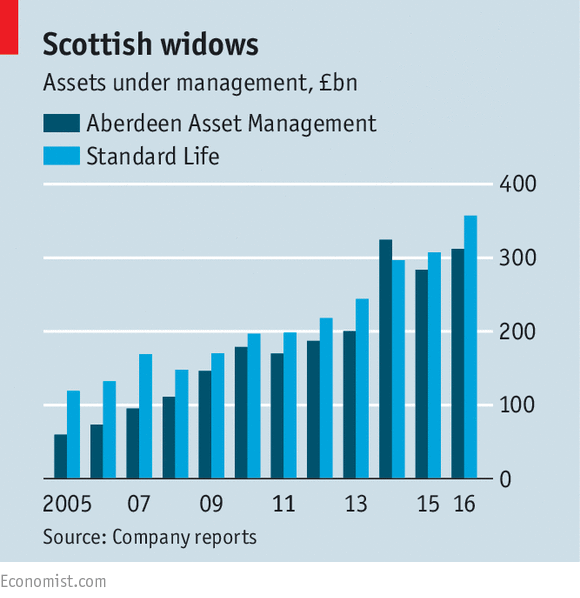
From fishing buddies to co-CEOs: that is how the relationship between Martin Gilbert, chief executive of Aberdeen Asset Management, and Keith Skeoch, his counterpart at Standard Life, will change after the companies this week announced plans to join forces. The merged company, to be based in Scotland, will have £660bn ($800bn) in assets under administration, making it Britain’s largest, and Europe’s second-largest, “active” asset manager.
Competition is forcing asset managers to consolidate. Henderson and Janus Capital teamed up last October; Amundi and Pioneer did the same in December. They hope to defend market share from fast-growing “passive” fund managers, whose funds track market indices rather than try to beat them, as active funds do. The research involved in trying to pick winners inevitably makes actively managed funds dearer than passive ones; once these costs are factored in, active managers tend to underperform passive ones. The fee gap is wide enough to have attracted scrutiny from British and European regulators: in Britain passive funds’ fees are around 0.15% of assets under management, compared with 0.9%…Continue reading
A New York startup shakes up the insurance business
 When insurance quickened the pulse
IT IS not typhoons or earthquakes that insurers should fear most, but geeks alert to their businesses’ inefficiencies. Daniel Schreiber and Shai Wininger, tech entrepreneurs with no insurance background, spotted that the industry is huge (worth $4.6trn in global premium income a year, reckons Swiss Re, a reinsurer), distrusted, antiquated and hopelessly unreformed.
In September they started Lemonade, a New York-based insurer for homeowners and renters. Some describe it as a peer-to-peer insurer (“Spiritually we’re a tech company,” says Mr Schreiber). Most agree that its app makes insurance a lot easier. This appeals to the digital generation: of 2,000 policies sold in its first 100 days, over 80% were to first-time buyers.
Insurance, the founders reasoned, suffers from misaligned incentives. Every dollar paid out comes from insurers’ pockets, encouraging poor behaviour. Normally upright people have few qualms about defrauding their insurer (as 25% of Americans do), pushing up premiums. Lemonade’s solution is to take 20% of premiums as a fee and to reward under-claiming…Continue reading
The coming revolution in insurance

IN THE stormy and ever-changing world of global finance, insurance has remained a relatively placid backwater. With the notable exception of AIG, an American insurer bailed out by the taxpayer in 2008, the industry rode out the financial crisis largely unscathed. Now, however, insurers face unprecedented competitive pressure owing to technological change. This pressure is demanding not just adaptation, but transformation.
The essential product of insurance—protection, usually in the form of money, when things go wrong—has few obvious substitutes. Insurers have built huge customer bases as a result. Investment revenue has provided a reliable boost to profits. This easy life led to a complacent refusal to modernise. The industry is still astonishingly reliant on human labour. Underwriters look at data but plenty still rely on human judgment to evaluate risks and set premiums. Claims are often reviewed manually.
The march of automation and technology is an opportunity for new entrants. Although starting a new soup-to-nuts insurer from scratch is rare (see