
Tag: FINANCE
Retailers and issuers are still battling over payment –card fees
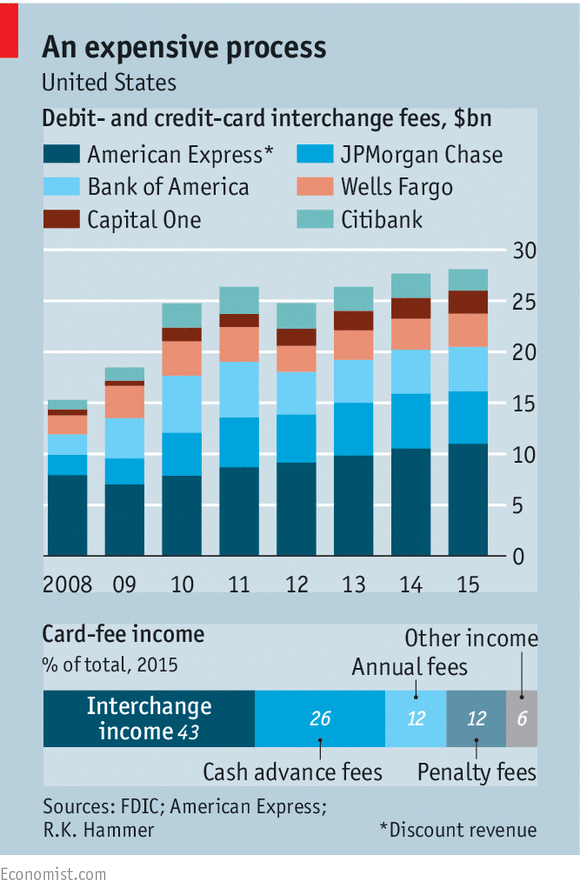
IN 1966 a medical journal identified a condition it dubbed “credit-carditis”: lower-back ache, with pain radiating down the leg—caused by a back-pocket wallet stuffed with plastic. Payment cards still inflict pain of a different sort. American merchants paid more than $40 billion to process debit- and credit-card transactions in 2015. Despite a reform by the Federal Reserve in 2011 aimed at reducing these costs, revenue from these so-called “interchange fees” has more than doubled since the financial crisis. Retailers are still in revolt; banks are still resisting. That is not surprising, since they rely on the fees for a large and growing share of their income.
American consumers favour debit and credit cards over cash by more than two to one. But this convenience comes at a cost. The seller is charged a fee for every card purchase: in America, typically 0.5% to 3% of its value. These fees are set by payment-card networks, such as Visa and MasterCard and collected by card issuers, such as Wells Fargo and JPMorgan Chase. Some portion of these fees is borne by consumers, including those who pay by cash, in the form of higher…Continue reading
Adventure tourism

VISITORS to Lisbon, Portugal’s hilly capital, usually seek its nightlife, its sweet custard tarts (pasteis de nata) or its gothic architecture. But no guidebook could help two visitors on October 10th. The pair of analysts, from Dominion Bond Rating Service (DBRS), a Canadian credit-ratings agency, went to assess the creditworthiness of the Portuguese government.
Markets are waiting anxiously for October 21st, when DBRS will update its rating of Portuguese sovereign debt. Hints from DBRS have been playing havoc with the ten-year bond yield: in August a gloomy comment from Fergus McCormick, DBRS’s chief economist, saw it climb 14 basis points (hundredths of a percentage point). This week, word that DBRS was “totally comfortable” with the government’s fiscal position saw it dip by ten basis points.
This unusual attention to a little-known ratings agency is due to the eligibility rules for the European Central Bank’s (ECB) quantitative-easing scheme. The ECB will buy only sovereign debt that is rated as investment grade by at least one of four approved ratings agencies: Fitch, Moody’s,…Continue reading
When a bubble is not a bubble

ESTATE agents in China, as elsewhere in the world, are normally a smooth-talking, self-assured bunch. But Liu Zhendong, a salesman at a large development in the northern reaches of Shanghai, is afflicted by doubts. He had expected business to be solid and steady this year. Instead, it has been manic, with clients jostling to see show apartments. Some had hoped to wait for the market to cool, but capitulated and bought as prices climbed higher week after week. Flats in the area, the once-rural village of Malu, still dotted with fields and scruffy wholesale food markets, now cost 90% more than a year ago. “It feels a bit like a bubble,” he says.
Mr Liu is in good company. Even the head of the central bank’s research bureau, usually cautious in his choice of language, has said a property bubble must be stopped before it gets too big. House prices have climbed by 16% nationwide over the past year, and double or even triple that in big cities. So in the past two weeks more than 20 municipalities have tried to calm the market down—for example, by requiring higher down-payments or limiting purchases by residents of other cities.
As the past…Continue reading
Why sterling suffered a “flash crash”

IF A country’s exchange rate represents international investors’ confidence in its government’s policies, the markets have given Britain the thumbs-down. So far this year, only the Nigerian naira among major currencies has put in a worse performance.
The decline seems to be accelerating. On October 7th the pound fell from $1.26 to $1.18 against the dollar within a few minutes, with one trade reported below $1.14. The shift occurred during Asian trading, when liquidity in sterling is likely to be thinnest. The most likely explanation for the plunge lies in the action of algorithmic trades—computer programs that automatically buy and sell assets, from currencies to commodities. Such programs may be designed to sell when an asset’s price falls below a certain level. These sales can be contagious, with one program’s trades setting off the sell signals of other algorithms.
The most famous “flash crash” occurred on Wall Street in May 2010, when the Dow Jones Industrial Average fell by almost 1,000 points in the middle of a trading day. On that occasion, the market righted itself before drifting lower in subsequent…Continue reading
Hard bargains

ECONOMICS can seem a rather bloodless science. In its simplest models, prices elegantly balance supply and demand, magically directing individuals’ pursuit of their own self-interest towards the greater good. In the real world, humans often undermine the greater good by grabbing whatever goodies their position allows them. The best economic theorising grapples with this reality, and brings us closer to understanding the role of power relationships in human interactions. This year’s Nobel prize for economic sciences—awarded to Oliver Hart and Bengt Holmström—celebrates their study of economic power, and the tricky business of harnessing it to useful economic ends.
Behind the dull-sounding “contract theory” for which the two were recognised lies an important truth: that when people want to work together, individual self-interest must be kept under control. For a chef and a restaurant-owner to work together productively, for example, the owner must promise not to use the power he has to change the locks in order to deny the chef his share of future profit. Mr Hart, a British economist working at Harvard University, tackled power dynamics while…Continue reading
Hide and seek

IT WAS one of the most spectacular robberies of modern times. In February thieves tried to steal nearly $1 billion from accounts held by Bangladesh Bank, the central bank, at the Federal Reserve Bank of New York. They were thwarted, but only after spiriting away $101m. Since then Bangladesh’s government has twice suppressed the publication of a report into the heist, most recently last month, on the ground that making it public would jeopardise efforts to retrieve from the Philippines $81m that is still missing. Interviews with officials and others in Dhaka lead to an obvious conclusion: the report will almost certainly never be made public.
The investigating panel’s remit was to establish why the central bank kept the theft secret for a month, whether bank officials were involved in it and how to avert a similar heist in future. Mohammed Farashuddin, a former central-bank governor, who led the probe and once advocated its publication, will not comment on its findings. The word in Dhaka is that the report is being buried because it exposed lapses at the central bank and implicated its officials or consultants. The government has consistently…Continue reading
Capital punishment

AMONG the proud titans humiliated in the financial crisis of 2007-08 was GE, forced to take a government bail-out in 2008. In response it swiftly slimmed down its lending arm, GE Capital. But the regulators were still not happy. In 2013 they labelled it a “systemically important financial institution” (SIFI), ie, one big enough to pose a global risk. That imposed costly regulatory burdens and encouraged GE’s boss, Jeffrey Immelt, to announce in April 2015 that he would wind down most of GE’s finance division within three years.
In a remarkable corporate transformation, he is ahead of schedule. The disposal to Wells Fargo this week of GE’s global inventory-financing business means that GE has sold $193 billion of “ending net investment”, or ENI (an adjusted asset figure), in the past 18 months, covering more than 25 lending units.
It has taken almost a decade. But GE is, almost, an ex-bank. As Mr Immelt promised last year, it is also much simpler. It shed its SIFI status in June. Lending, in ENI terms, is down by 85% from its peak in 2008 (see chart) and now focuses on its core industrial businesses. Its reliance…Continue reading
From base to gold

WHEN Marco Polo travelled to China in the 13th century, he found that among its wonders was “the secret of the alchemists”. Its imperial court could turn mulberry bark into money. It simply printed paper notes, decreed that people must accept them and killed counterfeiters. For a Venetian used to gold coins, the world’s first fiat currency was a marvel. Its value derived not from precious metal but from the credibility of the regime issuing it. This month China achieved another kind of monetary alchemy: to fashion a global reserve currency out of one that, by a range of criteria, does not yet merit such status.
On October 1st the yuan became the fifth entrant in the basket of currencies that forms the Special Drawing Right, a reserve asset created by the IMF. Immediate implications are limited. SDRs are a unit of account, not a real currency; inclusion in the basket does not force anyone to acquire the yuan. Symbolically, though, it is a big deal: the IMF’s seal of approval for China’s monetary system. It has deemed it safe for central banks around the world to add the yuan to their reserves. Dozens of central banks in fact already do so,…Continue reading
The green light
 Vestine sees the light
WHEN Vestine Mukeshimana bought electric lights last month from BBOXX, an off-grid solar company, it helped her spot snakes in her garden and stopped thieves making off with her cow. In her Rwandan village she and her neighbours now cook after dark and their children study in the evenings. They have never heard of the Green Climate Fund (GCF), a UN initiative to bring climate finance to developing countries. But last month such household solar schemes became its first disbursed investment.
Understaffed and buffeted by politics, the GCF is struggling to define itself. It started operations last year after coaxing $10.3 billion from governments. Raising money was hard; spending it is proving even harder. Its board meets on October 12th in Songdo, South Korea, to weigh up proposals. It will also have to mull appointing a new boss. Héla Cheikhrouhou, the old one, has left, warning that the wrong projects are being financed.
The debate goes to the very purpose of the GCF. It was set up in 2010, part of a pledge to transfer $100 billion of climate cash a year by 2020. Developing countries had long…Continue reading
Active defence

WHEN firms merge, their bosses gush Panglossian jargon. So it was with the tie-up announced this week of Henderson Global Investors, an Anglo-Australian asset manager, and Janus Capital, an American one. Janus Henderson, as the combined business will be known, will become a “truly global” asset manager that will deliver “compelling value creation”, boasted its American half. Yet behind the boosterism lie the real fears of active fund managers: of losing business to passive ones—ie, those offering funds that simply track a market index. It is hard not to see the merger as, more than anything, a defensive move.
To be fair, the companies do have a strong business case for merging. Janus is deeply established in America and Japan. It is famous for having in 2014 hired Bill Gross, the “bond king”, when he abruptly left Pacific Investment Management Co, PIMCO, the firm he co-founded and turned into a giant. Henderson’s sales network is centred on Europe. The firms stand to gain more from selling each other’s products in new markets than they will lose from stepping on each other’s toes.
Moreover, the combined…Continue reading