
TAURUS
Hard bargains

ECONOMICS can seem a rather bloodless science. In its simplest models, prices elegantly balance supply and demand, magically directing individuals’ pursuit of their own self-interest towards the greater good. In the real world, humans often undermine the greater good by grabbing whatever goodies their position allows them. The best economic theorising grapples with this reality, and brings us closer to understanding the role of power relationships in human interactions. This year’s Nobel prize for economic sciences—awarded to Oliver Hart and Bengt Holmström—celebrates their study of economic power, and the tricky business of harnessing it to useful economic ends.
Behind the dull-sounding “contract theory” for which the two were recognised lies an important truth: that when people want to work together, individual self-interest must be kept under control. For a chef and a restaurant-owner to work together productively, for example, the owner must promise not to use the power he has to change the locks in order to deny the chef his share of future profit. Mr Hart, a British economist working at Harvard University, tackled power dynamics while…Continue reading
Why sterling suffered a “flash crash”

IF A country’s exchange rate represents international investors’ confidence in its government’s policies, the markets have given Britain the thumbs-down. So far this year, only the Nigerian naira among major currencies has put in a worse performance.
The decline seems to be accelerating. On October 7th the pound fell from $1.26 to $1.18 against the dollar within a few minutes, with one trade reported below $1.14. The shift occurred during Asian trading, when liquidity in sterling is likely to be thinnest. The most likely explanation for the plunge lies in the action of algorithmic trades—computer programs that automatically buy and sell assets, from currencies to commodities. Such programs may be designed to sell when an asset’s price falls below a certain level. These sales can be contagious, with one program’s trades setting off the sell signals of other algorithms.
The most famous “flash crash” occurred on Wall Street in May 2010, when the Dow Jones Industrial Average fell by almost 1,000 points in the middle of a trading day. On that occasion, the market righted itself before drifting lower in subsequent…Continue reading
When a bubble is not a bubble

ESTATE agents in China, as elsewhere in the world, are normally a smooth-talking, self-assured bunch. But Liu Zhendong, a salesman at a large development in the northern reaches of Shanghai, is afflicted by doubts. He had expected business to be solid and steady this year. Instead, it has been manic, with clients jostling to see show apartments. Some had hoped to wait for the market to cool, but capitulated and bought as prices climbed higher week after week. Flats in the area, the once-rural village of Malu, still dotted with fields and scruffy wholesale food markets, now cost 90% more than a year ago. “It feels a bit like a bubble,” he says.
Mr Liu is in good company. Even the head of the central bank’s research bureau, usually cautious in his choice of language, has said a property bubble must be stopped before it gets too big. House prices have climbed by 16% nationwide over the past year, and double or even triple that in big cities. So in the past two weeks more than 20 municipalities have tried to calm the market down—for example, by requiring higher down-payments or limiting purchases by residents of other cities.
As the past…Continue reading
Adventure tourism

VISITORS to Lisbon, Portugal’s hilly capital, usually seek its nightlife, its sweet custard tarts (pasteis de nata) or its gothic architecture. But no guidebook could help two visitors on October 10th. The pair of analysts, from Dominion Bond Rating Service (DBRS), a Canadian credit-ratings agency, went to assess the creditworthiness of the Portuguese government.
Markets are waiting anxiously for October 21st, when DBRS will update its rating of Portuguese sovereign debt. Hints from DBRS have been playing havoc with the ten-year bond yield: in August a gloomy comment from Fergus McCormick, DBRS’s chief economist, saw it climb 14 basis points (hundredths of a percentage point). This week, word that DBRS was “totally comfortable” with the government’s fiscal position saw it dip by ten basis points.
This unusual attention to a little-known ratings agency is due to the eligibility rules for the European Central Bank’s (ECB) quantitative-easing scheme. The ECB will buy only sovereign debt that is rated as investment grade by at least one of four approved ratings agencies: Fitch, Moody’s,…Continue reading
Retailers and issuers are still battling over payment –card fees
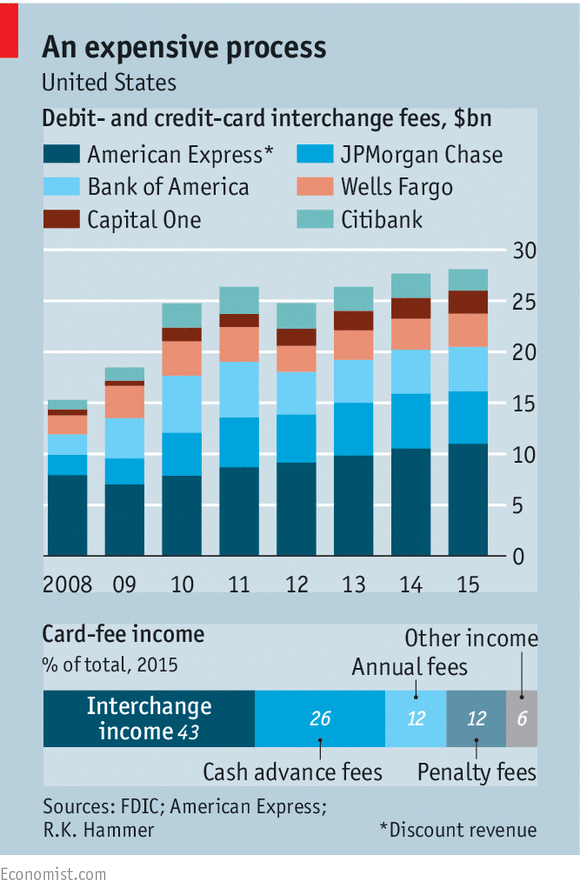
IN 1966 a medical journal identified a condition it dubbed “credit-carditis”: lower-back ache, with pain radiating down the leg—caused by a back-pocket wallet stuffed with plastic. Payment cards still inflict pain of a different sort. American merchants paid more than $40 billion to process debit- and credit-card transactions in 2015. Despite a reform by the Federal Reserve in 2011 aimed at reducing these costs, revenue from these so-called “interchange fees” has more than doubled since the financial crisis. Retailers are still in revolt; banks are still resisting. That is not surprising, since they rely on the fees for a large and growing share of their income.
American consumers favour debit and credit cards over cash by more than two to one. But this convenience comes at a cost. The seller is charged a fee for every card purchase: in America, typically 0.5% to 3% of its value. These fees are set by payment-card networks, such as Visa and MasterCard and collected by card issuers, such as Wells Fargo and JPMorgan Chase. Some portion of these fees is borne by consumers, including those who pay by cash, in the form of higher…Continue reading
Báñez cita a los agentes sociales el lunes para hablar de temporalidad
Las consecuencias de las sentencias europeas sobre los interinos centrarán el debate
¿Cómo son las grandes fortunas chinas? El dueño de Wanda, el más rico
Wang Jianlin retiene el título pero es seguido muy de cerca por Jack Ma, fundador de Alibaba
Dos exaltos cargos de Caja Madrid respaldan la tesis de que las ‘black’ eran de libre disposición
Han explicado que podían hacer uso de ella sin necesidad de presentar justificación, respaldando la tesis de gran parte de los acusados. Leer
Brexit means…higher prices

THE economic arguments for and against Brexit in the course of the referendum campaign were quite esoteric and confusing to the average voter. Similarly, sterling’s decline in the currency markets might seem like the kind of thing that only concerns City traders.
So the row that has broken out between Tesco, Britain’s biggest supermarket chain, and Unilever, the Anglo-Dutch multinational, has made the story concrete in ways that were not apparent before. Unilever wants to raise prices across a range of goods to reflect the fall in the pound, which has dropped from around $1.50 on the day of the referendum to less than $1.22 at the time of writing. Similar falls have been seen against the euro; indeed travellers who change their money at the airport are getting less than a euro per pound.
The row has centered on Marmite, a salty yeast-based spread that is loved by some, but not all, Britons including this blogger. (I have yet to meet an American who can stand it.) But Marmite isn’t the best example as it is made in this country. PG Tips, one of Britain’s favourite tea brands (pictured), is a better example; that is…Continue reading