
Economía
BlackRock prevé mayor crecimiento hasta final del año, pero también mayor volatilidad
La Reserva Federal comenzará a presionar con ligeras subidas de tipos. Leer
Capital punishment

AMONG the proud titans humiliated in the financial crisis of 2007-08 was GE, forced to take a government bail-out in 2008. In response it swiftly slimmed down its lending arm, GE Capital. But the regulators were still not happy. In 2013 they labelled it a “systemically important financial institution” (SIFI), ie, one big enough to pose a global risk. That imposed costly regulatory burdens and encouraged GE’s boss, Jeffrey Immelt, to announce in April 2015 that he would wind down most of GE’s finance division within three years.
In a remarkable corporate transformation, he is ahead of schedule. The disposal to Wells Fargo this week of GE’s global inventory-financing business means that GE has sold $193 billion of “ending net investment”, or ENI (an adjusted asset figure), in the past 18 months, covering more than 25 lending units.
It has taken almost a decade. But GE is, almost, an ex-bank. As Mr Immelt promised last year, it is also much simpler. It shed its SIFI status in June. Lending, in ENI terms, is down by 85% from its peak in 2008 (see chart) and now focuses on its core industrial businesses. Its reliance…Continue reading
From base to gold

WHEN Marco Polo travelled to China in the 13th century, he found that among its wonders was “the secret of the alchemists”. Its imperial court could turn mulberry bark into money. It simply printed paper notes, decreed that people must accept them and killed counterfeiters. For a Venetian used to gold coins, the world’s first fiat currency was a marvel. Its value derived not from precious metal but from the credibility of the regime issuing it. This month China achieved another kind of monetary alchemy: to fashion a global reserve currency out of one that, by a range of criteria, does not yet merit such status.
On October 1st the yuan became the fifth entrant in the basket of currencies that forms the Special Drawing Right, a reserve asset created by the IMF. Immediate implications are limited. SDRs are a unit of account, not a real currency; inclusion in the basket does not force anyone to acquire the yuan. Symbolically, though, it is a big deal: the IMF’s seal of approval for China’s monetary system. It has deemed it safe for central banks around the world to add the yuan to their reserves. Dozens of central banks in fact already do so,…Continue reading
The green light
 Vestine sees the light
WHEN Vestine Mukeshimana bought electric lights last month from BBOXX, an off-grid solar company, it helped her spot snakes in her garden and stopped thieves making off with her cow. In her Rwandan village she and her neighbours now cook after dark and their children study in the evenings. They have never heard of the Green Climate Fund (GCF), a UN initiative to bring climate finance to developing countries. But last month such household solar schemes became its first disbursed investment.
Understaffed and buffeted by politics, the GCF is struggling to define itself. It started operations last year after coaxing $10.3 billion from governments. Raising money was hard; spending it is proving even harder. Its board meets on October 12th in Songdo, South Korea, to weigh up proposals. It will also have to mull appointing a new boss. Héla Cheikhrouhou, the old one, has left, warning that the wrong projects are being financed.
The debate goes to the very purpose of the GCF. It was set up in 2010, part of a pledge to transfer $100 billion of climate cash a year by 2020. Developing countries had long…Continue reading
Active defence

WHEN firms merge, their bosses gush Panglossian jargon. So it was with the tie-up announced this week of Henderson Global Investors, an Anglo-Australian asset manager, and Janus Capital, an American one. Janus Henderson, as the combined business will be known, will become a “truly global” asset manager that will deliver “compelling value creation”, boasted its American half. Yet behind the boosterism lie the real fears of active fund managers: of losing business to passive ones—ie, those offering funds that simply track a market index. It is hard not to see the merger as, more than anything, a defensive move.
To be fair, the companies do have a strong business case for merging. Janus is deeply established in America and Japan. It is famous for having in 2014 hired Bill Gross, the “bond king”, when he abruptly left Pacific Investment Management Co, PIMCO, the firm he co-founded and turned into a giant. Henderson’s sales network is centred on Europe. The firms stand to gain more from selling each other’s products in new markets than they will lose from stepping on each other’s toes.
Moreover, the combined…Continue reading
An emerging threat

WHEN the returns on cash and government bonds in the developed world are zero, or even negative, it is hardly surprising that investors are casting their nets more widely. In the process the “search for yield”, as it has been called, has inevitably turned its attention to emerging markets.
One or two decades ago, emerging-market sovereign debt might have been the only beneficiary of these flows. But government bonds do not offer such a juicy return these days; the yields on ten-year bonds issued by Malaysia and the Philippines, for example, are around 3.6%.
As a result, investors are taking a big extra risk and piling into emerging-market corporate debt. So far this year bond funds in that sector have received inflows of $11.5 billion, according to HSBC. Their enthusiasm has been rewarded. Bloomberg’s emerging-market corporate-bond index has returned 13.4% since January 1st, compared with a return of just 4.4% from American Treasury bonds (see chart). This rally has occurred despite early-year wobbles about the strength of the Chinese economy and the impact of higher American interest rates.
The improved…Continue reading
How the other tenth lives

WHAT is the most important number in global economics? Judging by the volume of commentary it excites, America’s monthly payrolls report (released on October 7th) might qualify. Other contenders include the oil price or the dollar’s exchange rate against the euro, yen or yuan. These numbers all reflect, and affect, the pace of economic activity, with immediate consequences for bond yields, share prices and global prosperity—which is what economics is ultimately all about.
But if global prosperity is the ruling concern of economics, then perhaps a more significant number was released on October 2nd by the World Bank. It reported that 767m people live in extreme poverty, subsisting on less than $1.90 a day, calculated at purchasing-power parity and 2011 prices. The figure is not up-to-the-minute: such is the difficulty in gathering the data that it is already over two years out of date. Nor did the announcement move any markets. But the number nonetheless matters. It represents the best attempt to measure gains in prosperity among the people most in need of them.
The latest figures should arouse mixed feelings. They are…Continue reading
Career breaks
FRANK LLOYD WRIGHT quipped that “the modern city is a place for banking and prostitution and very little else.” Little did the early 20th-century architect know how banks would flourish, hoovering up much of the world’s talent by the early 2000s. But this golden age is ending: bankers’ jobs are at risk from the digital revolution on the one hand, and falling profits on the other.
Nowhere have bankers fallen from grace with such a bump as in Europe. This week ING, the Netherlands’ largest bank, announced that up to 7,000 jobs would be cut in the next five years. Commerzbank, Germany’s second-largest bank, had already reported it would cut its workforce by 9,600, nearly a fifth.
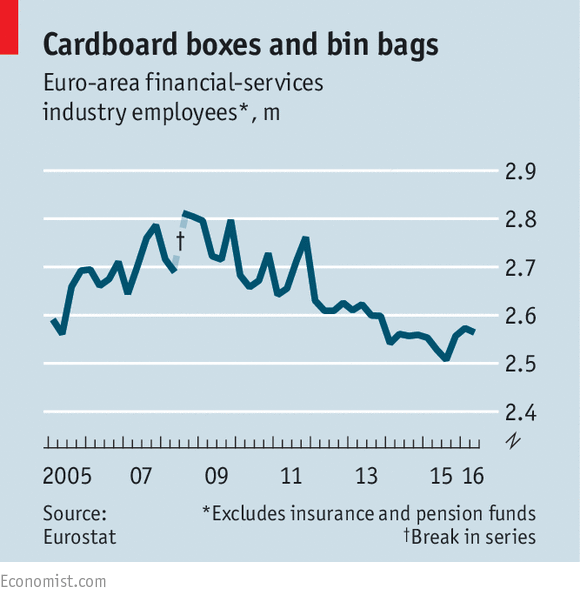
Across Europe, bankers are packing up. In Britain more than 10% of bank jobs were cut between 2011 and 2015; in Germany the workforce has shrunk by around 20% since 2001. Since the start of the year Credit Suisse has got rid of…Continue reading
Your name will also go on the list

FIRMS must list foreign workers, blares the headline of London’s Times newspaper today after a speech from the Conservative government’s new home secretary, Amber Rudd. The idea, it seems, is not to list each and every individual but for companies to list the total number of their foreign employees so that they can be “named and shamed”.
Conservative Home Secretaries have a tradition of throwing red meat to delegates so it may be that this policy never goes any further. On the BBC’s Today programme this morning, Ms Rudd was emphasising that the policy was only “for consultation”, and if she consults business, she’ll probably get a pretty rude answer. Which business would want to be named and shamed at the top of the list, with all the potential for adverse publicity, demonstrations etc? It’s all a bit reminiscent of the first world war, when shops with German-sounding names had their windows broken and the Royal family changed its name from Saxe-Coburg-Gotha to Windsor.
But this was not the only bad idea to come out of the current Conservative conference. First, there was the idea of