
Finanzas
Euphoria returns to markets
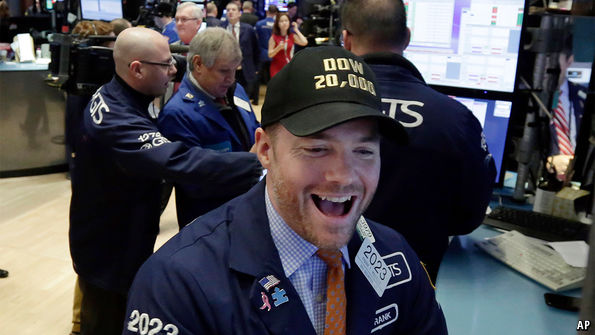
LIKE the weather in Chicago, you don’t have to wait long for a new trend in the stockmarkets. Just a few weeks ago, investors seemed to have second thoughts about their Trump-related euphoria (which itself was a contrast to the widespread nervousness ahead of the election). Now they have been recording new highs again.
While the spark for the rally seems to have been a Presidential comment about forthcoming tax cuts, the causes have been much broader; the MSCI World Index has also hit new highs. Commodity prices have perked up, which may be a sign that the Chinese economy is holding up (if you recall, a Chinese slowdown was the big worry 12 months ago). Asian trade has perked up after a long period of sluggishness (the exports of South Korea, a bellwether in this respect, have risen for three months in a row). According to…Continue reading
El Constitucional induce a reformar el impuesto sobre la plusvalía municipal
El tribunal cuestiona que haya que pagar el tribuno aunque el valor de los terrenos haya disminuido
La deuda pública española bajó en 2016 hasta el 98,98% del PIB
El endeudamiento de las Administraciones alcanzó los 1,105 billones de euros a cierre del año pasado
Bruselas presiona a España para que cumpla la sentencia
La Comisión asegura que está en contacto con el Gobierno para que respete los requisitos de Europa
Los sindicatos del Banco de España rechazan la recogida de firmas en favor de los imputados
«Este tipo de actuaciones no hacen sino comprometer más la posición de nuestra institución», señalan
Rechazo unánime de partidos y sindicatos a retrasar la edad de jubilación
UGT y CCOO ven “insulto a la inteligencia” la propuesta del Banco de España
Cláusula suelo: ¿Cómo le afecta la nueva sentencia del Supremo?
La sentencia se adapta a la decisión de la justicia europea
Asia’s exports rebound
IT IS easy to be downcast about the state of global trade. It has faced stiff headwinds in recent years: in 2016, for the first time in 15 years, it grew more slowly than the world economy. Regional and global trade deals are going nowhere, slowly. And America’s new president has promised to protect his country from trade-inflicted “carnage”.
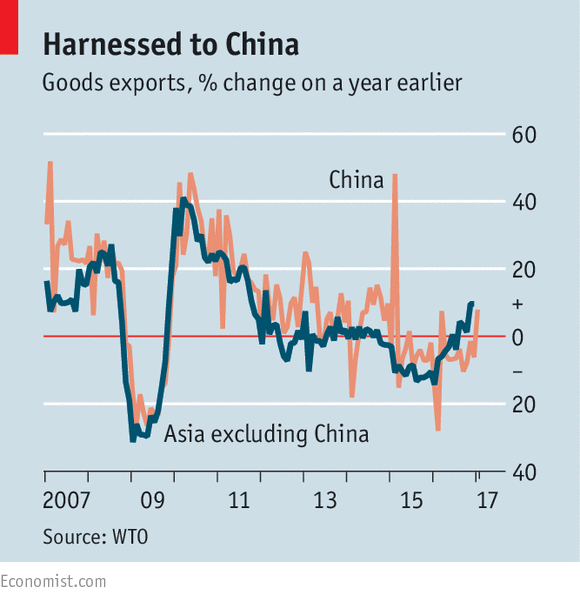
Amid all this gloom, optimism seems foolhardy. But in Asia’s export dynamos, trade is picking up steam. In January, Chinese exports rose year-on-year for the first time in ten months; South Korean shipments have increased for three months in a row. Surveys reveal strong export pipelines in Japan, Singapore and Taiwan. Healthy order books for Asia’s manufacturers normally bode well for global trade and indeed the global economy. It is too soon to declare a definitive upturn in global trade, but it looks like more than a blip (see chart).
The simplest explanation for the rebound is that global demand is itself on solid ground. Global growth is still slower than before the financial crisis of 2008, but is heading in the right direction. Both the IMF and the World Bank think it will…Continue reading
New models for new media
 Not watching Twitter
FOR months Twitter, the micro-blogging service, has received the kind of free attention of which most companies can only dream. Politicians, corporate bosses, activists and citizens turn to the platform to catch every tweet of America’s new president, who has become the service’s de facto spokesman. “The whole world is watching Twitter,” boasted Jack Dorsey (pictured), the company’s chief executive, as he presented its results on February 9th. He has little else to brag about.
But Donald Trump has not provided the kind of boost the struggling firm really needs. It reported slowing revenue growth and a loss of $167m. User growth has been sluggish, too: it added just 2m users in that period. Facebook added 72m. The day of the results, shares in Twitter dropped by 12%. Because news outlets around the world already report on Mr Trump’s most sensational tweets, many do not feel compelled to join the platform to discover them. Others are put off by mobs of trolls and reams of misinformation.
And not even Mr Trump could change the cold, hard truth about Twitter: that it can never be…Continue reading
France’s PSA Group may plan to buy Opel, GM’s European operation
AFTER sweeping past a significant milestone, drivers rarely slam their vehicles into reverse. Yet General Motors (GM), which last year joined Toyota and Volkswagen in an elite group that sells over 10m vehicles a year, may be on the brink of such a manoeuvre. On February 14th the American firm and PSA Group, which makes Peugeots and Citroëns, sprang a surprise by confirming that they were in talks that could lead to the French carmaker buying GM’s European operation. GM’s decision to downsize has many merits, but the advantages of getting bigger are much less clear-cut for its European counterpart.
The two carmakers say a deal for Opel (which carries the Vauxhall brand in Britain) is only a possibility. But GM’s global might is not reflected at Opel, and it is probably keen to offload a carmaker that it has owned for nearly 90 years. Opel has done little other than disappoint in the recent past. Its 6% share of the European market puts it behind seven other brands and the business has lost money for years.
GM has considered offloading Opel before. In 2009, as it struggled in bankruptcy protection in the wake of the financial…Continue reading