
Finanzas
Ralph Lauren and Macy’s tell a similar tale of woe

NEW YORK’s fashion week, which will start on February 9th, promises the usual show of glamour, but a more fascinating industry display came a week earlier. On February 2nd Ralph Lauren, a well-known brand, said that the executive it had hired in 2015 to overhaul its business would leave. On February 3rd the Wall Street Journal reported that Macy’s, America’s biggest department store, might be bought by Hudson’s Bay, a smaller Canadian rival. Each is an institution of American retailing. Each is a reminder of how hard it is to keep pace.
Consumer habits have changed especially rapidly in their world. Frocks, bags and shoes are now disproportionately bought online compared with other goods. Last year clothes and accessories accounted for a fifth of e-commerce, estimates Cowen, a financial-services firm; far higher than their 8% share of total retail spending. Cowen expects Amazon to surpass Macy’s as America’s top clothing seller this year.
For manufacturers, such as Ralph Lauren, the picture is more mixed. For some clothing firms, particularly small ones, Amazon offers a new way to reach…Continue reading
Internet firms’ legal immunity is under threat

GOOGLE, Facebook and other online giants like to see their rapid rise as the product of their founders’ brilliance. Others argue that their success is more a result of lucky timing and network effects—the economic forces that tend to make bigger firms even bigger. Often forgotten is a third reason for their triumph: in America and, to some extent, in Europe, online platforms have been inhabiting a parallel legal universe. Broadly speaking, they are not legally responsible, either for what their users do or for the harm that their services can cause in the real world.
It is becoming ever clearer, however, that this era of digital exceptionalism cannot last for ever. Governments and courts are chipping away at the sovereignty of internet firms, and public opinion is pushing them to police themselves better. Given their growing heft, this shift is likely not just to continue but to accelerate.
When the internet went mainstream in the mid-1990s, online firms feared being held liable if their services were used in illegal ways—for instance, when subscribers posted copyrighted content or defamatory information. The danger was underlined in…Continue reading
Remaking American financial regulation

AT FIRST blush, there is little to be excited about. The eighth executive order of Donald Trump’s infant presidency, signed on February 3rd, lists seven “core principles” for regulating America’s financial system. These include the prevention of bail-outs by taxpayers; advancing the American interest in international negotiations; and tidying the unruly thatch of federal regulation. The treasury secretary and regulators must report by early June on how well existing laws fit the bill. “There is little in the actual executive order that the Obama administration would have disagreed with,” says Doug Elliott of Oliver Wyman, a consulting firm.
And yet. Although the edict does not mention the Dodd-Frank act of 2010, which redefined financial regulation after the crisis of 2008, it is chiefly aimed at that law. (Another presidential memorandum paves the way to aborting a rule tightening financial advisers’ obligations to Americans saving for retirement.) Many banks, especially smaller ones, loathe the 848-page act and its reams of ensuing rules. According to Davis Polk, a law firm, 111 of its 390 “rule-making requirements” have not yet…Continue reading
Snow-making companies in a warming world
 Better than mud
THE creamy glide of fresh powder sends skiing enthusiasts into ecstasies. Scraping over brown patches and dodging lumpen rocks inspires far less enthusiasm. Thousands of families will hit Europe’s slopes this month, hoping that snow conditions will be more favourable than at the start of the season in December. A warming world is changing precisely how, when and where snow falls. For the winter-sports industry, such shifts could hit profits harder than a springtime avalanche.
The snowfall season has become shorter in places such as the Alps, says David Robinson of Rutgers University in New Jersey, as snow arrives later and melts earlier than it once did. Resorts at lower altitudes are among the most vulnerable. Since the 1970s the duration of the snow season, averaged over the northern hemisphere, has declined by five days a decade, according to the European Environment Agency. Huge regional variation exists, however, both in Europe and elsewhere. Californian slopes that were unable to open in recent years because of snow shortages had to close at the start of 2017 because too much of the stuff had…Continue reading
Grab battles Uber in South-East Asia
 Overtaking manoeuvres
SCOOTER-DRIVERS in bright green helmets enliven the dusk of rush hour in Ho Chi Minh City, Vietnam’s commercial centre. This conspicuous fleet is carrying round clients of Grab, a South-East Asian ride-hailing firm. Its operations, connecting travellers with taxis, private cars and motorbike taxis in six countries, straddle a region that is twice as populous as America and swiftly urbanising. Its future seems assured, if it can compete with Uber, a deep-pocketed American competitor.
Grab started life at Harvard Business School, where its 34-year-old boss, Anthony Tan, met his co-founder, Hooi Ling Tan (the pair are unrelated). Its headquarters are in Singapore. Anthony’s father runs Tan Chong Motors, a car assembler and distributor which is among Malaysia’s largest companies, but he does not have funding from the family outfit.
Mr Tan denies that he is building South-East Asia’s answer to Uber, and says he is more inspired by Chinese technology firms such as Tencent, an online-gaming and social-media firm that owns WeChat, a fantastically popular mobile-messaging service, and Alibaba…Continue reading
Shareholder democracy is ailing

DEMOCRACY is in decline around the world, according to Freedom House, a think-tank. Only 45% of countries are considered free today, and their number is slipping. Liberty is in retreat in the world of business, too. The idea that firms should be controlled by diverse shareholders who exercise one vote per share is increasingly viewed as redundant or even dangerous.
Consider the initial public offering (IPO) of Silicon Valley’s latest social-media star, Snap. It plans to raise $3-4bn and secure a valuation of $20bn-25bn. The securities being sold have no voting rights, so all the power will stay with Evan Spiegel and Bobby Murphy, its co-founders. Snap’s IPO has echoes of that of Alibaba, a Chinese internet giant. It listed itself in New York in 2014, in the world’s largest-ever IPO, raising $25bn. It is worth $252bn today and is controlled by an opaque partnership using legal vehicles in the Cayman Islands. Its ordinary shareholders are supine.
Optimists may dismiss the two IPOs as isolated events, but there is a deeper trend towards autocracy. Eight of the world’s 20 most valuable firms are not controlled by outside shareholders. They…Continue reading
El Poder Judicial propone que haya un juzgado especializado en claúsulas suelo en cada provincia
El órgano de gobierno de los jueces aprueba un plan de urgencia ante el previsible aumento de litigios por hipotecas abusivas
Brexit: the New Zealand precedent
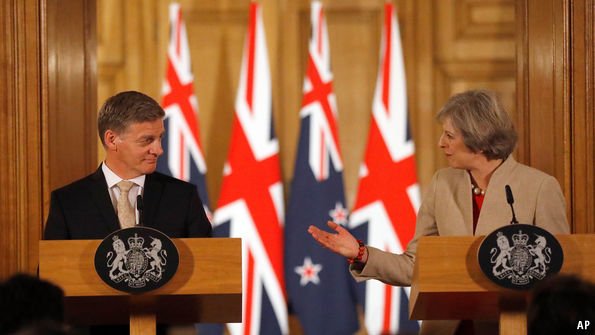
THE future of British trade after Brexit is shrouded in uncertainty. It is an unprecedented process, so it is hard to know where to look for clues as to how it may work out. One possibility is a country whose trading patterns were perhaps more disrupted than any other’s by Britain’s accession to the European Economic Community (EEC) in 1973: New Zealand.
Just as Brexit is likely to mean the end of British access to the single market, so “Brentry” ended New Zealand’s preferential access to the “mother country”. In 1961, when Britain first announced its intention to join the EEC, it took about half of New Zealand’s exports—a similar proportion to the EU’s share of British exports today.
New Zealand’s prime minister at the time, Keith Holyoake, warned his British counterpart, Harold Macmillan, that, without safeguards for its exports, New Zealand would be “ruined”. After years of negotiations, a transitional deal in 1971 agreed quotas for New Zealand butter, cheese and lamb over a five-year period, which helped to ease the shift away from Britain. Similarly—if in a much shorter time-span—Britain’s prime…Continue reading
Rato cobraba hasta 65.000 euros por cada conferencia que daba en cajas y empresas
Tras abandonar el FMI en 2007, Rato se dedicó a pronunciar conferencias. Entre 2007 y 2014 facturó 1,4 millones de euros, según la Agencia Tributaria
El PSOE impone que la agencia de protección del consumidor financiero pueda multar
Exigirá que la elección de la cúpula de los organismos supervisores se haga por un procedimiento de libre concurrencia