
Finanzas
CaixaBank se hace con el 84,5% del portugués BPI gracias a la opa
La angoleña Dos Santos vende su participación para pasarse al BCP
The elderly, cognitive decline and banking

“THE older the wiser” may ring true for much of life, but not for our ability to handle money. Studies suggest financial decision-making ability tends to reach its peak in a person’s mid-50s, after when deterioration sets in. “Age-friendly” banks are beginning to learn how to protect vulnerable older customers.
The most dramatic forms of age-related mental deterioration are neurodegenerative diseases, like Alzheimer’s. But even “normal” ageing can cause cognitive change. Financial-management skills are often early casualties, because they demand both knowledge and judgment.
Older people are more likely to struggle with day-to-day banking and are more susceptible to poor investment decisions. They are also more vulnerable to fraud or to financial exploitation, often by relatives. In 2010 the over-65s in America made up 13% of the population but had over a third of the wealth. British pensioners became especially vulnerable when reforms in April 2015 allowed them to withdraw savings previously locked up. Newspapers fretted that people would splurge their pensions on Lamborghinis. A greater concern should have been that they…Continue reading
Hoteliers would like to employ more robots

IN A recent blog post, Gulliver expressed his exasperation at having to interact with other humans when he stayed at hotels. After all, in the age of mobile check-in and automated bartenders, it must be possible to swerve most of these pointless encounters (and avoid having to hand over tips for the most mundane services, such as pouring a beer or being shown to your room).
One solution that didn’t occur to him was robot butlers. The M Social Singapore hotel is introducing a droid that can deliver room service to guests. It navigates using 3D cameras and can negotiate lifts and manoeuvre around people wandering down the corridors. The M Social is far from the first establishment to employ such robots. The machine, called Relay (pictured), which is made by Savioke, a Californian firm, already does shifts at some Aloft and Residence Inn hotels.
Tom Breedon, the general manager of the Residence Inn at Los Angeles airport, says using the robot for deliveries increases revenue per available room, a key industry measure, by…Continue reading
Bank of America estrena sucursales sin personal donde atienden por videoconferencia
El cliente interactúa en EE UU con los empleados por Internet para contratar una hipoteca o solicitar una tarjeta de crédito
How to make money from digital entertainment
Billions worldwide have access to on demand digital entertainment. But how do you turn a profit in the attention economy? Also on the show: The People’s Bank of China is in the throes of an interest-rate tightening cycle. And who pays a higher salary – big or small companies?
Bubbles are rarer than you think
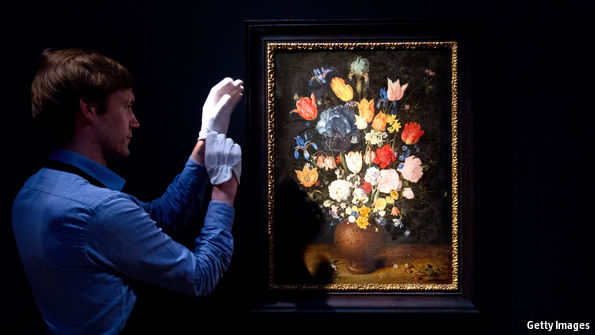
BUBBLES put the fun into financial history. Who can resist stories about Dutch tulips that were worth more than country estates or the floating of an “undertaking of great advantage but no one to know what it is”?
Ever since the financial crisis of 2007-08, economists have debated whether bubbles can be identified, or indeed stopped, before they can cause widespread damage. That is easier said than done: even tulipmania may have been caused by a quirk in the wording of contracts that meant speculators would, at worst, walk away with only a tiny loss.
For many investors, the more important question is whether it is possible to avoid being sucked into a bubble at the top, and suffering declines like the 80% drop experienced by the NASDAQ 100 index of technology stocks between March 2000 and August 2002. Two essays in a new book*, from the CFA Institute Research Foundation and the Cambridge Judge Business School, indicate just how difficult market timing can be.
The first, from William Goetzmann of Yale School of Management, looks at the history of 21 stockmarkets since 1900. Mr Goetzmann defines a bubble as a doubling in a…Continue reading
BBVA mejora las previsiones de crecimiento de España al 2,7% en 2017
La entidad cree que se podrían crear más de 900.000 puestos de trabajo, dejando la tasa de desempleo en el entorno del 15,8% en 2018
La CNMV suaviza el impacto del cambio en el impuesto de sociedades
El supervisor permite contabilizar en cinco años, en el pasivo del balance, las pérdidas fiscales afloradas en lugar de hacerlo de una sola vez
La Audiencia rechaza excarcelar a los exdirectivos de las cajas gallegas
Fernández Gayoso y Pradas recurrieron pero el tribunal les recuerda que no reconocen su culpabilidad y no tienen voluntad de reparación
Travel firms can afford to upset supporters of President Trump

WRITING a few weeks ago, Gulliver envisioned a close partnership between the then president-elect, Donald Trump, and the bosses of tech firms; one that could remove regulation and pave the way to a future of autonomous electric vehicles.
Since then politics has intervened. Specifically, Mr Trump signed an executive order barring citizens of seven Muslim-majority countries from travelling to America. Upon the announcement of the order, the transportation industry sprang into action. New York taxicab drivers staged a boycott of sorts, refusing to pick up passengers from John F Kennedy Airport to show solidarity with those affected by the ban. In response, Uber, a ride-hailing firm, sensed a business opportunity and dropped surge pricing for JFK pickups, effectively cutting the cost of hailing an Uber from the airport.
That proved to be a mistake. Progressives across America accused the firm of breaking the strike. Some noted that Travis Kalanick, Uber’s boss, had joined Mr Trump’s economic advisory council in December. A #DeleteUber campaign was launched. More than…Continue reading