
Finanzas
Los bancos analizan la sentencia y no devolverán el dinero automáticamente
Algunas entidades como el Sabadell aseguran que la decisión europea no les incluye porque ellos fueron transparentes
Los bancos se desploman en Bolsa tras la sentencia sobre cláusulas suelo
El Popular, ya inmerso en una grave crisis interna, lidera las caídas
El Banco de España alerta de que la inflación puede crecer al 2% por el petróleo
El supervisor prevé que la economía mantenga un crecimiento del 0,7% en el cuarto trimestre
La justicia europea obliga a la banca a devolver todo lo cobrado por ‘cláusulas suelo’
El Tribunal de la UE falla en contra del sistema financiero español, que debe retornar al menos 3.000 millones abonados por los hipotecados antes de 2013
The most profitable time of the year
We look at the decline in holiday spending in America and ask what surprises 2017 could bring. And Adrian Wooldridge takes on the ghosts of capitalism past, present and future
The Christmas spending bump flattens

The holiday season’s hold on Americans is getting weaker. In 1994, according to the Census Bureau, retailers earned $82bn (in 2015 dollars) more in sales during November and December than they would have without the seasonal effect of the holidays. That worked out at $310 per person. In 2015 seasonal sales during these months were just $76bn, or $240 per person. The decline in seasonal shopping is steepest in December. For that, blame three things. The growth of e-commerce has made it easier for people to shop for seasonal gifts whenever they want. Gift cards under the Christmas tree push purchases into January. And millennial shoppers are having an impact on sales: they tend to prefer experiences to yet more stuff.
A new industry has sprung up selling “indoor-location” services to retailers

“LOOK up there,” says Edward Armishaw of Walkbase, a Finnish retail-analytics firm, as he points to a small white box above a column clad in mirrors. The sensor—and over a hundred others like it hidden around this department store in London’s Oxford Street—tracks the footsteps of customers through the pings their smartphones emit in search of a Wi-Fi network. Quite unaware, a shopper in a silver puffa jacket ambles past and over to the fitting room. Whether she moves to the till will be logged by Walkbase and its client.
Think of it as footfall 2.0. For many years shops used rudimentary “break-beam” systems—lasers stretched across their entrances—to count people in and out. Only recently have they begun to follow customers inside their buildings, says Nick Pompa of ShopperTrak, an American firm whose work with 2,100 clients worldwide, including malls in Las Vegas and in Liverpool, makes it a giant in the area.
Tracking technologies are ingenious. Some flash out a code to smartphone cameras by means of LED lighting; others, such as IndoorAtlas, a startup with headquarters in California and Finland, monitor how devices…Continue reading
Our Schumpeter columnist pens a dark farewell
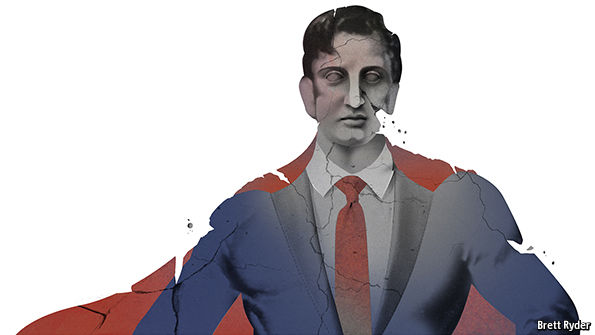
IT WAS in 1942 that Joseph Schumpeter published his only bestseller, “Capitalism, Socialism and Democracy”. The book was popular for good reason. It was a tour de force of economics, history and sociology. It coined memorable phrases such as “creative destruction”. But it was a notably dark book. At a time when people were looking for hope during the life-and-death struggle with Nazism, Schumpeter offered only gloom. “Can capitalism survive?” he asked. “No, I do not think it can.”
This column was inspired by the young Schumpeter’s vision of the businessperson as hero—the Übermensch who dreams up a new world and brings it into being through force of intellect and will. On its debut in September 2009, we argued that Schumpeter was a perfect icon for a business column because, unlike other economists, he focused on business leaders rather than abstract forces and factors. But as Schumpeter grew older, his vision darkened. He became increasingly preoccupied not with heroism but with bureaucratisation, and not with change but with decay. The same is true of the outgoing author of this column.
It would be…Continue reading
In Japan, a new kind of business school is retraining jaded salarymen

THE Institute of Social Human Capital in Tokyo is an unusual sort of business-training school. Those who attend it (two-thirds are men) have mostly quit or taken redundancy packages from big Japanese firms, and are trying to start again. Shedding the habits of a lifetime begins by breaking down barriers: former salarymen laugh nervously as they share a bento-box lunch with strangers, blindfolded (the idea is that they must use their other four senses to communicate).
The way to prepare them for a second career is to get them interacting as individuals, not as corporate workers or business partners, says Matsuhiko Ozawa, a director of the Institute, which specialises in this sort of course. In a country that sets great store by formal introductions, the students have not even exchanged business cards. Names, titles and personal information are banned (the ex-salarymen use made-up names) to avoid reproducing the old office hierarchies that exist outside the classroom. “We start from scratch and help these people find themselves again,” says Mr Ozawa.
For years, the salarymen rode a career escalator that rewarded them less for skills than…Continue reading
Indian business prepares to tap into Aadhaar, a state-owned fingerprint-identification system

THERE are two ways to sign up to Jio, a new and irresistibly priced mobile-telephony service which Mukesh Ambani, the boss of Reliance Industries, a conglomerate, launched in September 2016 and which is luring tens of millions of new customers each month. One way requires a wad of documents, multiple signatures and plenty of patience, since Jio takes days or weeks to go through “know-your-customer” procedures. The second way is magically simple: the person rests a finger on an inch-wide scanner, and if the print matches the identity the customer is claiming, Jio downloads the information it needs from the Indian authorities and activates the phone line within minutes.
Jio is tapping a database called Aadhaar, after the Hindi word for “foundation”. It is a cloud-based ID system that holds the details of over a billion Indians. The government’s purpose in setting it up in 2009 was to help the state correctly direct welfare payments to those entitled to them. By early 2017 all Indian adults should have provided their fingerprints, iris scans, name, birth date, address and gender in return for a single, crucial, 12-digit number.
In the public…Continue reading