
Finanzas
Why the Chapecoense football team’s plane ran out of fuel

MUCH remains unknown about Lamia Airlines flight 2933, which crashed into the hills of Colombia on November 28th, killing 71 of the 77 people on board (see article in this week’s print edition). Fans of Chapecoense, a Brazilian football team, must wait to hear the full story of how a plane carrying 22 of their players and several staff members failed to arrive safely. (Only three players are among the survivors.) Many Brazilian reporters covering the crash knew one of the 21 journalists on board, and are starting to ask why these lives were lost in such devastating circumstances.
The chartered plane was to fly the footballers from São Paolo in Brazil to the Colombian city of Medellín for the biggest match of their lives, the final of a continental club tournament. Two refuelling stops in Bolivia were scheduled, first in Santa Cruz de la Sierra and then in Cochabamba. But the second of these never happened. In a black-box recording leaked to the press, the pilot, Miguel Quiroga, could be heard saying that the plane was running out of fuel…Continue reading
El Gobierno se da dos años más de plazo para vender Bankia
El Estado tendrá hasta finales de 2019 para salir de la entidad presidida por José Ignacio Goirigolzarri, de la que controla el 65% del capital
Los expertos piden que Navarra y País Vasco aporten más a la hacienda común
Fedea y la Fundación Olof Palme reclaman un reparto más igualitario y en el que las comunidades que más ponen no pierdan
La Seguridad Social saca 9.500 millones de la hucha de las pensiones
En un año se han consumido 19.200 millones del Fondo de Reserva, que ya solo tiene dinero para menos de dos pagas
Siemens and General Electric gear up for the internet of things

IT DOESN’T take long to walk from Siemens’s old headquarters in Munich to its new one, inaugurated in June: the German industrial conglomerate has built it right next door. The design is cutting-edge, as are the building’s environmental features. It is packed with energy-saving sensors; channelled rainwater is used to flush the toilets.
General Electric, Siemens’s big American rival, will soon have a new base, too. But it takes three hours to drive from the old site in Fairfield, a Connecticut suburb, to the new one in Boston. Its building will also boast plenty of green technology, such as a huge canopy made of solar panels, as well as spaces that the public can enter, including co-working areas and lounges. There will be laboratories both for internal startups and some from outside.
The two industrial giants aren’t so much showing off as signalling transformation. Both firms are going through the most profound change in their corporate histories, attempting to switch from being makers of machines into fully digital businesses. GE’s chief executive, Jeff Immelt, says the plan is to join the world’s top ten software firms…Continue reading
France’s nuclear-energy champion is in turmoil
 Under pressure
THESE are difficult times for Electricité de France (EDF), the country’s quasi-monopolistic electricity provider, serving 88% of homes. Outages at no fewer than 18 of the 58 EDF-owned nuclear reactors that provide three-quarters of France’s electricity have meant a slump in production: the company says annual nuclear output could fall to 378 terawatt hours (TWH), from 417 TWH last year. Eight reactors are currently lying idle and several may not restart for weeks or months. Power stations are burning coal at a rate not seen since the 1980s. As electricity imports and prices soar, officials are having to deny that a cold snap could bring blackouts.
The cause of the crisis—possibly faulty reactor parts throughout EDF’s fleet—suggests it may not be easily contained. France’s nuclear regulator, the Autorité de Sûreté Nucléaire (ASN), this summer ordered urgent tests of reactor parts, mostly bases of cylindrical steam generators. Inspectors are worried about high carbon levels found in steel forged by Creusot Forge, which is owned by Areva, another French firm, and by Japan Casting & Forging…Continue reading
Donald Trump’s win has sent the shares of small American companies on a tear

THERE have been plenty of swings in financial markets since America’s election on November 8th. The Mexican peso has fallen against the dollar, reflecting worries about Donald Trump’s protectionist tendencies. Ten-year bond prices have tumbled as investors factor in the likelihood of much higher government borrowing. One particularly striking move has been a surge in the share prices of small firms. The Russell 2000 index of American midgets has leapt by 12%, compared with a 3% rise for the S&P 500 index of multinational leviathans (see chart).
Small companies are the backbone of America’s economy, employing about half of the private-sector workforce. But they have had a rotten decade. The Russell index had lagged the stockmarket until the election. The country’s 28m small firms—most of them unlisted—have never fully recovered from the financial crisis of 2008. As of October, confidence had yet to rise back to the level of 2006, according to an index of optimism that is based on surveys by the National Federation of Independent Business, a lobbying group. Giant firms, meanwhile, have been playing a bigger role: two-thirds…Continue reading
Japanese golf courses hunt for a new driver
 Slow fade
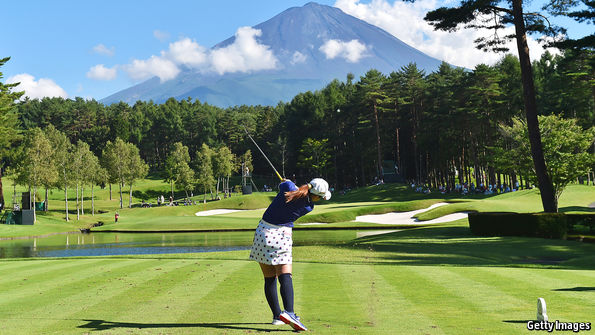
THE gold-coloured golf club priced at $4,700 that Japan’s prime minister, Shinzo Abe, gave to Donald Trump, America’s president-elect, in their first meeting last month may have been a piece of polished diplomacy. But it is unlikely to revive its posh Japanese maker, Honma, which calls itself “golf’s aristocracy”, presumably because it crafts the world’s most expensive clubs. It went bankrupt after Japan’s bubble-era splurge on new golf courses. Seven years ago a businessman from China bought the firm, hoping for an upswing.
Golf, long associated with extravagance in Japan, is flagging. Clubs have trimmed green fees as the level of golf-playing among Japanese has fallen by over 40% since a high in the early 1990s. As elsewhere, courses are in oversupply: Japan has over 2,300—half of Asia’s total.
More than 120 have closed since 2010. Entrepreneurial types have converted about 70 into solar-panel plants, encouraged by state subsidies for alternative-energy production following the disaster in March 2011 at the Fukushima Dai-ichi nuclear-power plant. A few others have been turned back into…Continue reading
OPEC reaches a deal to cut production

EXACTLY two years after Saudi Arabia coaxed its fellow OPEC members into letting market forces set the oil price, it has performed a nifty half-pirouette. On November 30th it led members of the oil producers’ cartel in a pledge to remove 1.2m barrels a day (b/d) from global oil production, if non-OPEC countries such as Russia chip in with a further 600,000 b/d. That would amount to almost 2% of global production, far more than markets expected. It showed that OPEC is not dead yet.
The size of the proposed cut, the first since 2008, caused a surge in Brent oil prices to above $50 a barrel. Some speculators think it may mark the beginning of the end of a two-year glut in the world’s oil markets, during which prices have fallen by half and producers such as Venezuela have come close to collapse. As long as prices continue to recover, Saudi Arabia can probably shrug off the fact that its previous strategy damaged OPEC at least as badly as non-members, and that this week’s deal gave more breathing space to its arch-rival Iran than it would have liked.
The rally’s continuation, however, depends on non-OPEC members such as Russia reliably committing…Continue reading
Emilio Saracho, nuevo presidente del Popular en sustitución de Ángel Ron
El consejo de administración aborda hoy el proceso de sucesión que concluirá en el primer trimestre de 2017