
Finanzas
Chinese firms are investing heavily in American hotels
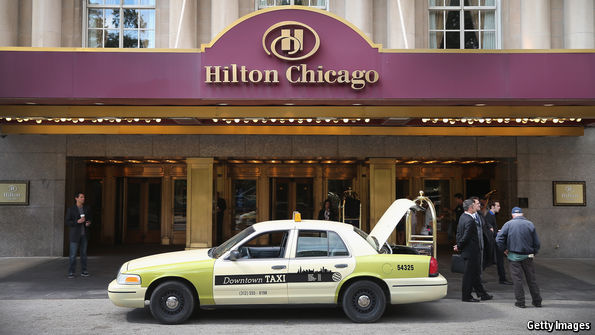
CHINESE tourists are an increasingly common sight in America’s cities, from New York to Honolulu. About 2m Chinese visit the country each year; that figure is expected to rise to over 3m by the end of the decade. But it is not just Chinese tourists who have been enjoying American hospitality; it’s Chinese investors, too.
This week HNA Group, a Chinese firm that began life as an aviation company, announced that it is to buy a 25% stake in Hilton Worldwide Holdings. It will be the largest shareholder in the hotelier whose brands also include Embassy Suites, Hampton Inn and Conrad.
The deal is the latest in a year that has already seen substantial Chinese investment in American hotels. In April, an HNA division announced it was buying Carlson Hotels, which owns Radisson and several other brands. Last month, Anbang Insurance Group completed the purchase of 15 American hotels in a deal worth more than $5bn, including the JW Marriott Essex House in New York, the Westin St. Francis in San Francisco, the InterContinental in Chicago, a Four Seasons in Washington, DC, and two Ritz-Carlton resorts. And just last week came the news that China…Continue reading
El Popular gana un 66% menos por la caída del negocio y las provisiones
El banco obtiene 94,3 millones hasta septiembre, con descensos en todos los márgenes
CaixaBank gana 970 millones hasta septiembre, un 2,6% menos que en 2015
La entidad reduce en un 33% las dotaciones para insolvencias y la morosidad cae al 7,1%
The only thing we have to fear is fear of inflation

DON’T look now, but after years of lingering on the brink of (or in) deflation, rich economies are heading in a different direction. Inflation is rising, and a handful of economy watchers are worrying that accelerating price increases could «rattle global markets», as Mike Bird of the Wall Street Journal writes:
Rich-country government-bond prices tumbled Thursday, sending yields up on both sides of the Atlantic to levels not seen since the U.K.’s vote to exit from the European Union in June. In the U.S., the yield on the 10-year U.S. Treasury note surged as high as 1.847%, according to Tradeweb, its highest level in four months. Yields rise as bond prices fall. The German bund’s yield rose about 0.07 percentage point to 0.161% and the 10-year U.K. gilt yield was up about 0.10 percentage point to 1.259%, according to Tradeweb.
The rising yields are the latest sign that investors are bracing for what could be an epic shift across markets. In recent years, falling commodities, meager wage rises and insipid economic growth kept prices low and pushed investors into…Continue reading
¿Es el momento de comprar una casa o es mejor vivir de alquiler?
Incluso cuando la situación económica permite acceder a una vivienda en propiedad, arrendarla también ofrece ventajas
Angling for the future of TV

IMAGINE a television which, as in the old days, has only a handful of channels to choose from instead of hundreds, as a typical cable set-up might offer today. In a decade or so TVs will once again have only a few channels, but each will run miles deep, with content that can be viewed on demand. Netflix might be one such offering; Amazon another. Both firms are spending billions of dollars making and buying TV shows and films to sell directly to viewers to watch when they like, and on devices other than the box in the corner of the room. And other rich tech firms may join them.
It is this vision that is now driving the direction of television and media. Broadcasters are willing to pay more to show live sporting events, and to invest more in producing TV shows, to make their networks the must-see choice for viewers. This trend has spurred the largest-ever merger of a telecommunications company with a media firm. AT&T, America’s wireless and pay-TV giant, announced on October 22nd an offer for Time Warner, the owner of HBO, CNN and Warner Brothers studio, worth $109bn. In doing so AT&T is betting that a few vertically integrated platforms will…Continue reading
Wind and solar advance in the power war against coal
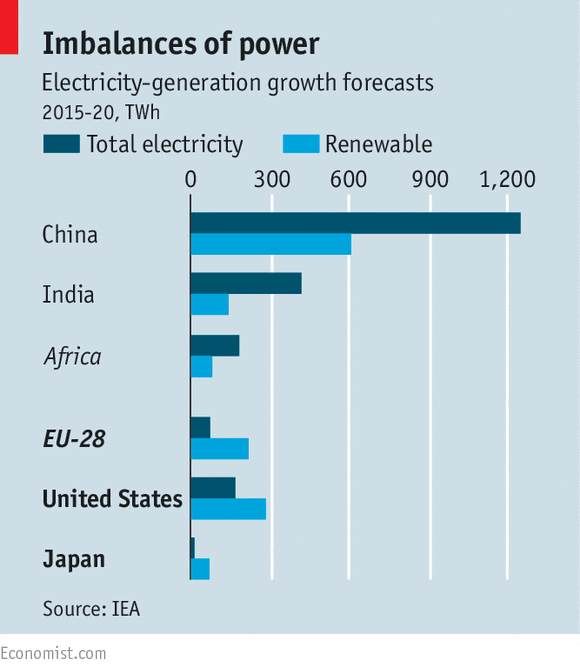
THE battle between clean energy and dirty coal has entered a new phase. The International Energy Agency (IEA), an industry forecaster, this week reported that in 2015 for the first time renewable energy passed coal as the world’s biggest source of power-generating capacity.
The IEA, whose projections for wind and solar energy have in the past been criticised as too low, accepted that renewables are transforming electricity markets. Last year 500,000 solar panels were installed every day around the world. In China alone, home to a whopping 40% of the 153 gigawatts (GW) of global growth in renewable-energy installations, two wind turbines were erected every hour. Based on existing policies, it forecasts that from 2015-21, 825GW of new renewable capacity will be added globally, 13% more than it projected just last year.
All those new wind and solar plants will not generate electricity all the time. Unlike coal, which burns around the clock, renewables are intermittent. But the IEA expects the share of renewables in total power generation to rise to almost 28% from 21%. Government policies to curb global warming and reduce air…Continue reading
New York deflates Airbnb
 No rules broken here
IN 2007, Brian Chesky and Joe Gebbia came up with a wheeze to rent out two air beds in their San Francisco apartment, because a conference had left the local hotels full-to-overflowing. Thus, Airbed & Breakfast was born. Since then, the firm’s only contraction has been its name. Today, Airbnb’s website lists over 2m properties for short-term let in 191 countries. Piper Jaffray, an investment bank, estimates that bookings through the firm will reach $14.4bn in 2016, compared with $52m in 2010. Analysts think the upstart might fetch $30bn were it to be taken public. That would make Airbnb worth more than Marriott, the world’s largest hotel chain.
But legislation signed in New York state on October 21st has taken some of the puff out of Airbnb’s mattress. New York City is the firm’s largest market in America, with around 35,000 properties available for rent. But many of the hosts offer their apartments illegally. In 2010, the state passed a law banning rentals of whole units in residential blocks for less than 30 days. (It is legal to do so if the tenant is living there at the same time.) To…Continue reading
Brazilian firms emerge from the gloom
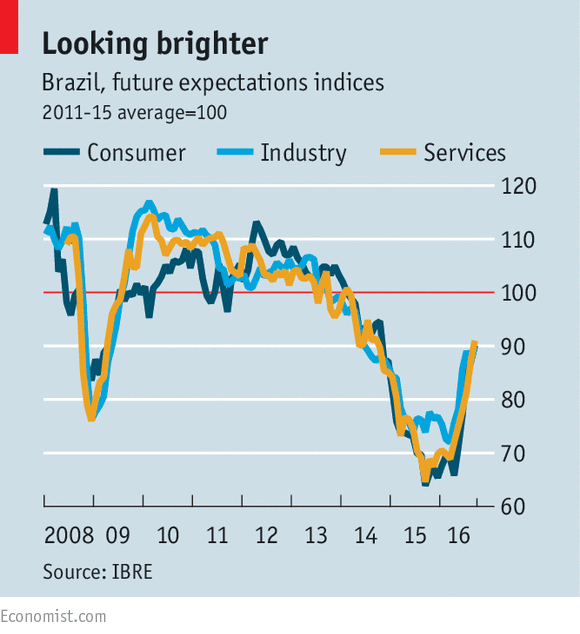
“BRAZIL is back in business,” proclaimed Abílio Diniz, chairman of BRF, a Brazilian pork and poultry giant, at a recent investor shindig. Really? The economy, mired in recession since mid-2014, is not expected to stir before the end of the year—and then only sluggishly. After rebounding in the first half of 2016, industrial production plummeted again in August. Retail sales fell by more than forecast. Firms expect to hire just 100,000 temporary workers in the run-up to Christmas, 3% fewer than last year’s already low tally. BRF’s own domestic operations are hardly a picture of health. Sales dropped by 5% in the second quarter, year on year (though this was offset by rising global revenues).
For all that, Mr Diniz is not alone in his optimism. Surveys point to rising confidence among bosses and consumers alike (see chart). Investors’ spirits are up—and with them the São Paulo stockmarket, which has returned to levels last seen in 2012. The real has strengthened by a third against the dollar since January.
The collective mood swing has less to do with the real economy, and more with realpolitik. In August the…Continue reading
How to confront a dark corporate past
“WE THOUGHT we knew our story, and we knew it wasn’t great,” says Maurice Brenninkmeijer, chairman of COFRA Holding, which owns C&A, a 175-year-old Dutch clothing retailer with over 2,000 stores globally. Yet the full account of how the German branch of his family behaved in the second world war “tore through your heart when you heard it”, he adds. Mr Brenninkmeijer’s ancestors—considered to be genial, virtuous, Catholic and reserved—turned out to have been avid Nazi collaborators. Old letters revealed cosy, corrupt, ties to Hermann Goering. From 1942 onwards C&A and Siemens, a German engineering firm, together exploited forced Eastern European labourers in Germany, keeping them in such a wretched state that malnutrition killed several women and children. C&A profited from “Aryanisation”, grabbing business and property from terrified Jewish owners. Perhaps worst, it used Jewish tailors and leather-workers, corralled in Lodz, a dreadful ghetto in Poland. Of some 200,000 people trapped in inhumane conditions there, only 1,000 survived to liberation.
Such grim details are now public thanks to Mark Spoerer, a historian in Regensburg who specialises in archival research to assess companies’ dark pasts, putting “immoral business behaviour” into historical context. Remarkably, his new book “C&A: A family business in Germany, the…Continue reading