
Finanzas
Qatar planea elevar su participación en Deutsche Bank hasta el 25%
La acción de la entidad financiera se toma un respiro en el mercado neoyorquino
Un acusado de las ‘black’: “La tarjeta no la inventó Caja Madrid, la tenían más bancos”
Mariano Pérez Claver, exdirectivo de la entidad, asegura que la visa era legal porque era parte de su sueldo
El G20 alerta de que los riesgos para la economía global aumentan
Los ministros de finanzas advierten de que populismo profundo contra la globalización genera más incertidumbre
How to get around America without knowing how to drive

LIKE many Londoners, your correspondent does not possess a car. Thanks to the Underground, buses, taxis, shared bikes and the gift of upright bipedal motion (to say nothing of the impossibility of street parking) it has always seemed more trouble than it is worth. But unlike most other functioning adults, this Gulliver also lacks the licence—and indeed the ability—to drive.
Which made the prospect of reporting a story from deepest Florida daunting. Never mind the snakes, alligators and Florida men; without a car I worried more about negotiating America’s creaky public transport system than fending off local fauna. Few American cities outside New York offer the possibility to get around without driving. As for unincorporated towns and rural areas in poor counties? Forget it.
It is not as if I have never reported outside conurbations. But much of that reporting has been in developing countries where rented cars tend to come with people to drive them. As it turns out, Florida offers something similar.
The presence of Uber, a ride-hailing service, is…Continue reading
Change of tune
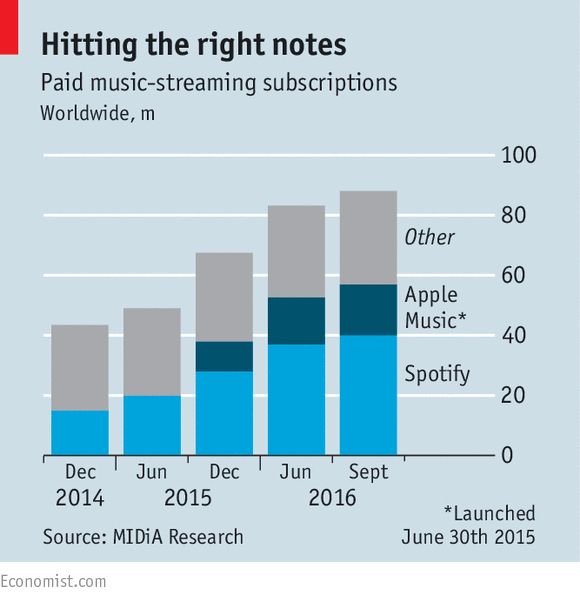
IT WAS an eventful summer in the business of streaming music. Taylor Swift and other artists attacked YouTube over rampant free streaming. Frank Ocean and Katy Perry cut exclusive deals with Apple Music, to the dismay of executives at Spotify, a Swedish rival. Behind the scenes, Pandora, a radio-like service, and Amazon, an e-commerce giant, stepped up their efforts to take on Spotify and Apple. Then last month Spotify began talks to buy SoundCloud, another streaming firm.
All this drama obscures two emerging realities. The first is that subscription streaming is now the future of the music business. The industry suffered a catastrophic collapse in sales from 1999 onwards before beginning to recover last year. Selling music to own, whether via iTunes downloads or CDs, is still a declining business globally.
But American record labels and music publishers are now on track for a second consecutive year of growth. Recent reports on sales of music from Europe, where some countries are experiencing double-digit increases in revenues, suggest that the recovery will also continue in other parts of the world.
Most…Continue reading
Techno parties

CAMPAIGNING is no longer the preserve of big organisations like political parties and trade unions. Online platforms have given voice to individuals around the world and increasingly, the firms behind those platforms are taking activist positions of their own. Facebook’s founder, Mark Zuckerberg, is on a mission “to connect the world”. Apple’s boss, Tim Cook, has vigorously defended customers’ privacy rights. This week the campaigning side of two other technology giants was on display.
On October 3rd Microsoft published a book that could easily be mistaken for a manifesto. Entitled “A Cloud for Global Good”, the 200-page volume offers no fewer than 78 “public-policy recommendations” in 15 “categories”, ranging from protecting privacy to preventing cybercrime. Most intriguing, Microsoft wants the computing clouds to be inclusive. They shouldn’t just benefit the rich and the able, says the firm. As income inequality widens, the book notes, “there are very real concerns about who will benefit.”
The next day 170,000 people descended on San Francisco to attend Dreamforce, a shindig organised by Salesforce, a big provider…Continue reading
A yen for cheapness
 Best-sellers from Tokyo to Texas
IT HAS become a staple story in the local American press: a Daiso store opening near you. Last month it was the turn of Plano, Texas, to get a branch of the Japanese chain of shops where everything costs ¥100. (In America it actually charges $1.50 per item, giving it a premium over the current exchange rate of 97 cents per ¥100.) The Plano store is the second of 44 shops planned for the state. To date California has 49 branches.
America is far from alone. As well as its 3,000-odd stores in Japan, Daiso has 1,500-plus outlets abroad. Its bargain range of products, from value-for-money bags to Japanese “kawaii” or “cute” figures, are sold around the world, from countries in Latin America to the Gulf states and throughout the rest of Asia. (As yet there are no ¥100 stores in Europe.)
This roll-out is orchestrated from a headquarters in the eastern suburbs of Hiroshima. The building looks bland from the outside. But its interior is decked out in Daiso’s trademark pink. One floor is abuzz with buyers examining packs of wet wipes and plastic toys;…Continue reading
They’re watching Yahoo

A FAILED turnaround and then, last month, the biggest data breach from a single site in history. Yahoo, an online firm, has had a bad run of news. On October 4th came a fresh blow when Reuters, a newswire, reported that the company had written customised software to scan all incoming e-mail for certain keywords, complying with a request either from America’s National Security Agency or the FBI.
The company’s first response was to say that it is a law-abiding company. It later issued a statement saying that the Reuters article was “misleading” and that the “mail scanning” the article described “does not exist on our systems”. But that is only a partial denial, and does not rule out the possibility that Yahoo did some kind of scanning. According to Reuters, Yahoo’s chief information-security officer, Alex Stamos, left Yahoo in 2015 because of a decision by Marissa Mayer, its chief executive, to obey an order from a government agency. (He now does the same job at Facebook.)
Even the possibility of a real-time wiretap raises important questions. If the government has demanded such bulk scanning it may represent an expansion…Continue reading
Putting it all on grey

SHORTLY after Mark Frissora took over as chief executive of Caesars Entertainment last year, he paced the floors of his American casinos, with their rows and rows of idle slot machines, and grasped the scale of the existential threat that faces his industry. Casino customers are ageing, and younger people have little interest in taking their place. Mr Frissora called on his company to brainstorm a new “casino within a casino” to draw in millennials who grew up playing video and mobile-phone games.
Next door on the Las Vegas Strip, Jim Murren, CEO of MGM Resorts International, the city’s largest gaming operator, is making similar moves. Mr Murren has convened a committee of millennial employees to work out how to keep the business relevant to future generations. Both firms will soon open experimental spaces for young people, including new types of slot-machine games that test players’ skills as much as their wallets.
These offer a glimpse of a casino of the future that looks very different indeed. There are gravity-free rooms where you can literally climb the walls; LED screens that continuously change interior backgrounds; and…Continue reading
Autumn blues
QUEASY calm is unpleasant, but it beats sickening panic. Late on September 29th Deutsche Bank’s share price lurched downwards again, to a 34-year low, after Bloomberg reported that “about ten” hedge funds had switched some business away from the troubled German lender. That capped a stomach-churning fortnight, after America’s Department of Justice (DoJ) requested $14 billion to settle claims that Deutsche mis-sold residential mortgage-backed securities (RMBSs) before the financial crisis. Hopes that it might settle with the DOJ for $5 billion-odd, though so far unfulfilled, have since brought uneasy respite. On October 5th Deutsche’s shares were some 20% above their nadir.
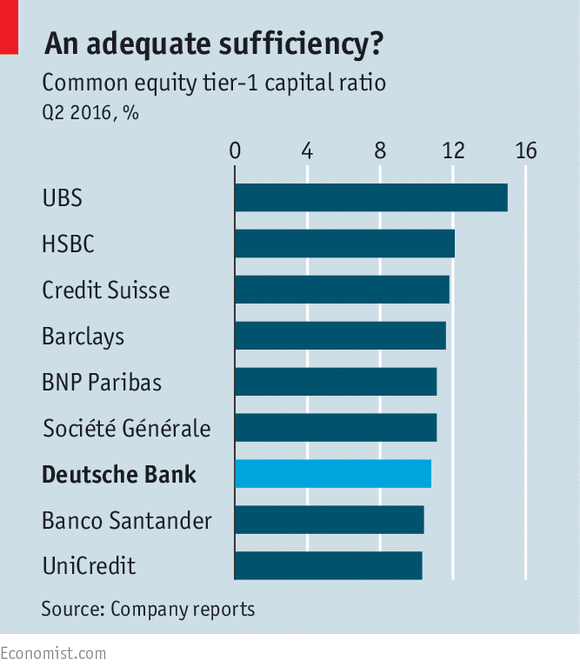
A swift, affordable agreement would end uncertainty about the bill and quieten chatter, pooh-poohed by government and bank, that the German state might have to prop up the country’s biggest lender. It would also buy breathing space….Continue reading