
Tag: Approved
Remaking American financial regulation

AT FIRST blush, there is little to be excited about. The eighth executive order of Donald Trump’s infant presidency, signed on February 3rd, lists seven “core principles” for regulating America’s financial system. These include the prevention of bail-outs by taxpayers; advancing the American interest in international negotiations; and tidying the unruly thatch of federal regulation. The treasury secretary and regulators must report by early June on how well existing laws fit the bill. “There is little in the actual executive order that the Obama administration would have disagreed with,” says Doug Elliott of Oliver Wyman, a consulting firm.
And yet. Although the edict does not mention the Dodd-Frank act of 2010, which redefined financial regulation after the crisis of 2008, it is chiefly aimed at that law. (Another presidential memorandum paves the way to aborting a rule tightening financial advisers’ obligations to Americans saving for retirement.) Many banks, especially smaller ones, loathe the 848-page act and its reams of ensuing rules. According to Davis Polk, a law firm, 111 of its 390 “rule-making requirements” have not yet…Continue reading
Explaining euro-zone market jitters
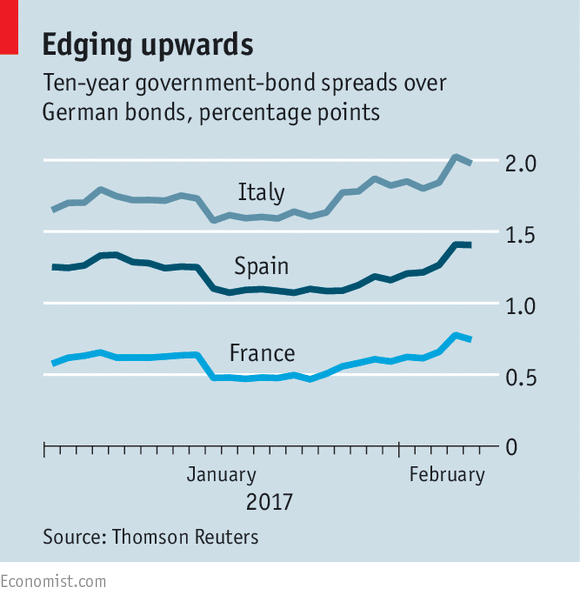
IT was not an ideal way to mark a silver jubilee. The 25th anniversary of the signing of the Maastricht treaty, which gave life to the idea of a single European currency, fell on February 7th, the same day that the IMF published its annual health-check on the Greek economy. It said most (but not all) of its board favoured more debt relief to get Greece’s public finances in order—an idea quickly trashed by euro-zone officials.
A day earlier the spread between ten-year government bonds in France and Germany had reached its widest level in four years. The proximate cause seemed to be a growing concern about political risks to the euro. François Fillon, once the front-runner in the race for the French presidency, is embroiled in a scandal and losing ground. A fear is that his fall from grace might boost support for Marine Le Pen, leader of the National Front, who wants France to leave the euro and the EU.
Shorter odds on a Le Pen victory would certainly justify a higher risk premium on French bonds. Yet there is more to the latest bout of euro-area bond jitters than a sharper focus on politics. After all, bond markets…Continue reading
Big data, financial services and privacy

DONALD TRUMP’s health-insurance premiums could soon go up, and not just because of his love of burritos. Data-crunchers have found a link between the negativity of someone’s tweets and his risk of dying of heart disease. The education levels of your Facebook friends or the activity on your phone can help reveal how likely you are to repay a loan. Money-managers are rummaging ever more curiously through customers’ digital lives.
This is all part of an “intensifying data arms-race in finance”, says Magda Ramada Sarasola from Willis Towers Watson, a consultancy, which claims that no industry used more big data last year. Banks and insurers used to rely only on what customers and credit agencies told them, but today websites and mobile-banking apps let them get much more close and personal. Less conventional sources are also popular. Social-media profiles, web-browsing, loyalty cards and phone-location trackers can all help. In a trial, FICO, America’s main credit-scorer, found that the words someone uses in his Facebook status could help predict his creditworthiness (tip: avoid “wasted”). Even facial expressions and tone of voice are being…Continue reading
Snow-making companies in a warming world
 Better than mud
THE creamy glide of fresh powder sends skiing enthusiasts into ecstasies. Scraping over brown patches and dodging lumpen rocks inspires far less enthusiasm. Thousands of families will hit Europe’s slopes this month, hoping that snow conditions will be more favourable than at the start of the season in December. A warming world is changing precisely how, when and where snow falls. For the winter-sports industry, such shifts could hit profits harder than a springtime avalanche.
The snowfall season has become shorter in places such as the Alps, says David Robinson of Rutgers University in New Jersey, as snow arrives later and melts earlier than it once did. Resorts at lower altitudes are among the most vulnerable. Since the 1970s the duration of the snow season, averaged over the northern hemisphere, has declined by five days a decade, according to the European Environment Agency. Huge regional variation exists, however, both in Europe and elsewhere. Californian slopes that were unable to open in recent years because of snow shortages had to close at the start of 2017 because too much of the stuff had…Continue reading
Donald Trump and the dollar standard

TRUMPISM is in part an expression of American exhaustion at bearing burdens it first took up 70 years ago. Donald Trump has moaned less about the dollar than about shirking NATO allies or cheating trade partners. Yet the dollar standard is one of the most vulnerable pillars of global stability. And the world is far from ready for America to ditch its global financial role.
Unlike other aspects of American hegemony, the dollar has grown more important as the world has globalised, not less. In the Bretton Woods system devised for the post-war world, Western economies fixed their exchange rates to the dollar, which was in turn pegged to the price of gold. After the fracturing of this system under the inflationary pressures of the 1970s, the dollar became more central than ever. As economies opened their capital markets in the 1980s and 1990s, global capital flows surged. Yet most governments sought exchange-rate stability amid the sloshing tides of money. They managed their exchange rates using massive piles of foreign-exchange reserves (see chart). Global reserves have grown from under $1trn in the 1980s to more than $10trn…Continue reading
Grab battles Uber in South-East Asia
 Overtaking manoeuvres
SCOOTER-DRIVERS in bright green helmets enliven the dusk of rush hour in Ho Chi Minh City, Vietnam’s commercial centre. This conspicuous fleet is carrying round clients of Grab, a South-East Asian ride-hailing firm. Its operations, connecting travellers with taxis, private cars and motorbike taxis in six countries, straddle a region that is twice as populous as America and swiftly urbanising. Its future seems assured, if it can compete with Uber, a deep-pocketed American competitor.
Grab started life at Harvard Business School, where its 34-year-old boss, Anthony Tan, met his co-founder, Hooi Ling Tan (the pair are unrelated). Its headquarters are in Singapore. Anthony’s father runs Tan Chong Motors, a car assembler and distributor which is among Malaysia’s largest companies, but he does not have funding from the family outfit.
Mr Tan denies that he is building South-East Asia’s answer to Uber, and says he is more inspired by Chinese technology firms such as Tencent, an online-gaming and social-media firm that owns WeChat, a fantastically popular mobile-messaging service, and Alibaba…Continue reading
How to measure North Korea’s economy
 An area of darkness
FACTS about the North Korean economy are not so much alternative as non-existent. The country has never published a statistical yearbook. If it did, no one would believe it. Nicholas Eberstadt of the American Enterprise Institute, a think-tank, calls analysis of its economy “essentially pre-quantitative”.
The most-cited estimate of the size of the economy comes from South Korea’s central bank. Its methodology is opaque but is based, at least in part, on the South Korean intelligence agency’s estimates of the North’s physical output, which is then translated to South Korean prices. But it is hard to estimate market valuations for goods that are not traded on the market, and physical goods make up only a fraction of overall economic output. Another technique is to “mirror” statistics from the country’s trading partners. But most North Korean trade is with China, where statistics are unreliable.
The advent of satellite imaging has helped, providing researchers with better estimates of manufacturing output, coal production and urbanisation. Yet another strategy is to work out…Continue reading
Shareholder democracy is ailing

DEMOCRACY is in decline around the world, according to Freedom House, a think-tank. Only 45% of countries are considered free today, and their number is slipping. Liberty is in retreat in the world of business, too. The idea that firms should be controlled by diverse shareholders who exercise one vote per share is increasingly viewed as redundant or even dangerous.
Consider the initial public offering (IPO) of Silicon Valley’s latest social-media star, Snap. It plans to raise $3-4bn and secure a valuation of $20bn-25bn. The securities being sold have no voting rights, so all the power will stay with Evan Spiegel and Bobby Murphy, its co-founders. Snap’s IPO has echoes of that of Alibaba, a Chinese internet giant. It listed itself in New York in 2014, in the world’s largest-ever IPO, raising $25bn. It is worth $252bn today and is controlled by an opaque partnership using legal vehicles in the Cayman Islands. Its ordinary shareholders are supine.
Optimists may dismiss the two IPOs as isolated events, but there is a deeper trend towards autocracy. Eight of the world’s 20 most valuable firms are not controlled by outside shareholders. They…Continue reading
Brexit: the New Zealand precedent
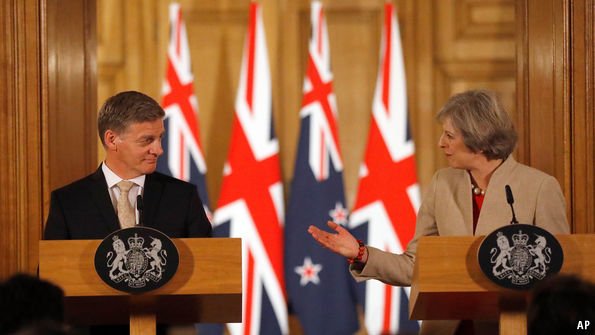
THE future of British trade after Brexit is shrouded in uncertainty. It is an unprecedented process, so it is hard to know where to look for clues as to how it may work out. One possibility is a country whose trading patterns were perhaps more disrupted than any other’s by Britain’s accession to the European Economic Community (EEC) in 1973: New Zealand.
Just as Brexit is likely to mean the end of British access to the single market, so “Brentry” ended New Zealand’s preferential access to the “mother country”. In 1961, when Britain first announced its intention to join the EEC, it took about half of New Zealand’s exports—a similar proportion to the EU’s share of British exports today.
New Zealand’s prime minister at the time, Keith Holyoake, warned his British counterpart, Harold Macmillan, that, without safeguards for its exports, New Zealand would be “ruined”. After years of negotiations, a transitional deal in 1971 agreed quotas for New Zealand butter, cheese and lamb over a five-year period, which helped to ease the shift away from Britain. Similarly—if in a much shorter time-span—Britain’s prime…Continue reading
The elderly, cognitive decline and banking

“THE older the wiser” may ring true for much of life, but not for our ability to handle money. Studies suggest financial decision-making ability tends to reach its peak in a person’s mid-50s, after when deterioration sets in. “Age-friendly” banks are beginning to learn how to protect vulnerable older customers.
The most dramatic forms of age-related mental deterioration are neurodegenerative diseases, like Alzheimer’s. But even “normal” ageing can cause cognitive change. Financial-management skills are often early casualties, because they demand both knowledge and judgment.
Older people are more likely to struggle with day-to-day banking and are more susceptible to poor investment decisions. They are also more vulnerable to fraud or to financial exploitation, often by relatives. In 2010 the over-65s in America made up 13% of the population but had over a third of the wealth. British pensioners became especially vulnerable when reforms in April 2015 allowed them to withdraw savings previously locked up. Newspapers fretted that people would splurge their pensions on Lamborghinis. A greater concern should have been that they…Continue reading