
Tag: Approved
European financial centres after Brexit
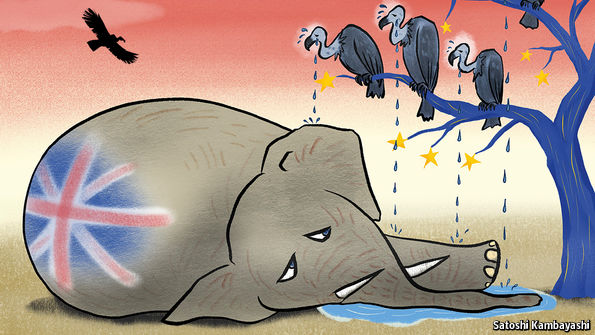
“WHEN the vote took place,” says Valérie Pécresse, “it was an opportunity for us to promote Île de France”, the region around Paris of which she is the elected head. Two advertising campaigns were prepared, depending on the result of Britain’s referendum last June on leaving the European Union. The unused copy ran: “You made one good decision. Make another. Choose Paris region.”
Brexit has made Paris bolder. Once Britain leaves Europe’s single market, the many international banks and other firms that have made London their EU home will lose the “passports” that allow them to serve clients in the other 27 states. Possibly, mutual recognition by Britain and the EU of each other’s regulatory regimes will persist. But no one can rely on the transition to Brexit being smooth, rather than a feared “cliff edge”. Best to assume the worst.
Britain is expected to start the two-year process of withdrawal next month. Given the time needed to get approval from regulators, find offices and move (or hire) staff, financial firms have long been weighing their options. London will remain Europe’s leading centre, but other cities…Continue reading
Sovereign-bond issuers shrug off downgrades
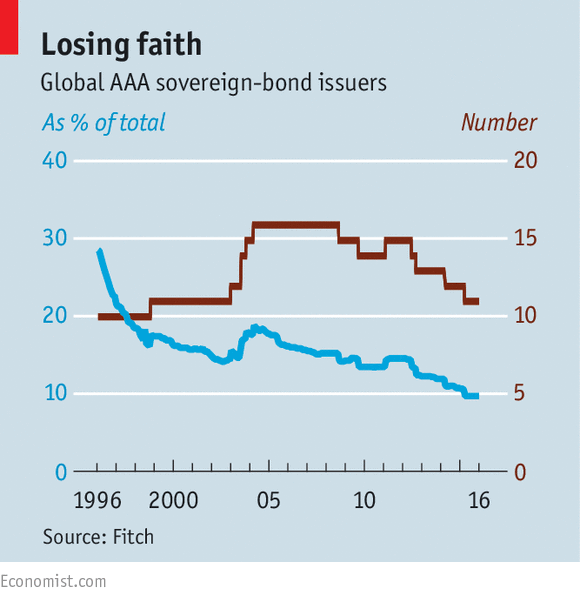
ONCE upon a time, countries jealously guarded their credit ratings. Before the 2010 British election, George Osborne, soon to be the chancellor of the exchequer, emphasised the importance of cutting the budget deficit in order to maintain the country’s top AAA rating.
But despite the spending cuts and the tax increases he imposed, Britain was downgraded in 2013. There are only 11 countries with AAA status, according to Fitch, a rating agency, down from 16 in 2009. By value, only 40% of global sovereign debt has the highest rating, down from 48% a decade ago.
There has been an even more dramatic downward trend in corporate debt ratings. There were 99 AAA-rated American corporations in 1992, according to S&P Global, another ratings group; now there are just two. That trend is linked to the tax deductibility of interest: in terms of tax efficiency, it has made sense to increase the amount of debt, and reduce the equity, on the balance-sheet.
Clearly, at the sovereign level, the deterioration has been driven by the global financial crisis, which dented both economic growth and tax revenue. But with bond yields very…Continue reading
A settlement ends Hank Greenberg’s epic lawsuit

A SETTLEMENT to be signed in front of a New York judge as The Economist went to press on February 16th marked the end of years of attritional legal warfare. It was less clear who had won: the state of New York or Maurice (Hank) Greenberg, the now 91-year-old former chief executive of AIG, once the world’s largest insurer, but saved by a government bail-out in 2008.
Eric Schneiderman, New York’s attorney-general, had seemed in little doubt when he issued a surprise statement on February 10th. Hank Greenberg had admitted “to initiating, participating and approving two fraudulent transactions…that fundamentally misrepresented AIG’s finances.” He had agreed to pay a $9m fine.
Mr Greenberg, however, saw things differently. Within hours of Mr Schneiderman’s statement, his attorney, David Boies, issued a response, accusing the state of being false and misleading and noting that Mr Greenberg’s own carefully negotiated statement had no “reference to any accounting being fraudulent” or suggested that Mr Greenberg was aware of any fraud.
By February 13th Mr Greenberg was on the offensive. In a press…Continue reading
Spain’s banking clean-up

ALMOST five years have passed since the near-collapse of Bankia, one of Spain’s biggest lenders, forced the country into a European banking bail-out. But inquiries into what went wrong continue—and widen. This week, for the first time, the investigations embroiled Spain’s financial regulators, including a former governor of the central bank, the Bank of Spain, Miguel Angel Fernández Ordóñez.
On February 13th the national court indicted Mr Fernández Ordóñez and seven other senior regulators, ordering a criminal investigation but without specifying any charges. The court is questioning why they allowed Bankia to sell shares in an initial public offering in 2011, less than a year before Bankia’s portfolio of bad mortgage loans forced the government to seize control of it. It said there was evidence the regulators had “full and thorough knowledge” of Bankia’s plight. After its nationalisation, it went on to report a €19.2bn ($24.7bn) loss for 2012, the largest in Spanish corporate history.
The investigation comes as several bankers are already awaiting sentencing for mismanagement and fraud. Most prominent…Continue reading
The European Union’s delicate political economy

GREECE’S marathon crisis is at least instructive. Past flare-ups have illustrated a textbook’s worth of economic principles. The latest episode—a dispute over the sustainability of Greece’s mammoth debt—provides a lesson in political economy. The beleaguered economy itself is not at the centre of the disagreement; rather it is the European Commission and the IMF and others that are at loggerheads, squabbling over projections of Greek growth. This sort of institutional wrangling is not incidental to the process of European integration; it has historically been a crucial ingredient, helping defang the continent’s tricky interstate relations. But as Greece’s latest turn in the spotlight demonstrates, the role of Europe’s institutions has changed during the euro-area crisis. Paradoxically, they themselves have become part of the existential threat facing the European project.
Like European identity itself, the role of “institutions” can seem vague, amorphous and of overstated importance. Yet institution-building has been one of the most consequential aspects of European integration. Economists view institutions as the solutions to social…Continue reading
Investors flock to buy a piece of Mexico’s leading tequila-maker

OVER the course of more than 200 years in the tequila business, Jose Cuervo will have been responsible for a fair few moments of giddy pleasure. Last week, it got one of its own thanks to a successful initial public offering (IPO). It was eight times oversubscribed and raised 18.6bn pesos ($920m) in exchange for 15% of the company.
Jose Cuervo, which is based in the western state of Jalisco, is one of the country’s best-known brands, and has been run by the same family for 11 generations. It dominates the Mexican tequila industry; sales in 2015 came to 18.5bn pesos. It also holds an assured place in the history of mixology: the original margarita cocktails were purportedly made with Jose Cuervo tequila.
Long considered a candidate for flotation, it eventually published a prospectus in September 2016. The IPO was delayed, though, seemingly to allow the company to take stock of the impact of Donald Trump’s election victory in November. Since then the peso has dropped over 10% against the dollar, and Mr Trump’s desire to rework, even to rip up, the North Atlantic Free-Trade Agreement, and perhaps impose a border tax on Mexican exports to America has sent tremors…Continue reading
Tata’s governance is still faulty
 Chandra in, Cyrus out
PROFIT is to good corporate governance what tides are to swimming trunks: when the former is high, absence of the latter tends to go unnoticed. The ebbing of profits at Tata, India’s largest conglomerate, in recent years has prompted a power struggle that in turn has exposed the often dysfunctional relationship between several dozen businesses, holding companies, people and charities that use the Tata name. The struggle is now over: on February 6th, Cyrus Mistry, Tata’s boss until last October (pictured on next page, on the right) was finally booted out of the company. Natarajan Chandrasekaran (on the left), the boss of one of the group’s key operating firms, Tata Consultancy Services, takes over as chairman on February 21st.
Executives at the 149-year-old group hope that will close a grim chapter in its history. Mr Mistry, whose family owns an 18% stake in Tata Sons, the main holding company, which is unlisted, reacted badly to being evicted as its chairman last year. The move to oust him was set in motion by Ratan Tata, the group’s 79-year old patriarch (and Mr Mistry’s interim successor)….Continue reading
Ralph Lauren and Macy’s tell a similar tale of woe

NEW YORK’s fashion week, which will start on February 9th, promises the usual show of glamour, but a more fascinating industry display came a week earlier. On February 2nd Ralph Lauren, a well-known brand, said that the executive it had hired in 2015 to overhaul its business would leave. On February 3rd the Wall Street Journal reported that Macy’s, America’s biggest department store, might be bought by Hudson’s Bay, a smaller Canadian rival. Each is an institution of American retailing. Each is a reminder of how hard it is to keep pace.
Consumer habits have changed especially rapidly in their world. Frocks, bags and shoes are now disproportionately bought online compared with other goods. Last year clothes and accessories accounted for a fifth of e-commerce, estimates Cowen, a financial-services firm; far higher than their 8% share of total retail spending. Cowen expects Amazon to surpass Macy’s as America’s top clothing seller this year.
For manufacturers, such as Ralph Lauren, the picture is more mixed. For some clothing firms, particularly small ones, Amazon offers a new way to reach…Continue reading
Internet firms’ legal immunity is under threat

GOOGLE, Facebook and other online giants like to see their rapid rise as the product of their founders’ brilliance. Others argue that their success is more a result of lucky timing and network effects—the economic forces that tend to make bigger firms even bigger. Often forgotten is a third reason for their triumph: in America and, to some extent, in Europe, online platforms have been inhabiting a parallel legal universe. Broadly speaking, they are not legally responsible, either for what their users do or for the harm that their services can cause in the real world.
It is becoming ever clearer, however, that this era of digital exceptionalism cannot last for ever. Governments and courts are chipping away at the sovereignty of internet firms, and public opinion is pushing them to police themselves better. Given their growing heft, this shift is likely not just to continue but to accelerate.
When the internet went mainstream in the mid-1990s, online firms feared being held liable if their services were used in illegal ways—for instance, when subscribers posted copyrighted content or defamatory information. The danger was underlined in…Continue reading
China tightens monetary policy (discreetly)

IF ASKED before the start of 2017 to bet on which important central bank would be the first to raise interest rates this year, the safe choice would have been the Federal Reserve. Some gamblers, relishing the long odds, might have gone for the Bank of England or even taken a flutter on the European Central Bank. All these guesses would have been wrong. The first to budge this year? The People’s Bank of China.
On February 3rd the Chinese central bank raised a series of short-term rates. The decision received scant attention. The increases were, after all, small: one-tenth of a percentage point for the main rates. It also seemed quite technical, primarily affecting liquidity tools that lenders can tap if short of cash. And there was no fanfare: the central bank did not publish an explanation.
But China’s move is important for two reasons. First, it highlights the government’s dilemma in managing the economy. Growth is expected to slow from last year’s pace of 6.7%, and recent surveys suggest that momentum is already ebbing. Sentiment is fragile: investment by private companies last year increased at its slowest pace in more than a…Continue reading