
Tag: Approved
The sanctity of trade statistics
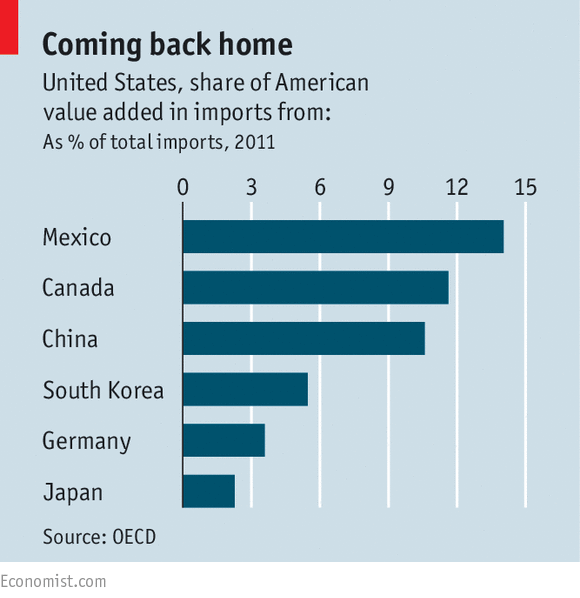
MIGHT Donald Trump’s promise to shake up America’s trade policy extend to its statistics? According to a report in the Wall Street Journal, discussions are afoot on changing the way trade figures are tallied. The Bureau of Economic Analysis, the country’s main statistical body, calls this “completely inaccurate”. But in trade as elsewhere, the new administration seems prone to using statistics as a drunk uses a lamppost—for support rather than illumination.
The proposal reportedly involves stripping out some of America’s exports from the gross numbers. America sold $1.5trn of goods abroad in 2016, but of that $0.2trn were re-exports that left the country much as they had arrived. This type of trade has been growing, reflecting America’s role as a hub for North American trade. As a share of its combined exports to Mexico and Canada, re-exports rose from 12% to 20% between 2002 and 2016. Truckers and shippers benefit from this kind of trade. But critics see it as “padding”, obscuring gloomier trends in “made in America” exports.
Stripping out re-exports makes no sense when thinking…Continue reading
Europe’s securitisation market remains stunted
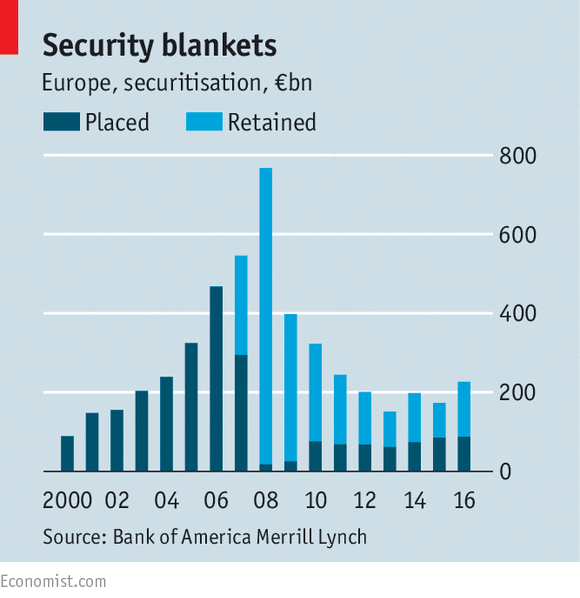
SECURITISATION, the bundling and repackaging of income streams as tradable securities, goes in and out of fashion. America is still dealing with the fallout from the disaster in one part of the market—sub-prime mortgages—in 2008-09 (see article). In Europe, the swings in popularity have been just as marked. During the crisis, European securitised assets were hit by only small losses but the market suffered from guilt by association. It has since enjoyed a limited renaissance.
Leading the revival, oddly, are European regulators. They have sought not just to rehabilitate, but indeed actively to promote such “structured” finance. As early as 2013 the European Central Bank (ECB) was effusive not only about securitisation’s ability to spread risks, but also about its ability to channel funding to the economy, including small and medium-sized enterprises (SMEs). The ECB and the Bank of England even published a rare joint paper in 2014 making the case for a “better-functioning…Continue reading
India’s hostels for the upwardly mobile
 Rite of passage
IF SEVERAL hundred million Indians do migrate from the countryside to cities between now and 2050, as the UN expects, it will be a fiendishly busy few decades for Vivek Aher, who runs a low-cost hostel, one of five, on the outskirts of Pune, a well-off city three hours’ drive from Mumbai. A fair few of the new arrivals will have their first experience of urban living bunking in one of the hostels’ 1,350 beds. Should recent experience be anything to go by, most of the new arrivals will test Mr Aher’s patience by tacking posters on his hostel’s walls, or endlessly complaining about the Wi-Fi.
India has two main drags on economic growth. One is the difficulty of finding a job, especially in the places people live. The other is a chronic shortage of cheap housing. Aarusha Homes, Mr Aher’s employer, started in 2007 to help people seize economic opportunities far from home. Its rooms are basic and cheap. They include up to six beds, a bathroom for every three or four residents, some common areas and little else. Rent ranges between 3,500 and 10,000 rupees ($52-$149) a month including food.
Most…Continue reading
Toymakers bounce back in the land of adult nappies

WILLIAM ELLIOT GRIFFIS, an American educator who travelled to Japan in the 1870s, noted that in the previous two and a half centuries, “the main business of this nation was play”. He described toyshops filled as full as Christmas stockings and plenty of grown-ups “indulging in amusements which the men of the West lay aside with their pinafores”.
Griffis would have found it familiar walking today around Hakuhinkan Toy Park, one of the largest toy stores in Tokyo. Teens, office workers and grandparents are mostly to be seen perusing its 200,000-odd knick-knacks across five floors. Its director, Hiroyuki Itoh, says he wants the store to be a place where everyone can play. After work, suited salarymen come to spend ¥200 (under $2) for a five-minute whizz around a 36-metre slot-car racetrack. In another corner a gaggle of university students fiddle with displays of toys from the era of their childhoods.
Playthings aimed at the over-20s make up 27% of Japan’s domestic toy sales, according to figures from Euromonitor, a market-research firm. That grown-up portion of the market has been crucial for Japan’s three biggest players,…Continue reading
Why national budgets need to take gender into account
 A good investment
LIKE many rich-country governments, Britain’s prides itself on pursuing policies that promote sexual equality. However, it fails to live up to its word, argues the Women’s Budget Group, a feminist think-tank that has been scrutinising Britain’s economic policy since 1989. A report in 2016 from the House of Commons Library, an impartial research service, suggests that in 2010-15 women bore the cost of 85% of savings to the Treasury worth £23bn ($29bn) from austerity measures, specifically cuts in welfare benefits and in direct taxes. Because women earn less, rely more on benefits, and are much more likely than men to be single parents, the cuts affected them disproportionately.
The government does not set out to discriminate, says Diane Elson, the budget group’s former chair. Rather, it overlooks its own bias because it does not take the trouble to assess how policies affect women. Government budgets are supposed to be “gender-neutral”; in fact they are gender-ignorant. Ms Elson is one of the originators of a technique called “gender budgeting”—in which governments analyse fiscal policy in…Continue reading
Are technology firms madly overvalued?
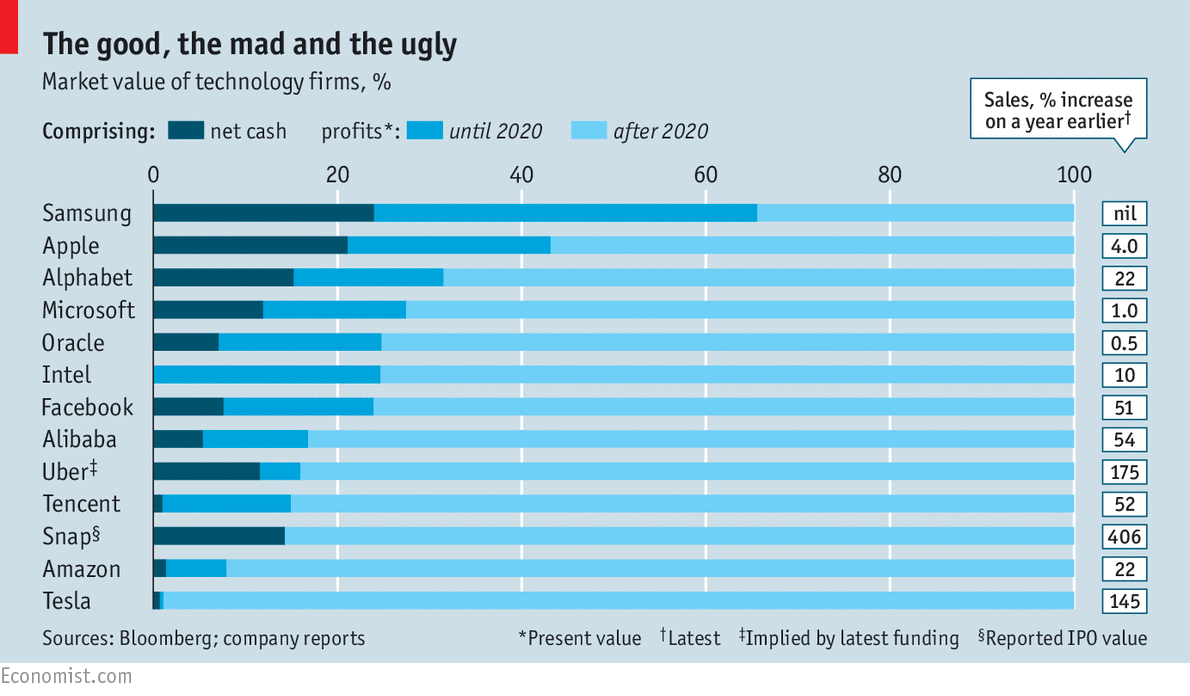
IS THE technology industry in La La Land? There are alarming signs. House prices in San Francisco have risen by 66% more than in New York over the past five years. Even at the height of the dotcom bubble in 2001, the gap was lower, at 58%. Shares of technology firms trade on their highest ratio to sales since the turn of the century. Four of the world’s most valuable firms are tech companies: Apple, Alphabet, Microsoft and Amazon. Snap, a tiddler with $400m of sales and $700m of cash losses in 2016, is expected to list shares on March 1st that will give it a valuation of over $20bn.
For companies and investors in any industry, it is hard to work out if you are living in a bubble. To help, Schumpeter has created three sanity tests for global tech firms. These examine their cashflow, whether investors differentiate between companies, and whether forecasts of their future earnings suffer from a fallacy of composition. The exercise suggests that tech valuations are frothy, but not bubbling.
The first test is cashflow, and the industry passes it with flying colours. In 2001 about half of all listed tech firms were unable to convert…Continue reading
The rise of “deep-tech” is boosting Paris’s startup scene

EUROPE will never create a hub of tech firms and investors to rival Silicon Valley, many experts on entrepreneurship concur. Its markets are still fragmented along national lines, flows of capital into the region are limited and because of lingering, conservative attitudes to risk, few startups grow to rival American champions. “Europe is toxic”, argues Oussama Ammar, an outspoken founder of an incubator in Paris. “Life that should happen, does not happen”, he says.
But some digital life does flourish, spread among cities rather than fixing in one spot. Fintech firms cluster in London. Gamers and music-sharing sites do well in the Nordic countries. Berlin has a crop of companies that go beyond the kind of me-too consumer sites incubated by Rocket Internet, a notorious startup factory: new companies with expertise in the “internet of things”, for example. Milan, with strong medical universities, has flourishing biotech startups.
The most striking case of fresh growth is in Paris. Mention of France has long elicited sighs from venture capitalists. Its rigid labour laws and hefty taxes on wealth and on stock options have meant that…Continue reading
In fintech, China shows the way

CHINESE banks are not far removed from the age of the abacus. In the 1980s they used these ancient counting boards for much of their business. In the 1990s many bank employees had to pass a basic abacus test. Today the occasional click-clack, click-clack can still be heard in villages as tellers slide their abacus beads up and down the rack.
But these days the abacus is mainly a symbol, more likely to be used in the branding of China’s online-finance companies than as a calculating tool. At least three internet lenders have paid homage to it in their names: Abacus Loans, Small Abacus and Modern Abacus. The prominence, so recently, of the abacus is testament to how backward Chinese banking was a short time ago. The rise of the online lenders shows how quickly change has come.
By just about any measure of size, China is the world’s leader in fintech (short for “financial technology”, and referring here to internet-based banking and investment). It is far and away the biggest market for digital payments, accounting for nearly half of the global total. It is dominant in online lending, occupying three-quarters of the global market. A…Continue reading
Why taxing robots is not a good idea

BILL GATES is an unlikely Luddite, however much Microsoft may have provoked people to take a hammer to their computers. Yet in a recent interview with Quartz, an online publication, he expressed scepticism about society’s ability to manage rapid automation. To forestall a social crisis, he mused, governments should consider a tax on robots; if automation slows as a result, so much the better. It is an intriguing if impracticable idea, which reveals a lot about the challenge of automation.
In some distant future robots with their own consciousnesses, nest-eggs and accountants might pay income taxes like the rest of us (presumably with as much enthusiasm). That is not what Mr Gates has in mind. He argues that today’s robots should be taxed—either their installation, or the profits firms enjoy by saving on the costs of the human labour displaced. The money generated could be used to retrain workers, and perhaps to finance an expansion of health care and education, which provide lots of hard-to-automate jobs in teaching or caring for the old and sick.
A robot is a capital investment, like a blast furnace or a…Continue reading
Samsung’s boss is arrested on bribery charges

IN ONE of the many interrogations Lee Jae-yong has undergone in connection with a presidential influence-peddling scandal, he said that he would surrender management control of Samsung, the South Korean electronics giant that he is running on behalf of his incapacitated father, Lee Kun-hee, “if there is anyone better than me”. He may now be forced to do so. On February 17th Mr Lee was arrested on suspicion of bribery, embezzlement, perjury, moving assets abroad illegally and concealing evidence of criminal profit, after a local court agreed to a request from a special prosecution team for a pre-trial detention.
Last month investigators accused Mr Lee of paying 43bn won ($36m) in bribes to organisations tied to Choi Soon-sil, a confidante of South Korea’s president, Park Geun-hye (who is herself under investigation by the constitutional court). The prosecution team’s first request for a pre-trial arrest warrant was rejected. But the court reversed its decision, it said today, after prosecutors put forward additional evidence. (The court denied, however, a request to arrest another Samsung executive, Park Sang-jin, on similar charges.) The move…Continue reading