
Tag: Approved
An impossible mind: the late Kenneth Arrow

SOME great economists are Aristotelians, discerning the logic of markets from tangible examples around them. Others are Platonists, using their powers of reasoning to grasp ideal economic forms, of which actually existing markets are but flickering shadows. Kenneth Arrow, who died on February 21st aged 95, was both. His ideas gave economics some of its most compelling abstractions and most fruitful applications.
The abstractions won him the Nobel prize at the age of 51. (He remains the youngest winner and the most cited by others in their prize lectures.) He established the conditions under which prices might successfully co-ordinate production and exchange, eliminating shortages and surpluses. Adam Smith provided the best metaphor for this underappreciated feat: the “invisible hand”, guiding resources to their best uses. Ken Arrow and his co-author, Gérard Debreu, provided the best algebra.
To economists versed in mathematics, a well co-ordinated economy is like a system of simultaneous equations, which all hold true at the same time. The solution to these equations is a set of prices that equates demand and supply for scarce commodities…Continue reading
Competition for private-equity deals heats up

TIME was, the private-equity industry felt spoiled for choice. The difficulty was choosing deals, not finding them. Yet according to numbers from Dealogic, a data provider, that have been crunched by Bain & Company, a consultancy, private-equity houses are now losing out in mergers and acquisitions (M&A) to non-financial companies. In 2016 private equity’s global share of all deals dipped to 4.2%, the lowest level since the depths of the post-crisis recession in 2009. This was down from 5.4% as recently as 2014 and an all-time high of 7.9% in 2006. The same trend is evident in Europe and in America, private equity’s two biggest markets (see chart).
Yet the pressure on private-equity firms to deploy their capital has never been greater. The industry has raised well over $500bn from investors in each of the past four years, the longest such streak ever. The amount of uninvested cash they are sitting on (“dry powder”) reached a record $1.47trn at the end of 2016. Of that, $534bn was specifically earmarked for buy-outs. Investors, who pay fees as a percentage of the capital they have committed, even when it is still uninvested,…Continue reading
Second-degree moral hazard
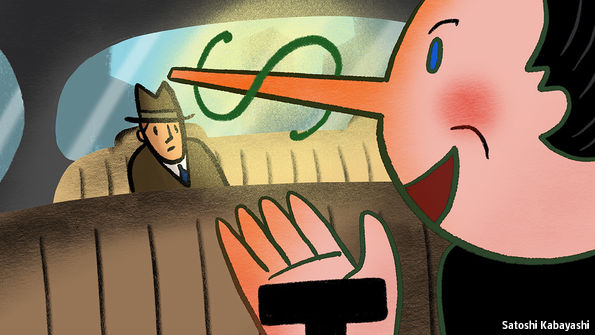
MORAL hazard is a problem that crops up often in economics. People behave differently if they do not face the full costs or risks of their actions: deposit insurance makes customers less careful about picking their bank, for example.
Moral hazard can also be second-hand. Take medicine. A patient with private insurance may be happy to sit through extra tests, and a doctor may be happy to order them. Doctors might be more reluctant to order tests if they know that the patient would bear the full cost.
A newly published paper* sets out to test this secondary problem by examining a common-enough situation—taking a taxi ride in a strange city. The authors, a trio of academics at the University of Innsbruck, sent researchers on 400 taxi rides, covering 11 different routes, in Athens, Greece. In all cases, the researchers indicated they were not familiar with the city. But in half the cases, the researchers indicated that their employers would be reimbursing them for the journey. The researchers in the latter group were 17% more likely to be overcharged for their trip and paid a fare that was, on average, 7% higher.
The most common form of…Continue reading
Interest rates and investment returns

IF THERE is one aspect of the current era sure to obsess the financial historians of tomorrow, it is the unprecedentedly low level of interest rates. Never before have deposit rates or bond yields been so depressed in nominal terms, with some governments even able to borrow at negative rates. It is taking a long time for investors to adjust their assumptions accordingly.
Real interest rates (ie, allowing for inflation) are also low. As measured by inflation-linked bonds, they are around -1% in big rich economies. In their latest annual report for Credit Suisse on global investment returns, Elroy Dimson of Cambridge University and Paul Marsh and Mike Staunton of the London Business School look at the relationship between real interest rates and future investment returns. Very low real rates have in the past been associated with poor future equity returns (see chart).
That may come as a nasty shock for state and local-government pension funds in America. They have to assume a future rate of return on their investments when calculating how much they need to contribute to their plans each year. Most opt for 7-8%, a level that has…Continue reading
Travis Kalanick’s uber-apology

“I MUST fundamentally change as a leader and grow up.” It is rare for the boss of a big technology firm to be so contrite. It is even more of a surprise to have Travis Kalanick (pictured), the chief executive of Uber, a popular ride-hailing company, go that far: he is one of the most pugnacious entrepreneurs in Silicon Valley. “This is the first time I’ve been willing to admit that I need leadership help and I intend to get it,” he added.
Mr Kalanick had little option but to grovel. On February 28th Bloomberg, a media group, released a video showing a heated discussion between him and an Uber driver, Fawzi Kamel, about the fact that the firm has lowered the rates its drivers receive. Mr Kamel told Mr Kalanick that he had lost $97,000 and gone bankrupt because of him, at which point Mr Kalanick lost his cool: “Some people don’t like to take responsibility for their own shit.”
The video capped a terrible month for Mr Kalanick. First, more than 200,000 subscribers deleted their Uber app after the firm was accused of breaking a strike by taxi drivers protesting Donald Trump’s executive order against refugees. Then a former…Continue reading
Taxi drivers overcharge when passengers are on expenses

MORAL hazard is a problem that crops up frequently in economics. People behave differently if they do not face the full costs or risks of their actions: deposit insurance makes customers less careful about choosing their banks, for example.
Moral hazard can also be second-hand. Take medicine. A patient with private insurance may be happy to sit through extra tests, and a doctor may be happy to order them. Doctors might be more reluctant to order tests if they know that the patient would bear the full cost.
A newly published paper* sets out to test this secondary problem by examining a common-enough situation—taking a taxi ride in a strange city. The authors, a trio of academics at the University of Innsbruck, sent researchers on 400 taxi rides, covering 11 different routes, in Athens, Greece. In all cases, the researchers indicated they were not familiar with the city. But in half the cases, the researchers indicated that their employers would be reimbursing them for the journey. The researchers in the latter group were 17% more likely to be overcharged for their trip and paid a fare that was, on average, 7% higher.
The most…Continue reading
The rise of artificial intelligence is creating new variety in the chip market, and trouble for Intel
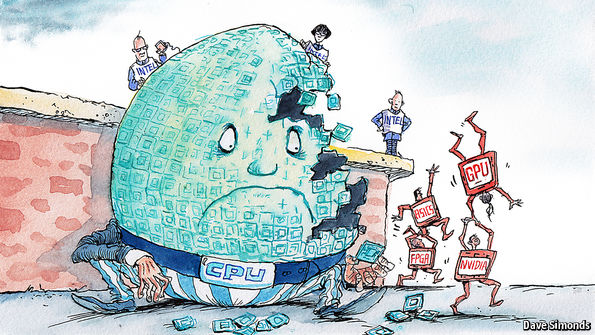
“WE ALMOST went out of business several times.” Usually founders don’t talk about their company’s near-death experiences. But Jen-Hsun Huang, the boss of Nvidia, has no reason to be coy. His firm, which develops microprocessors and related software, is on a winning streak. In the past quarter its revenues increased by 55%, reaching $2.2bn, and in the past 12 months its share price has almost quadrupled.
A big part of Nvidia’s success is because demand is growing quickly for its chips, called graphics processing units (GPUs), which turn personal computers into fast gaming devices. But the GPUs also have new destinations: notably data centres where artificial-intelligence (AI) programmes gobble up the vast quantities of computing power that they generate.

Soaring sales of these chips (see chart) are the clearest sign yet of a secular shift in information technology. The architecture of computing is fragmenting…Continue reading
Investors in America’s housing-finance giants lose in court

ONE unresolved issue from the financial crisis is the future of Fannie Mae and Freddie Mac, the two firms that stand behind much of America’s housing market. Fannie and Freddie purchase mortgages, bundle them into securities and sell them on to investors with a guarantee. When America’s housing market collapsed a decade ago, the government had to bail them out. Its treatment of the firms since then has created a titanic legal struggle. Shareholders have cried foul. On February 21st, a federal appeals court upheld a ruling in the government’s favour.
At issue is the Obama administration’s decision in 2012 to hoover up all of Fannie and Freddie’s profits. Until then, it had received a fixed dividend on its investment. The timing of the shift was striking—just before a surge in the firms’ profitability. Since 2008 the Treasury has sucked in about $250bn from the firms, 30% more than the cost of the bail-out.
The change enraged hedge funds who had bought Fannie and Freddie’s shares and found themselves expropriated. The investors’ lawsuit held that the government overstepped its authority by seizing all profits. A federal court…Continue reading
3G missed Unilever but its methods are spreading
 Rejected suitor
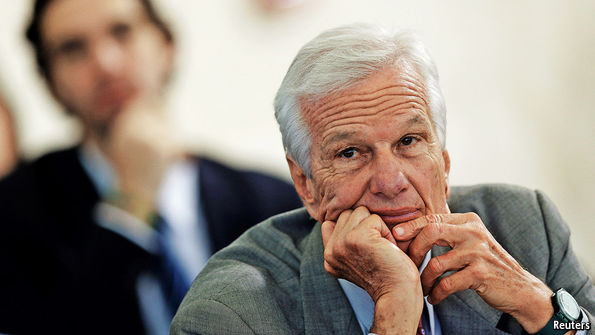
JORGE PAULO LEMANN (pictured), a Brazilian investor, is ill-accustomed to failure. On February 17th Kraft Heinz, backed by Mr Lemann’s 3G Capital, said it had bid $143bn for Unilever, a maker of food and personal products. 3G has gobbled many a consumer firm, slashed costs, then bought an even bigger one. Even so, the Unilever bid was surprising in its audacity—the merger would have been the second-largest ever. As shocking, it collapsed two days later.
Kraft Heinz had hoped to continue talks in private, but news of its offer leaked out. Its management appeared to have badly misjudged the depth of Unilever’s attachment to its culture and its pursuit of long-term, “sustainable” growth. Unilever’s outright rejection meant that 3G and Warren Buffett, who was expected to help fund a deal, faced the prospect of going hostile against a revered firm. It was a rare stumble. But the episode doesn’t spell the end of its model. More deals are likely. And Kraft Heinz is already changing how Unilever and other rivals operate.
Times are hard for big consumer companies, once among the world’s…Continue reading
It is easier than ever to fund an indie film, but harder than ever to get people to see it
 Atypical success
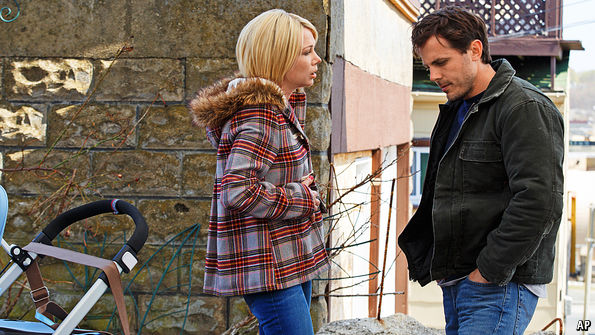
IT MIGHT seem a great time for indie cinema. The Academy Awards on February 26th will be something of a showcase for films not financed by a major studio. “Manchester by the Sea”, a contender for six Oscars, including best picture, was a darling of the Sundance Film Festival last year. Kenneth Lonergan’s masterpiece (one scene is pictured) about family and loss has earned $46m in cinemas in America and Canada, a spectacular return on its production costs of $8.5m. Amazon, which bought distribution rights, will benefit.
Movie buffs can find all manner of films online that are made more cheaply still. “The Break-In”, a horror film shot by Justin Doescher on his girlfriend’s iPhone for less than $20, has earned him more than $20,000, with more than half a million people having watched at least part of it on Amazon’s streaming-video platform.
For every success story there are thousands of indie films that go unwatched. The digital age has made it easier than ever to make a film, but also harder than ever to break through the clutter of entertainment options to an audience. Chris Moore, a…Continue reading