
Tag: Approved
How the City of London hopes to navigate a hard Brexit

THERESA MAY’S speech on January 17th set Britain definitively on a path to a “hard” Brexit, in which it will leave not just the EU but the European single market. This was not what the City of London wanted to hear. The prime minister did at least pick out finance, along with carmaking, as an industry for which “elements of current single-market arrangements” might remain in place as part of a future trade deal. The City is holding out hope that a bespoke deal built on the existing legal concept of “equivalence” could still accord it a fair degree of access to Europe.
“Passporting”, which allows financial firms in one EU member state automatically to serve customers in the other 27 without setting up local operations, was always going to be difficult after Brexit. Outside the single market, says Damian Carolan of Allen & Overy, a law firm, the “passport as we know it is dead.” Already, two big banks, HSBC and UBS, this week each confirmed plans to move 1,000 jobs from London.
Financial companies all have to firm up their contingency plans. For the City, these focus on so-called “equivalence” provisions, allowing third-country financial…Continue reading
Republican tax-reform plans face many hurdles, including Donald Trump

AMONG other things, the start of Donald Trump’s presidency this week heralds a collision between campaigning rhetoric and legislative and economic reality. What follows will be a learning experience for all, it is fair to say. Though not perhaps the most consequential of the looming reality checks, the outcome of a brewing debate over a proposed border-adjusted tax plan could prove a taste of things to come. As Mr Trump and his Congress work to make policy, there are many ways for things to go awry.
Both Mr Trump and congressional Republicans are keen to cut taxes on corporations. America’s inefficient corporate-tax system has remarkably high rates but leaks like a sieve, yielding a pitiful tax take (see chart). As a solution, Mr Trump favours a large cut in the corporate-tax rate, from 35% to 15%, and a chance for companies to repatriate foreign profits at a tax rate of 10%. Paul Ryan, Speaker of the House of Representatives and chief Republican policy wonk, has something very different in mind.
At present American firms are assessed for tax on their global income. This encourages multinationals either to use clever…Continue reading
A merger is the latest sign of Big Tobacco’s resilience

BRITISH AMERICAN TOBACCO (BAT) announced on January 17th a final deal to buy Reynolds American for $49bn. BAT already owns 42% of Reynolds; buying the rest of it will create the world’s largest listed tobacco company by sales and profits. It will peddle brands such as Dunhill, Camel and Newport. The casual observer might imagine the deal to be a frantic bid to revive an ailing industry. On the contrary. Cigarettes may kill you, but the big companies that make them are rather healthy.
That is despite a decline in smoking rates. In 2015 just over a fifth of adults smoked, estimates the World Health Organisation, down from almost a quarter ten years earlier. This drop hardly helps companies, but it isn’t ruinous either.

Smoking is still popular in certain spots. More than three-quarters of men light up in Indonesia, for example. The habit is becoming more common among men in Africa and the eastern…Continue reading
Businesses can and will adapt to the age of populism

AS THEY slid down the streets of Davos this week, many executives will have felt a question gnawing in their guts. Who matters most: shareholders or the people? Around the world a revolt seems under way. A growing cohort—perhaps a majority—of citizens want corporations to be cuddlier, invest more at home, pay higher taxes and wages and employ more people, and are voting for politicians who say they will make all that happen. Yet according to law and convention in most rich countries, firms are run in the interest of shareholders, who usually want companies to use every legal means to maximise their profits.
Naive executives fear that they cannot reconcile these two impulses. Should they fire staff, trim costs and expand abroad—and face the wrath of Donald Trump’s Twitter feed, the disgust of their children and the risk that they’ll be the first against the wall when the revolution comes? Or do they bend to popular opinion and allow profits to fall, inviting the danger that, in the run up to their 2018 annual general meeting, a fund manager from, say, Fidelity or Capital will topple them for underperformance?
Wiser executives…Continue reading
Ukraine’s conflict with Russia is also financial

IN THE tense, uncertain days of late 2013, when Ukrainians filled Kiev’s Independence Square in protest at their government’s turn towards Russia, the then president, Viktor Yanukovych, grabbed a lifeline. To bolster his resolve in resisting the demands of pro-EU protesters, Russia lent Ukraine $3bn in the form of a bond. Mr Yanukovych was subsequently ousted anyway. Russia and Ukraine went to war. The money was never paid back.
So Russia took legal action against Ukraine. The bond was issued under English law, and a hearing began this week in London. Those on the Ukrainian side say the country has no case to answer. In 2015 a group of creditors agreed to a debt restructuring on favourable terms: Russia refused to take part. And Russia itself made it much harder for Ukraine to repay the bond by annexing Crimea and stoking war in the Donbass. Moreover, it has fiddled with gas supplies to the country and slapped on trade sanctions. In 2013-15 Ukraine’s GDP dropped by 15%. The purchasing power of ordinary folk has fallen far more. In 2013 eight hryvni bought one American dollar; it now takes more than 25.
It is not clear, however,…Continue reading
Two big European makers of eyewear agree to merge

GIANT, cross-border mergers in Europe have been rare in recent years. Deals fail to happen even when mid-sized companies—such as family-owned and run specialist manufacturers in northern Italy or the Mittelstand in Germany—have the chance to gain global heft. For that blame founding owner-managers, many of whom are reluctant to lose control of treasured companies. Blame too an artisanal culture, particularly in southern Europe, in which firms’ owners say they are content to remain small and relatively obscure. Occasionally, too, nationalist politicians block efforts by perfidious foreigners to snaffle prized local brands.
Now, though, one of the largest-ever mergers in Europe actually looks set to go ahead. Luxottica, an Italian maker of fancy specs that was founded in 1961—it owns brands such as Ray Ban and Oakley—is to merge with Essilor, a spiffy French producer of lenses. The joint entity is set to combine Italian style with deft French engineering. The deal is supposed to be completed by the end of the year, creating a new entity with a market value of €46bn ($49bn), 140,000 staff and annual revenues of €15bn. It will be…Continue reading
A continental merger between Luxottica and Essilor fits a pattern
 An eye-catching opportunity
IT MAY be an exaggeration to talk of French firms “colonising” corporate Italy. Some Italian business leaders nonetheless fret about expansionists from across the northern border plucking control of some of their most celebrated local firms. Family-run companies, especially, can make tempting prospects: ones that make excellent products but struggle to grow, or that face agonising succession problems, are notably juicy targets.
The latest example, announced this week, is the merger between Luxottica, an Italian maker of fancy specs, and Essilor, a spiffy French producer of lenses. Together they will produce an entity with a market value of at least €46bn ($49bn), 140,000 staff and annual revenues of €15bn. The deal, one of the largest cross-border tie-ups attempted by European firms, had long been expected by industry watchers. The idea is to produce an entity that combines Italian style and skills in marketing with deft French engineering.
The new firm will be listed on the Paris bourse (as probably its eighth-largest firm) later this year. That will mark the culmination of…Continue reading
Tokyo’s showy tuna auctions do not augur economic growth

KIYOSHI KIMURA does not like to lose. For the past six years he has outbid all comers for the first bluefin tuna of the year sold by Tokyo’s famed Tsukiji fish market. Last week Mr Kimura, who owns a chain of sushi shops, paid ¥74.2m ($642,000) to win the first fish. That nets out to some $3,000 per kilogram.
Folk wisdom has it that high tuna-auction prices signal future economic buoyancy. Mr Kimura has said that he pays the exorbitant prices to “encourage Japan”. But that rationale seems fishy.
After a rival Hong Kong bidder baited him, Mr Kimura paid three times as much for the Tsukiji tuna in 2013 as in the previous year—a record-high ¥155.4m. GDP growth did not replicate that rise, however, sinking from 1.7% to 1.4%. In fact, Japan’s economic fortunes and Tokyo’s season-opening tuna prices seem to float rather erratically (see chart). A deep dive by The Economist suggests that tuna prices explain only 6% of the fluctuation in GDP. The correlation is a red herring.
Environmentalists, meanwhile, are gutted. Bluefin tuna are endangered; stocks have plunged by 97% from their peak, according to one estimate. The…Continue reading
Our Big Mac index of global currencies reflects the dollar’s strength
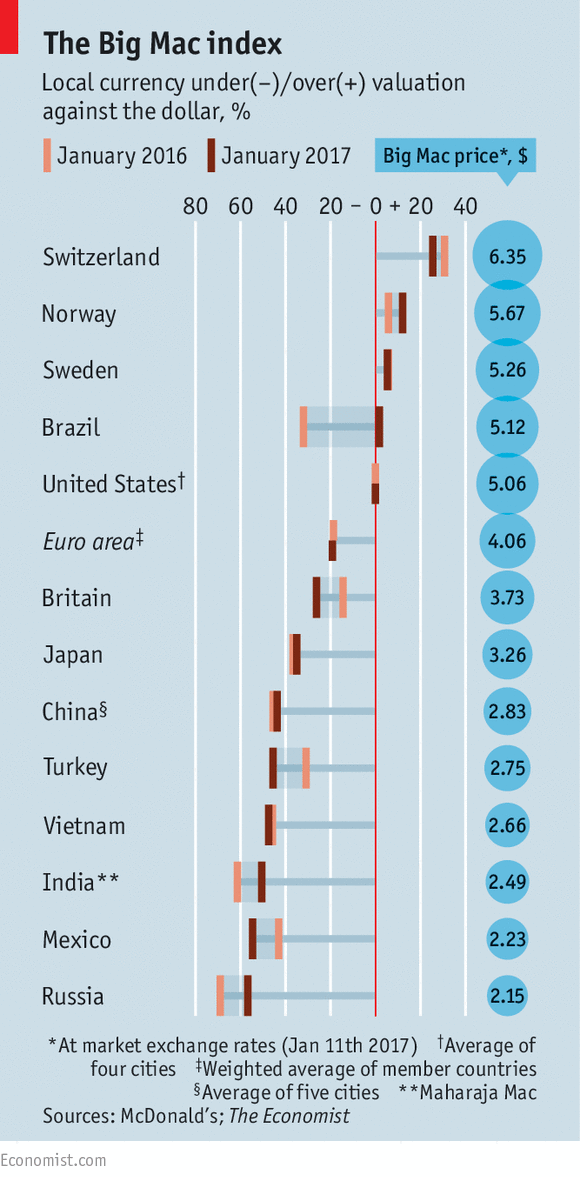
IT IS perhaps not surprising that the worst-performing major currency in the world this year is the Turkish lira. Many emerging-market currencies have taken a battering since the election in November of Donald Trump raised expectations of faster monetary tightening in America and sent the dollar soaring. But the lira has many other troubles to contend with, too: terrorist bombings, an economic slowdown, alarm over plans by the president, Recep Tayyip Erdogan, to strengthen his powers, and a central bank reluctant to raise interest rates to defend the currency. It has plunged to record lows. According to the Big Mac index, our patty-powered currency guide, it is now undervalued by 45.7% against the dollar.
The Big Mac index is built on the idea of purchasing-power parity, the theory that in the long run currencies will converge until the same amount of money buys the same amount of goods and services in every country. A Big Mac currently costs $5.06 in America but just 10.75 lira ($2.75) in Turkey, implying that the lira is undervalued.
However, other currencies are even cheaper. In Big Mac terms, the Mexican peso is…Continue reading
A controversial transaction sits at the heart of Liberty Media’s takeover of Formula One

ON JANUARY 17th shareholders of Liberty Media Corporation, an American firm controlled by John Malone, a billionaire, are expected to approve a transaction that many hail as the sports deal of the decade. In September 2016 Liberty agreed to buy the Formula One (F1) motor-racing franchise from CVC, a private-equity group, for $8bn. F1, which generates annual revenue of $1.8bn, is now central to Liberty’s global plans: in a sign of the importance he attaches to the deal, Mr Malone has installed Chase Carey, a former president of Rupert Murdoch’s 21st Century Fox, as F1 chairman. The main Liberty subsidiary is to be renamed Formula One Group.
The deal has lots of attractions. For F1 it offers a potential solution to the problem of who will take over from Bernie Ecclestone, its 86-year-old impresario. There was no credible succession plan for the man whose wheeling and dealing has long held together the sport and its fractious collection of racing teams. With Mr Carey leading the search, there could be.
As for Liberty, F1 offers the sort of live, exclusive content it needs to lock in audiences that are peeling off to on-demand streaming…Continue reading