
Tag: Approved
Awards
Awards: Tom Easton, our American finance editor, was named journalist of the year by the CFA Society of the UK in a ceremony on January 11th. The Economist was named publication of the year.
China’s currency upsets forecasts by beginning the new year stronger

THE omens for the Chinese yuan seemed bad heading into 2017. The capital account looked as porous as ever, making a mockery of the government’s attempts to fix the leaks. The new year, when residents received fresh allowances for buying foreign currency, was due to bring even more pressure. The mighty dollar would be a magnet for Chinese investors as it strengthened still further in the run-up to Donald Trump’s inauguration. Analysts braced for a stampede for the exits from China. The yuan had fallen sharply at the beginning of 2016, catching them by surprise. This time, they were ready.
Instead, the yuan began the year as one of the world’s star performers. This was particularly so in the offshore market, where foreigners trade it most freely. It gained 2.5% against the dollar over two days in the first week of 2017, its biggest two-day increase since 2010, when trading began in Hong Kong, its main offshore hub. Within China itself, price increases were more subdued, but the yuan still climbed to a one-month high.
The high economic costs of India’s demonetisation

MOST economists might hazard a guess that voiding the bulk of a country’s currency overnight would dent its immediate growth prospects. On November 8th India took this abstruse thought experiment into the real world, scrapping two banknotes which made up 86% of all rupees in circulation. Predictably, the economy appears indeed to have been hobbled by the sudden “demonetisation”. Evidence of the measure’s costs is mounting, while the benefits look ever more uncertain.
At least the new year has brought a semblance of monetary normality. For seven weeks queues had snaked around banks, the main way for Indians to exchange their old notes for new ones or deposit them in their accounts. That is over, largely because the window to exchange money closed on December 30th. The number of fresh notes that can be withdrawn from ATMs or bank counters is still curtailed, but the acute cash shortage is abating, at least in big cities.
As data trickle through, so is evidence of the economic price paid for demonetisation. Consumers, companies and investors all wobbled in late 2016. Fast-moving consumer goods, usually a reliable growth sector, retrenched…Continue reading
Supervisors put off finalising reforms to bank-capital rules

SOME banks find existing capital requirements too taxing. To no one’s surprise, on December 23rd Monte dei Paschi di Siena, at present Italy’s fourth-biggest bank, asked the Italian state for help, having failed to raise from the private sector €5bn ($5.2bn) in capital demanded by the European Central Bank before the year’s end. Three days later Monte dei Paschi said that the ECB had redone its sums—and concluded that the stricken lender faced an even bigger shortfall, of €8.8bn.
Plenty of other European banks—in far better nick than poor old Monte dei Paschi, which is overloaded with bad loans—are grumbling that they too may eventually have to find more capital. They have spent years plumping up cushions that the financial crisis showed to be worryingly thin, but fear that proposed adjustments to Basel 3, the latest global standards, will require more. The Basel Committee on Banking Supervision, which draws up the standards, had hoped to agree on the revisions by the end of 2016. It’s not there yet: on January 3rd an imminent meeting of central-bank governors and supervisors, to approve the changes, was postponed.
The…Continue reading
2016 may have been an economic as well as political turning-point
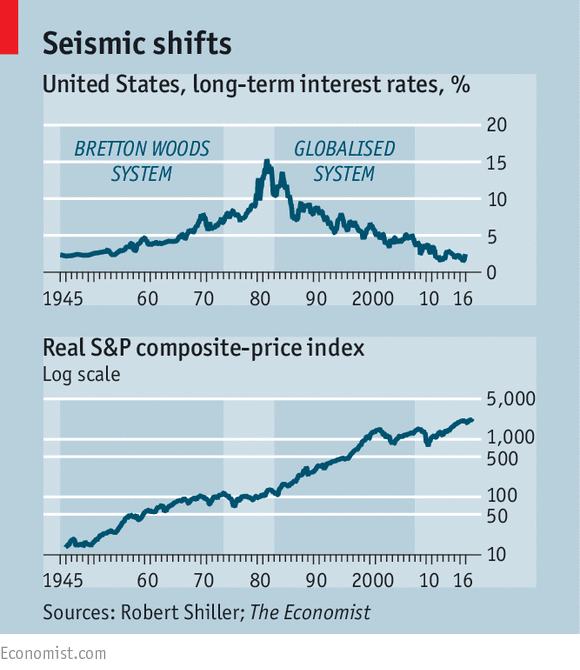
THANKS to Brexit and the election of Donald Trump, 2016 is widely viewed as a political turning-point. But it may also come to be seen as an economic turning-point, marking the third big change of direction since the second world war.
The post-war period from 1945 to 1973 was the era of the Bretton Woods system of fixed exchange rates and capital controls. It was a time of rapid economic growth in the rich world as countries rebuilt themselves after the war and as the technological innovations of the first half of the 20th century—cars, televisions, and so on—came into widespread use. High taxes reduced inequality; fiscal policy was used to control the economic cycle. It all came crashing down in the early 1970s as the fixed-currency system collapsed, and an oil embargo imposed by Arab producers ushered in stagflation (ie, high unemployment combined with inflation).
By the early 1980s, a new system had emerged. Currencies floated, capital controls were abolished, the financial sector was liberalised, industry was privatised and tax rates on higher incomes were cut. In this system inequality widened again (although…Continue reading
Ford Motors courts Donald Trump by scrapping a planned plant in Mexico

IT WAS in the spring of 2016 that Donald Trump singled out Ford Motors, calling its plans to build a plant in Mexico an “absolute disgrace” and promising it would not happen on his watch. Back then, it seemed remarkable that the candidate thought he could boss around a firm of Ford’s stature. On January 3rd Ford cancelled its $1.6bn project in the Mexican state of San Luis Potosí and said it would instead invest $700m into an existing plant in Flat Rock, Michigan, to build electric and autonomous cars.
Ford’s manoeuvre seems more wheel-spin than U-turn. Mr Trump’s strong-arming of corporate America is real enough, and the carmaker will have gained much favour with the president-elect. But its decision can be explained largely in operational terms. The original plan was for the new Mexican plant to build chiefly Focus cars—small passenger vehicles for which demand has fallen, thanks to America’s love affair with SUVs, crossovers and pick-up trucks and to low petrol prices. The decision to scrap the new plant looks far more like Ford reducing its exposure to the small-car game in North America than reducing its footprint in Mexico, says George…Continue reading
“Open outcry” is in retreat but futures and options trading-volumes surge
 Nothing to outcry about
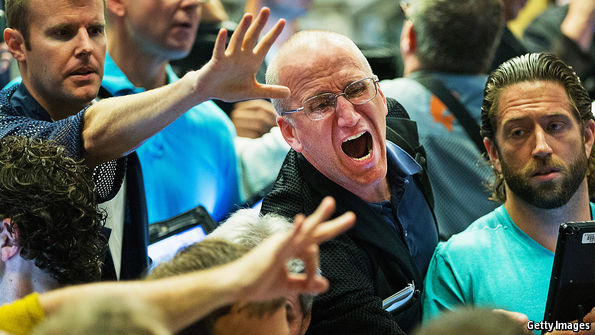
AS A new trading year began this week in the art-deco tower that houses the Chicago Board of Trade, big men were clustered around pits dealing in futures and options tied to various commodities. Their approach dates back to the building’s opening in 1930, and was once familiar in cities throughout America. But after decades of attrition, on December 30th the CME Group (named after the Chicago Mercantile Exchange) closed the “open outcry” trading pits that it operated in New York. In America, Chicago’s hue and cry has become unique.
Even this exchange is a shadow of its former self. There are now nine pits, down from 32 in 2007. A once teeming trading floor was closed in 2015. Most activity in the contracts still traded in the pits is electronic. No one in the surviving CME pits in Chicago seems worried by the New York closures. But they have a symbolic impact. The markets have long been a colourful, fractious component of America’s financial architecture.
They have always lured the ambitious. Two alumni of New York’s commodity markets have joined the Trump administration. Gary…Continue reading
Toshiba admits to a ruinous overpayment for an American nuclear firm
 Ritual contrition
THE probe in 2015 into one of Japan’s largest-ever accounting scandals, at Toshiba, an electronics and nuclear-power conglomerate that has been the epitome of the country’s engineering prowess, concluded that number-fiddling at the firm was “systemic”. It was found to have padded profits by ¥152bn ($1.3bn) between 2008 and 2014. Its boss, and half of the board’s 16 members, resigned; regulators imposed upon it a record fine of $60m.
Now its deal-making nous is in doubt too. In December 2015—the very same month that it forecast hundreds of billions of yen in losses for the financial year then under way, as it struggled to recover from the scandal—Toshiba’s American arm, Westinghouse Electric, bought a nuclear-construction firm, CB&I Stone & Webster. One year on, on December 27th, Toshiba announced that cost overruns at that new unit could lead to several billions of dollars in charges against profits.
Its shares fell by 42% in a three-day stretch as investors dumped them, fearing a write-down that could wipe out its shareholders’ equity, which in late September stood at…Continue reading
Anthony Atkinson, a British economist and expert on inequality, died on January 1st
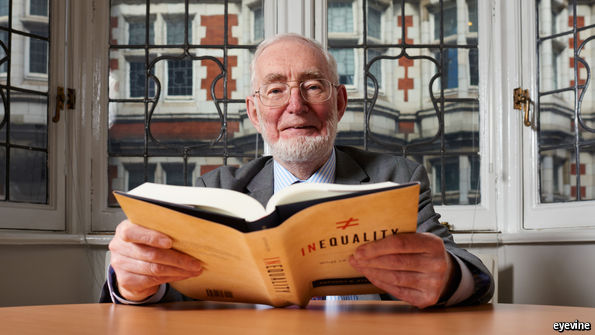
“TIME is of the essence,” wrote Sir Anthony Atkinson, a British economist, in a report on measuring global poverty, published in July 2016. His sense of urgency may have been influenced by another constraint. In 2014 Sir Anthony had been diagnosed with incurable cancer. Some might have paused; he sped up. He chaired the World Bank commission that produced the poverty report, and wrote a book, “Inequality: What Can Be Done?”, in just three months. On January 1st, his time ran out.
In his lifetime, he was tipped for a Nobel prize. On his death, fellow economists rushed to describe him as “one of the all-time greats” and emphasised his extraordinary “decency, humanity and integrity”. The two were linked. For him, economics was about improving people’s lives.
A six-month stint volunteering as a nurse in a hospital in deprived inner-city Hamburg was an early influence. He saw poverty, and went on to spend his life combating it. He fought his battles gently—shying away from the adversarial style he experienced as a student at Cambridge—but with rigorous precision and an unfailing sense of social justice.
The three Rs behind global banks’ recovery

IN THE Bible, seven years of feast were followed by seven years of famine. For banks there have been ten lean years. Subprime-loan defaults started to rise in February 2007, causing a near-collapse of the industry in America and Europe. Next came bail-outs from governments, then years of grovelling before regulators, mass firings of staff and quarter after quarter of poor results that left banks’ shareholders disappointed. Now, a decade later, the moneylenders are quietly wondering if 2017 is the year in which their industry turns a corner.
Over the past six months the FTSE index of global bank shares has leapt by 24%. American banks have led the way, with the value of Bank of America rising by 67%, and that of JPMorgan Chase by 39%. In Europe BNP Paribas’ market value has risen by 52%. In Japan shares in the lumbering Mitsubishi UFJ Financial Group—the rich world’s biggest bank by assets—have behaved like those of a frisky internet startup; they are up by 57%. Predictions about global banks’ future returns on equity have stopped falling, note analysts at UBS, a Swiss bank. Some of the biggest casualties of the financial crisis are even…Continue reading