
Tag: Approved
When stars die, insurers count the cost
 Carrie trade
THE death of Carrie Fisher, a much-loved actor in the “Star Wars” movies, left a hole in the force for fans. It may also burn a hole in the pockets of underwriters, syndicated under Lloyds of London. They may have to fork out as much as $50m to meet Disney’s claim for its loss. The studio, which owns the sci-fi saga, had wisely taken out so-called contractual-protection insurance (CPI) in case death thwarted a contractual obligation: in Ms Fisher’s case to film and promote future “Star Wars” episodes.
Contrary to the headlines, 2016 was not an especially lethal year to be a celebrity. Like the rest of us, they do die. But unlike most of us, their employers can be left with astronomic bills. When Paul Walker, an actor in “The Fast and the Furious”, a series of action movies, died in 2013 while filming the seventh instalment, Universal Pictures had to spend considerable effort (and dollars) to make his on-screen persona live on. This included hiring body-doubles and digitally inserting Mr Walker into the movie with hundreds of computer-generated images.
Most workers are easier to…Continue reading
“Impact investing” inches from niche to mainstream

WHEN investors gathered in Amsterdam in late 2016 for perhaps the largest annual conference on “impact investing”, the mood was upbeat. The concept of investing in assets that offer measurable social or environmental benefits as well as financial returns has come a long way from its modest roots in the early 2000s. Panellists at the conference included, among others, representatives of two of the world’s largest pension funds, TIAA of America and PGGM of the Netherlands, and of the asset-management arm of AXA, a French insurance behemoth. A niche product is inching into the mainstream.
In the past two years BlackRock, the world’s biggest asset manager, launched a new division called “Impact”; Goldman Sachs, an investment bank, acquired an impact-investment firm, Imprint Capital; and two American private-equity firms, Bain Capital and TPG, launched impact funds. The main driver of all this activity is investor demand. Deborah Winshel, boss of BlackRock Impact, points to the transfer of wealth to women and the young, whose investment goals, she says, transcend mere financial returns. Among institutions, sources of demand have…Continue reading
Sub-national currencies struggle to survive
 Five Bowies make a Winston
TUCKED away in a corner of Brixton, in south London, a rainbow-coloured ATM dispenses cash, looking for all the world like any other. But the notes it spews out are not pounds sterling. They are Brixton pounds (B£). Not to be mistaken for silly Monopoly money, the Brixton pound can actually be spent, legally: the currency, which has a fixed one-for-one exchange rate with sterling, is accepted at over 150 local shops and businesses. It can even be used to pay local taxes.
Launched in 2009, this is one of many such initiatives. Local currencies have been adopted in other towns and cities in Britain, such as Bristol, Exeter and Totnes. Elsewhere, examples include the eusko, used in the French Basques; BerkShares, used in western Massachusetts; and the Ithaca Hour, in Ithaca, New York. Barcelona plans an experiment in 2017.
Such schemes aim to boost spending at local retailers and suppliers, by encouraging the recirculation of money within a community. Because the currency is worthless outside its defined geographic area, holders spend it in the neighbourhood, thus creating a “local…Continue reading
The state steps in to rescue Monte dei Paschi di Siena

FOR months, a bail-out had seemed likely; for weeks, unavoidable. On December 23rd it became fact. Monte dei Paschi di Siena, Italy’s third-largest bank and Europe’s most troubled, announced it had requested state help. The European Central Bank (ECB), Monte dei Paschi’s supervisor, had given it until the end of the year to find €5bn ($5.2bn) in equity, but the bank’s attempts to raise the money from the private sector failed. Paolo Gentiloni, Italy’s new prime minister, said that “today represents a turning-point [for the bank] and a reassurance for its depositors and its future”.
That is the hope. The Tuscan lender’s problems have been rumbling for years. In 2007 it ill-advisedly bought Antonveneta, another Italian bank, from Spain’s Santander for €9bn in cash; more tales of mismanagement have emerged since. Monte dei Paschi has already had two state bail-outs, and raised €8bn from share issues in 2014 and 2015. Its gross non-performing loans amount to one-third of its book. In this summer’s European stress tests, it ranked 51st of 51 institutions. In the past year its stockmarket value has fallen by 88%, to a piddling…Continue reading
Germany’s biggest lender reaches a settlement with America’s Department of Justice

WELL, it might have been worse. Early on December 23rd Deutsche Bank announced that it had reached a settlement “in principle” with America’s Department of Justice (DoJ), over claims that it had mis-sold residential mortgage-backed securities (RMBSs) in 2005-07, in the run-up to the financial crisis. Deutsche says the agreement is worth $7.2bn—a far cry from the $14bn that the DoJ demanded in September, sending Deutsche’s share price reeling. Credit Suisse said that it too had struck a deal, worth $5.3bn. However, the DoJ is suing Barclays, with which it had also been negotiating, and two of its bankers. Barclays says it will fight the complaint.
Deutsche, Germany’s biggest bank, has always insisted that it would not pay anything like as much as the DoJ had asked for. Although $7.2bn is more than analysts had expected, investors will probably see the deal as good news: Deutsche will fork out only—“only”—$3.1bn in cash and pay the rest as “consumer relief”, such as changes to borrowers’ loans, which will be spread over five years. On the morning of the announcement the bank’s shares were trading 3-4% up.
Such…Continue reading
The Christmas spending bump flattens

The holiday season’s hold on Americans is getting weaker. In 1994, according to the Census Bureau, retailers earned $82bn (in 2015 dollars) more in sales during November and December than they would have without the seasonal effect of the holidays. That worked out at $310 per person. In 2015 seasonal sales during these months were just $76bn, or $240 per person. The decline in seasonal shopping is steepest in December. For that, blame three things. The growth of e-commerce has made it easier for people to shop for seasonal gifts whenever they want. Gift cards under the Christmas tree push purchases into January. And millennial shoppers are having an impact on sales: they tend to prefer experiences to yet more stuff.
A new industry has sprung up selling “indoor-location” services to retailers

“LOOK up there,” says Edward Armishaw of Walkbase, a Finnish retail-analytics firm, as he points to a small white box above a column clad in mirrors. The sensor—and over a hundred others like it hidden around this department store in London’s Oxford Street—tracks the footsteps of customers through the pings their smartphones emit in search of a Wi-Fi network. Quite unaware, a shopper in a silver puffa jacket ambles past and over to the fitting room. Whether she moves to the till will be logged by Walkbase and its client.
Think of it as footfall 2.0. For many years shops used rudimentary “break-beam” systems—lasers stretched across their entrances—to count people in and out. Only recently have they begun to follow customers inside their buildings, says Nick Pompa of ShopperTrak, an American firm whose work with 2,100 clients worldwide, including malls in Las Vegas and in Liverpool, makes it a giant in the area.
Tracking technologies are ingenious. Some flash out a code to smartphone cameras by means of LED lighting; others, such as IndoorAtlas, a startup with headquarters in California and Finland, monitor how devices…Continue reading
Our Schumpeter columnist pens a dark farewell
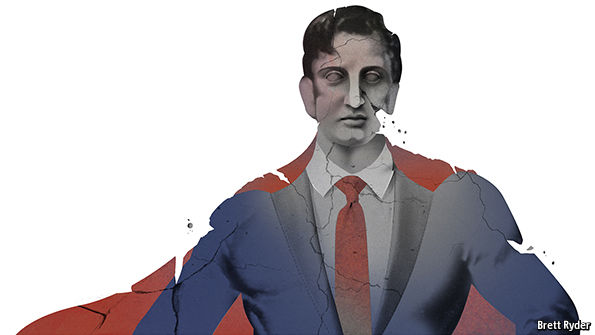
IT WAS in 1942 that Joseph Schumpeter published his only bestseller, “Capitalism, Socialism and Democracy”. The book was popular for good reason. It was a tour de force of economics, history and sociology. It coined memorable phrases such as “creative destruction”. But it was a notably dark book. At a time when people were looking for hope during the life-and-death struggle with Nazism, Schumpeter offered only gloom. “Can capitalism survive?” he asked. “No, I do not think it can.”
This column was inspired by the young Schumpeter’s vision of the businessperson as hero—the Übermensch who dreams up a new world and brings it into being through force of intellect and will. On its debut in September 2009, we argued that Schumpeter was a perfect icon for a business column because, unlike other economists, he focused on business leaders rather than abstract forces and factors. But as Schumpeter grew older, his vision darkened. He became increasingly preoccupied not with heroism but with bureaucratisation, and not with change but with decay. The same is true of the outgoing author of this column.
It would be…Continue reading
In Japan, a new kind of business school is retraining jaded salarymen

THE Institute of Social Human Capital in Tokyo is an unusual sort of business-training school. Those who attend it (two-thirds are men) have mostly quit or taken redundancy packages from big Japanese firms, and are trying to start again. Shedding the habits of a lifetime begins by breaking down barriers: former salarymen laugh nervously as they share a bento-box lunch with strangers, blindfolded (the idea is that they must use their other four senses to communicate).
The way to prepare them for a second career is to get them interacting as individuals, not as corporate workers or business partners, says Matsuhiko Ozawa, a director of the Institute, which specialises in this sort of course. In a country that sets great store by formal introductions, the students have not even exchanged business cards. Names, titles and personal information are banned (the ex-salarymen use made-up names) to avoid reproducing the old office hierarchies that exist outside the classroom. “We start from scratch and help these people find themselves again,” says Mr Ozawa.
For years, the salarymen rode a career escalator that rewarded them less for skills than…Continue reading
Indian business prepares to tap into Aadhaar, a state-owned fingerprint-identification system

THERE are two ways to sign up to Jio, a new and irresistibly priced mobile-telephony service which Mukesh Ambani, the boss of Reliance Industries, a conglomerate, launched in September 2016 and which is luring tens of millions of new customers each month. One way requires a wad of documents, multiple signatures and plenty of patience, since Jio takes days or weeks to go through “know-your-customer” procedures. The second way is magically simple: the person rests a finger on an inch-wide scanner, and if the print matches the identity the customer is claiming, Jio downloads the information it needs from the Indian authorities and activates the phone line within minutes.
Jio is tapping a database called Aadhaar, after the Hindi word for “foundation”. It is a cloud-based ID system that holds the details of over a billion Indians. The government’s purpose in setting it up in 2009 was to help the state correctly direct welfare payments to those entitled to them. By early 2017 all Indian adults should have provided their fingerprints, iris scans, name, birth date, address and gender in return for a single, crucial, 12-digit number.
In the public…Continue reading