
Tag: Approved
Changing the guard at HSBC

YOU spend 38 years at a mighty global bank, the last seven as chief executive. As boss you clean up a stinking mess, the legacy of ill-conceived acquisitions and shoddy practice. You shell out billions in fines and legal costs. You shed businesses and cut jobs by a quarter. You build a solid capital base. You maintain dividends. On your last day, you announce decent results, with revenue growing after five years of shrinkage and profits up nicely. The market’s parting gift to you? The share price falls by 3%.
Analysts had expected better from Stuart Gulliver’s final report as boss of Britain’s HSBC, the world’s seventh-biggest bank by assets, on February 20th. They were surprised by charges for impaired loans to two companies, thought to be Carillion, a failed British contractor, and Steinhoff, a troubled South African retailer, and miffed that HSBC put off buying back more shares. That, the bank said, must wait until it has raised $5bn-7bn of “additional tier-1” capital…Continue reading
Japan’s central bank chooses continuity over tradition

GOVERNORS of the Bank of Japan (BoJ) tend not to linger long in their post. Twenty-two people have headed the institution since 1914, compared with 16 at the Federal Reserve and 12 at the Bank of England. The last time a BoJ governor won a second term was 1961, when Japan’s economy was growing by over 11% and inflation was over 5%. As Richard Werner, the author of “Princes of the Yen”, a history of the central bank’s failures, points out, by tradition the job alternates every five years between a candidate backed by the finance ministry and a “true-born” BoJ insider.
This tradition will be broken by the reappointment of Haruhiko Kuroda, who was nominated for a second term on February 16th. If he completes it, he will become the longest-serving governor in the BoJ’s history.
With luck that might be long enough for him to reach the central bank’s elusive inflation target of 2%, a goal set five years ago which he had hoped to meet by 2015. Although the BoJ has…Continue reading
Donald Trump mulls restrictions on steel and aluminium imports

TEN months ago the Trump administration took aim at steel and aluminium imports, giving itself a year to decide whether they threatened national security and, if so, what to do about it. On February 16th it concluded that America is indeed under threat. The president has until mid-April to choose whether to respond.
The reports handed to Donald Trump by the Department of Commerce, which led the investigations, describe America as effectively under siege. Its steel industry might struggle to respond to a crisis similar to the second world war, they fret, as foreigners are filling a third of American demand for steel, even as 28% of national capacity lies idle. The share of primary aluminium (the kind smelted from ore, rather than recycled metal) that is imported is 91%, and 61% of local smelting capacity lies cold. Doubters can point out that the Department of Defence requires a tiny slice of American steel supply, and that America’s largest supplier for both metals, Canada, is an ally (see…Continue reading
OPEC mulls a long-term alliance with Russia to keep oil prices stable
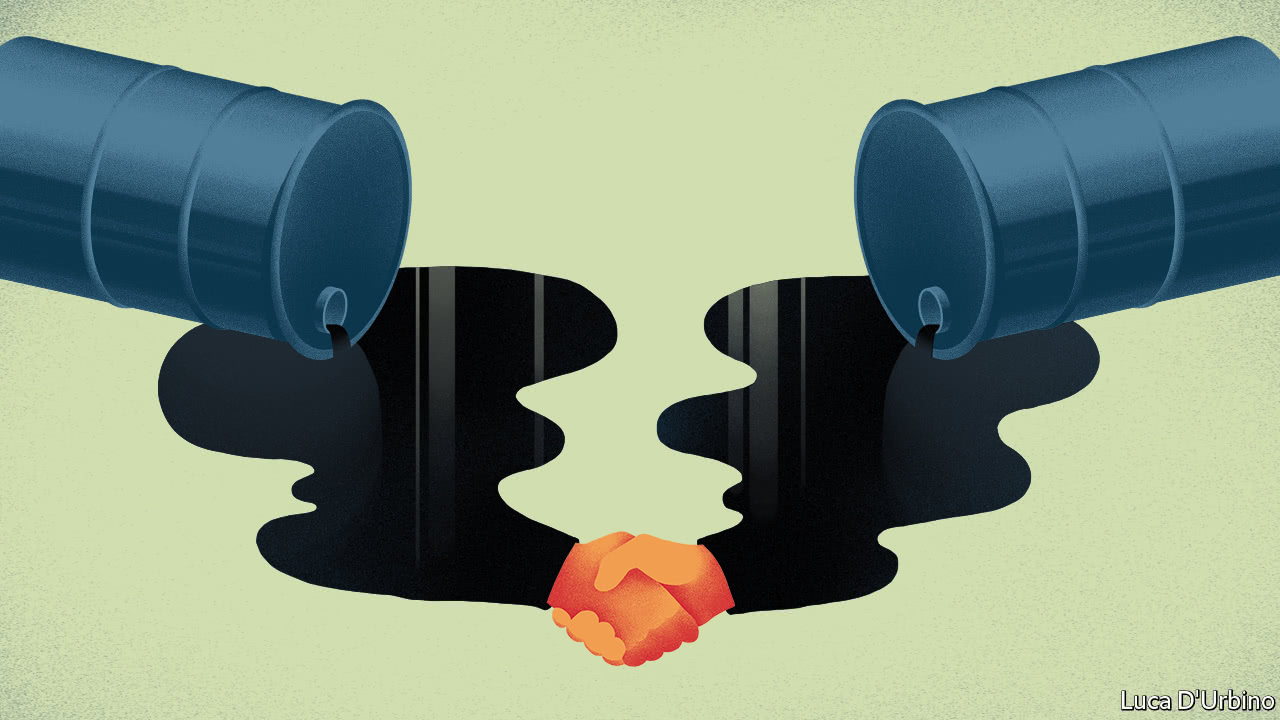
OIL bears beware. On February 20thSuhail al-Mazrouei, OPEC’s rotating president and energy minister of the United Arab Emirates, said the 14-member producers’ group is working on a plan for a formal alliance with ten other petrostates, including Russia, aimed at propping up oil prices for the foreseeable future. If it comes to anything, it could be OPEC’s most ambitious venture in decades.
The result will not be, he insists, a “supergroup”. The notion of Saudi Arabia and Russia joining forces as the Traveling Wilburys of the oil world may be a bit jarring. It remains an idea in “draft” form. But whatever its chances, it attempts to shift a belief widely held by participants in oil markets: that non-American oil producers are helpless against the shale revolution.
That belief has strengthened because of a renewed flood of American shale production in the latter part of 2017 after prices of West Texas Intermediate climbed above $50 a barrel. The International Energy Agency…Continue reading
The long-term returns from collectibles
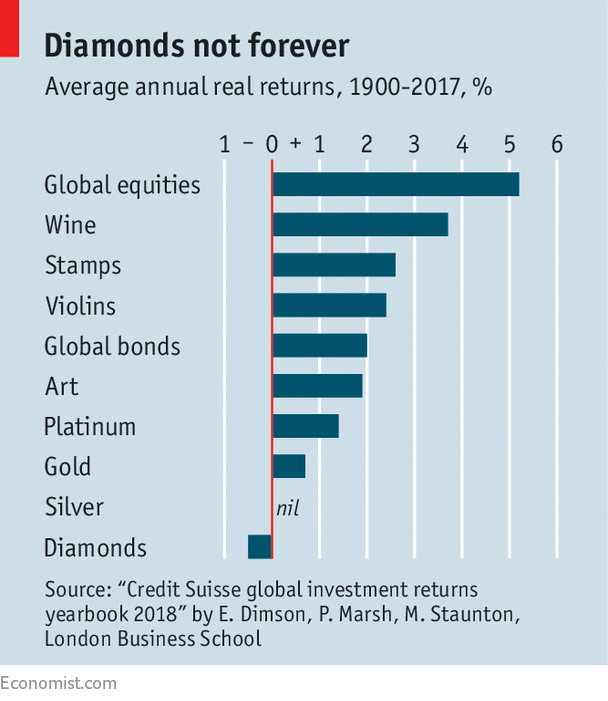
BONDS, shares and Treasury bills are all very well, but in the end they are just pieces of paper. They are not assets you can hang on the wall or display to admiring neighbours. Many rich people like to invest their wealth in more tangible form; property, of course, but also collectibles such as art, fine wine and classic cars.
Is that wise? Elroy Dimson, Paul Marsh and Mike Staunton of the London Business School (LBS) have run the numbers for their annual analysis of the financial markets in the Credit Suisse global investment-returns yearbook. Some of these assets have done rather better than others (see chart). Fine wine delivered the best returns; surprising to cynics who might assume that, in the long run, the value of wine vanishes as it turns into vinegar. Really old wine often has historical resonance. A bottle of Chateau Lafite Rothschild from 1787 was sold for $156,450 in 1985 because it was thought to belong to Thomas Jefferson.
Estimating the returns from these assets, after…Continue reading
A banking centre seeks to reinvent itself

ON A clear day, sunset over Lake Zug is magnificent. Snow-dusted mountains cut through the orange glow above and are mirrored in the lake below. “Zug is our spiritual home,” says Jeremy Epstein, from Washington, DC, who has just taken 40 foreigners to tour the small Swiss town south of Zurich. They came not for sunsets, though, but to find out how Zug has become known as “crypto-valley”—meaning the home of many firms dealing in crypto-currencies and related activities.
Switzerland’s famous banking secrecy is falling to a global assault on money-laundering and tax evasion. But financial security remains in demand. The country should seek to become the “crypto-nation”, said the economy minister, Johann Schneider-Ammann, last month. Zug aims to be the capital of that nation.
To that end, Switzerland is maintaining loose rules for crypto-businesses, even as other countries are tightening theirs. An industry is developing to store tangible crypto-assets, such as the hard…Continue reading
Economists cannot avoid making value judgments

AMID the name-calling and bluster that mar many fights between economists are a few common tactics. Belligerents may attack the theory used to support a claim, or the data analysis used to quantify an effect. During the debate over President Donald Trump’s tax bill, to take a recent example, economists bickered over which side had more credibly calculated the economic effect. They did not, for the most part, argue about whether it was morally acceptable to pass a regressive tax reform after years of wage stagnation and rising inequality. To do so would strike many economists as entirely un-economist-like. Yet economics has not always been so shy about moral philosophy. As well as “The Wealth of Nations”, Adam Smith wrote a “Theory of Moral Sentiments”. Great 20th-century economists like Paul Samuelson and Kenneth Arrow also took questions of values very seriously. Their successors would do well to take several pages from their books.
Modern economists have attempted…Continue reading
Russian meddling is only one challenge facing the social-media giant

IN ITS early days Facebook embraced the motto “move fast and break things” to describe its engineers’ strategy of rapid innovation. “Move slowly, and try not to break anything else” seems to be its new creed. In the last year Facebook has contended with several controversies, including charges that it helped spread false news, unwittingly facilitated Russian meddling in the 2016 election and fanned political polarisation (see Briefing). After denials of responsibility and little action, Mark Zuckerberg, its boss, has talked of “fixing” Facebook in 2018. It will be a huge task.
Russia’s alleged manipulation of Facebook users will harm the company. On February 16th special counsel Robert Mueller filed conspiracy and fraud charges against 13 Russians for interfering in America’s 2016 election; Facebook was mentioned no fewer…Continue reading
Latvia’s top banking official has been accused of taking a bribe

ILMARS RIMSEVICS, governor of Latvia’s central bank for the past 17 years, had been due to retire next year. Instead, he is facing calls to resign. On February 17th he was detained by Latvia’s anti-corruption authority on suspicion of taking a bribe of at least €100,000 ($123,000). The prime minister, Maris Kucinskis, says the allegations are so serious that Mr Rimsevics cannot possibly return to work. Mr Rimsevics, for his part, is staying put. Released on bail on February 19th, he denies the allegations, saying he was set up and is facing death threats.
Just a few days earlier, in an unrelated case, the US Treasury had proposed sanctions on ABLV, one of Latvia’s largest banks. It claimed ABLV had “institutionalised money laundering” and facilitated transactions with North Korea, which is under sanctions. In the days that followed €600m was withdrawn by the bank’s customers. On February 19th, seeking to stabilise the institution, the ECB froze payments by ABLV….Continue reading
Latvia’s top banking official is accused of demanding bribes
ILMARS RIMSEVICS, for 17 years the governor of Latvia’s central bank, had been due to retire next year. Instead, he is facing calls to resign. On February 17th Latvia’s anti-corruption authority detained him on suspicion of demanding bribes of at least €100,000 ($123,000). That sparked international concern. Mr Rimsevics is a member of the governing council of the European Central Bank (ECB) and privy to the most sensitive monetary-policy decisions.
The prime minister, Maris Kucinskis, says the allegations are so serious that Mr Rimsevics must stand down. But he is staying put. Released on bail on February 19th, the central bank chief says the allegations are a set-up to punish him for cracking down on lax practices. He also says he has received death threats.
Latvia’s outsized and ill-regulated offshore banking industry has been a headache since the country regained independence in 1991. During the global financial crisis ten years ago, Parex Bank, the largest…Continue reading