
Tag: Approved
Who’s afraid of disruption?
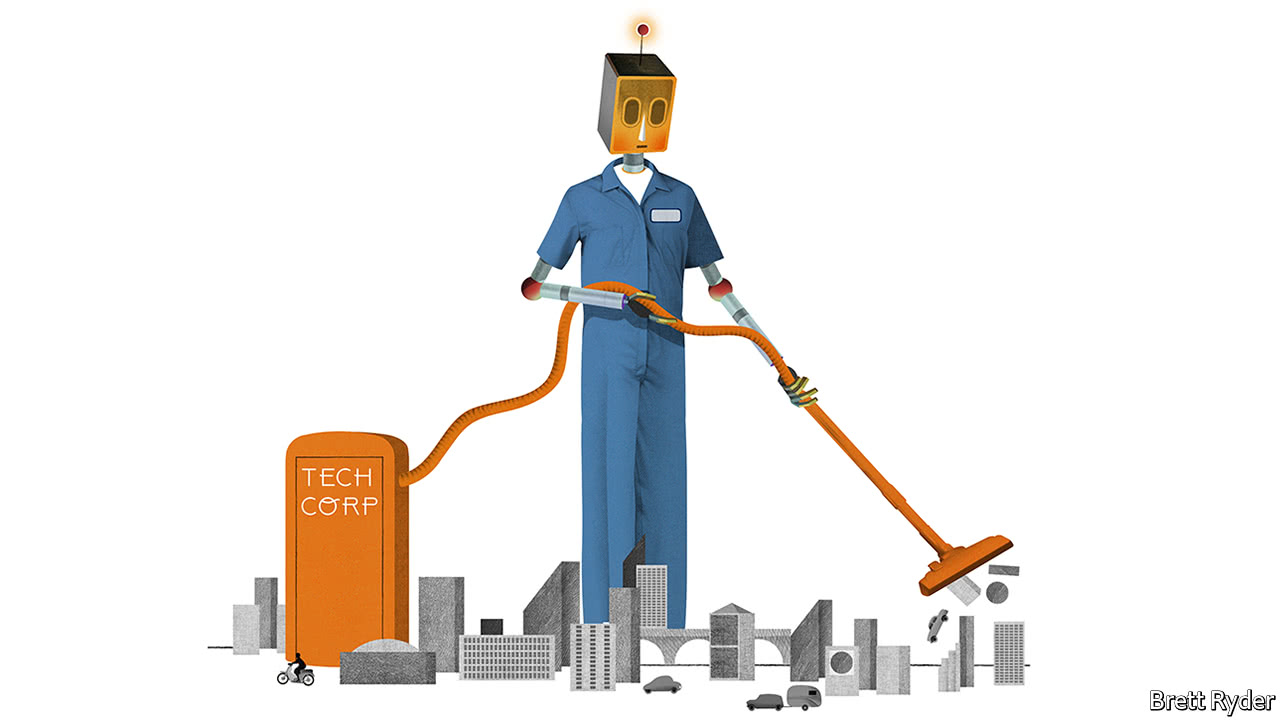
LAST week Schumpeter met two tech tycoons who control businesses in total worth $600bn. In both cases the mayhem around them was what you would expect if Beyoncé hit town, minus the musical talent and looks. Hotel floors were locked down by the official secret service; the corridors were crammed with lines of petitioners and in one case a Wall Street boss gatecrashed the room in order to hug his idol.
The message from both titans—you ain’t seen nothing yet—was imperious. Over the next decade, they say, conventional industries will face an onslaught from tech competitors wielding vast financial resources, new technologies and massive reserves of data. It is a view that has swept through traditional firms’ boardrooms, too, where enthusing about virtual reality and singing the praises of Jeff Bezos, Amazon’s boss, is almost obligatory. The notion of disruption, with its promise to destroy the status quo and then renew it, is the most fashionable idea in global business since the…Continue reading
The next financial crisis may be triggered by central banks
AS WITH London buses, don’t worry if you miss a financial crisis; another will be along shortly. The latest study on long-term asset returns from Deutsche Bank shows that crises in developed markets have become much more common in recent decades. That does not bode well.
Deutsche defines a crisis as a period when a country suffers one of the following: a 15% annual decline in equities; a 10% fall in its currency or its government bonds; a default on its national debt; or a period of double-digit inflation. During the 19th century, only occasionally did more than half of countries for which there are data suffer such a shock in a single year. But since the 1980s, in numerous years more than half of them have been in a financial crisis of some kind.
The main reason for this, argues Deutsche, is the monetary system. Under the gold standard and its successor, the Bretton Woods system of fixed exchange rates, the amount of credit creation was limited. A country that expanded its money supply too quickly would suffer a trade deficit and pressure on its currency’s exchange rate; the government would react by slamming on the monetary brakes. The result was that it was harder for financial bubbles to inflate.
But since the early 1970s more countries have moved to a floating exchange-rate system. This gives governments the flexibility to deal with an…Continue reading
Europe’s capital markets face a big shake-up and are not ready

FINANCIERS usually regard new regulations as dull, annoying drudgery best left to lawyers or the compliance department. That is not an option with the second iteration of the Markets in Financial Instruments Directive (MiFID 2), a European Union law years in the making and entering into force on January 3rd 2018. The law introduces radical changes to trading in trillions of euros-worth of stocks, bonds and derivatives. But its sheer scope and complexity mean that an unprecedented number of issues and technicalities are still unresolved.
MiFID 1, in force since 2007, was aimed at shares, and spawned a proliferation of new trading venues ranging from electronic platforms to “dark pools” run by investment banks, breaking the oligopoly of dozy national stock exchanges. The new, more ambitious, law seeks to bring transparency to a far wider range of asset classes, notably bonds and derivatives.
The single reform that has probably received most attention is the requirement to…Continue reading
The cost of innovation has risen, and productivity has suffered
WERE there far fewer undiscovered ideas out there than in our more primitive past, how would people know? This is not an idle question; decoding the mysteries of nature, from atmospheric pressure to electricity to DNA, allowed people to bend the natural world to their will, and to grow richer in the process. A dwindling stock of discoverable insights would mean correspondingly less scope for progress in the future—a dismal prospect. And some signs suggest that the well of our imagination has run dry. Though ever more researchers are digging for insights, according to new research, the flow of new ideas is flagging. But that uncovering new ideas is a struggle does not mean that humanity is near the limits of its understanding.
The development of new ideas—meaning scientific truths or clever inventions—allows economies to grow richer year after year. Adding more workers or machinery to an economy boosts GDP, but only for a while. Applying ever more men with hoes to the cultivation of a field will generate diminishing returns in terms of crop yields, for instance; wringing more from the soil eventually requires the use of better seed-stock or fertiliser. Unless humanity finds new ways to do more with the same amount of labour and capital, growth in incomes peters out to nothing.
Dwindling growth in incomes is not a bad description of what has happened…Continue reading
Streaming has pushed Latin music into the mainstream

“MI GENTE” lures listeners with a mesmerising hook, a thumping beat and lyrics about breaking down barriers. A collaboration between J Balvin, a Colombian reggaeton star (pictured), and Willy William, a French producer, the latest product of this summer’s Latin craze is crooned almost entirely in Spanish. (The title means “My People”; reggaeton borrows from hip hop, reggae and rap.) The song topped the charts on Spotify, a streaming service, for weeks. “To be a crossover artist, you used to have to sing in English,” said John Reilly, Mr Balvin’s publicist. Now six of YouTube’s top ten music videos are predominantly in Spanish. In August the Billboard Hot 100, which tracks streams, sales and radio plays, sported seven Latin hits. Just five graced the chart in all of 2016.
Latin music is helping the music industry to arrest years of decline. Its growth is far outpacing that of other genres. Last year Latin America yielded just $598m out of total global recorded-music…Continue reading
Online matchmaking businesses in India have many ways to woo

“IT WAS 2012…I was number 37,” says Ashwini, referring to the badge that was pinned on her shirt pocket. Her task was to go onto the stage and introduce herself to around 70 eligible bachelors and their parents. Families then conferred and, provided caste and religious background proved no obstacle, would approach the event’s moderator asking to meet number 37. At midday girls would wait for prospects to swing by, again with parents on either side. A brief exchange might establish the potential bride’s cooking skills or her intention to work after marriage. If the two sides hit it off, they would exchange copies of their horoscopes. Nearly 50 men lined up to meet Ashwini that day, speed-dating style. No one made the cut. She later married a colleague.
Such gatherings form an important part of the wedding industry, worth around $50bn a year, in a country where arranged marriages continue to be the norm. India has 440m…Continue reading
What if large tech firms were regulated like sewage companies?

THREE-QUARTERS of Americans admit that they search the web, send e-mails and check their social-media accounts in the bathroom. That is not the only connection between tech and plumbing. The water and sewage industry offers clues to the vexed question of how to regulate the Silicon Valley “platform” firms, such as Alphabet, Amazon and Facebook. The implications are mildly terrifying for the companies, so any tech tycoons reading this column might want to secure a spare pair of trousers.
In America and in Europe a consensus is emerging that big tech firms must be tamed. Their dominance of services such as search and social media gives them huge economic and political clout. The $3trn total market value of America’s five biggest tech firms (Apple and Microsoft are the other two) suggests that investors believe they are among the most powerful firms in history, up there with the East India Company and Standard Oil.
Trustbusters in need of instant gratification want to break…Continue reading
Behind the veil of Saudi Aramco
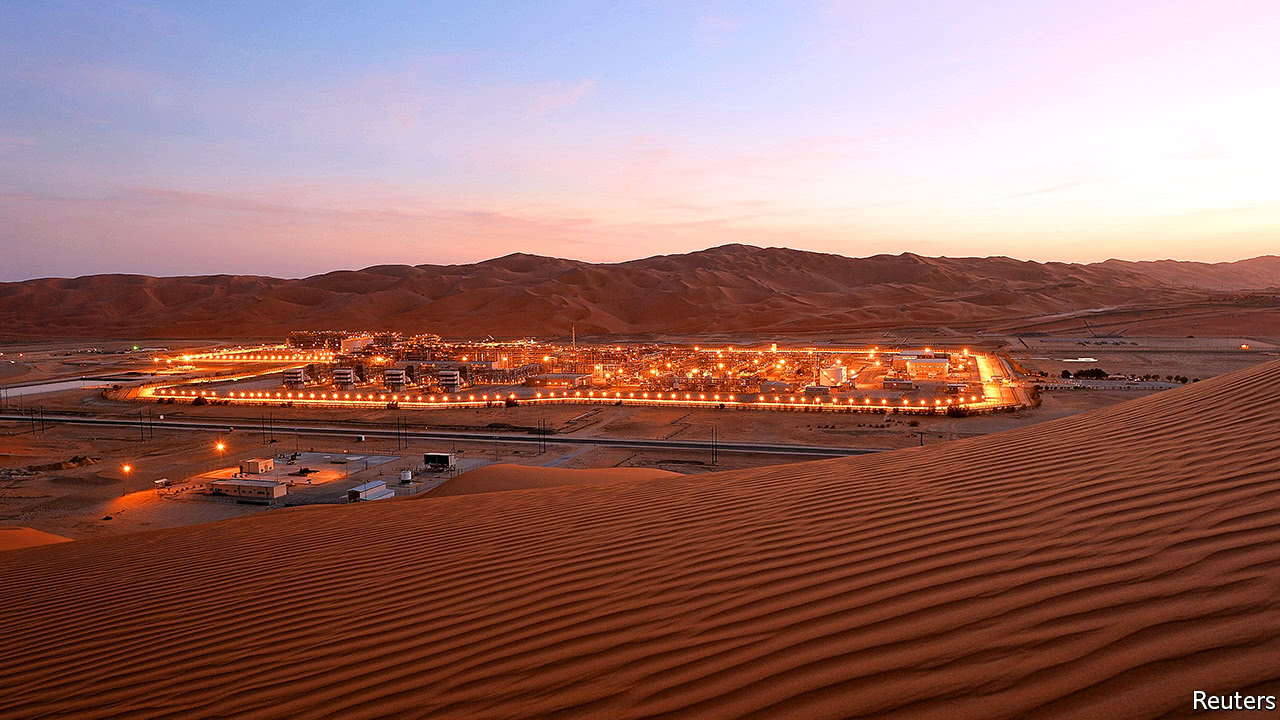
IF SAUDI ARAMCO is a state within a state in Saudi Arabia, then the blandly named Oil Supply Planning and Scheduling (OSPAS) is its deep state. To enter it, you pass tight security at Aramco’s suburban-style headquarters in Dhahran, in the east of the kingdom. The transition is eye-opening. Suddenly, English is the common tongue even among Saudi “Aramcons”, as its workers are known. Female employees, their faces uncovered, lead meetings of male colleagues. The crisp banter is common to engineers everywhere. A toilet break is called a “pressure-relief” exercise.
Deep within, OSPAS is even further removed from the kingdom outside. The few executives with clearance to enter call it the “nerve centre” of the world’s largest oil company. Using 100,000 sensors and data points on wells, pipelines, plants and terminals, it directs every drop of oil and cubic foot of gas that comes out of the kingdom (10% of the world’s oil supply), monitors it on giant screens as it heads to…Continue reading
Ryanair cancels more than 2,000 flights over the next six weeks

RYANAIR, an Irish airline, is known for three things: low fares, the brash way in which Michael O’Leary, its chief executive, advertises them, and its record for sticking to its flight schedules. The last of these is key to its appeal: many businessmen chose Ryanair more for its punctuality than its cheapness. And so the announcement on September 15th that it is cancelling over 2,000 flights between now and the end of October—around 2% of its capacity over the period—is more serious than it may at first seem. Ryanair’s share price fell by more than 5% in the aftermath.
The problems began in early September when Ryanair’s on-time record plunged, owing to a pilot shortage. To restore punctuality, it cancelled many flights at short notice; passengers were marooned around Europe. Up to 400,000 people booked on the 2,000 scrapped flights risk missing business trips and holidays.
Mr O’Leary says the…Continue reading
Boeing takes off on a flight of hypocrisy against Bombardier

“WE WON’T do business with a company that is busy trying to sue us.” So said an uncharacteristically stern Justin Trudeau, Canada’s prime minister, alongside his British counterpart, Theresa May, in Ottawa on September 18th. The two had teamed up to take on Boeing. The giant American aeroplane-maker is pressing Donald Trump’s administration to impose duties on commercial jets made by Canada’s Bombardier. Boeing says its smaller rival is using Canadian government subsidies to sell aircraft to Delta, an American carrier, at below cost price.
Few in either country question that Bombardier has had vital financial support from the Canadian and British governments since 2005 for its small jetliner, the C-Series. As the plane’s development costs soared, to $5.4bn, Bombardier struggled to find buyers for it; financial trouble followed. An estimated C$4bn ($3.4bn) in state support, including C$2.8bn in 2015, stopped a nosedive. It was not until 2016 that the aircraft’s future seemed…Continue reading