
Tag: Approved
A legal vulnerability at the heart of China’s big internet firms
COMPANIES’ legal structures are usually mind-numbing fare. But occasionally it is worth pinching yourself and paying attention. Take “variable interest entities” (VIEs), a kind of corporate architecture used mainly by China’s tech firms, including two superstars, Alibaba and Tencent. They go largely unremarked, but VIEs have become incredibly important. Investors outside China have about $1trn invested in firms that use them.
Few legal experts think that VIEs are about to collapse, but few expect them to endure, either. One sizeable investor admits loving Chinese tech firms’ businesses while feeling queasy about their legal structures. Like scientists appalled by their monstrous creations, even the lawyers who designed VIEs worry. They are “China’s version of too-big-to-fail”, says one. As well as being spooky, VIEs are another instance of how China’s weak property rights hurt its citizens.
What are VIEs? Over 100 companies use them. Since the 1990s private firms have sought to break free of China’s isolated legal and financial systems. Many have done so by forming holding companies in tax havens and listing their shares in New York or Hong Kong. The problem is that they are then usually categorised as “foreign firms” under Chinese rules. That in turn prohibits them from owning assets in some politically sensitive sectors, most…Continue reading
Global LNG giants turn to poor countries for new markets

WHEN it comes to liquefied natural gas (LNG), the supermajors have supersized appetites. The likes of Royal Dutch Shell, ExxonMobil and BP make discoveries described as “elephants”; their cost overruns alone can run into the tens of billions of dollars; and projects take the best part of a decade to complete. For years, the industry has demanded fixed, long-term contracts from their customers to justify the size of these megaprojects.
The producers also have pretty big problems. They are in the midst of a vast expansion in Australia and elsewhere just as the shale revolution and the start of American LNG exports has brought an unexpected burst of gas onto markets, clobbering prices for the foreseeable future and forcing producers into concessions. Demand in rich countries such as Japan and much of western Europe appears to be in long-term decline.
At least one big customer, China, is making life easier….Continue reading
The business of sperm banks

BROWSING websites that list sperm donors is weirdly similar to online dating. “Sanford is the total package,” begins one online ad, describing his strong jawline and piercing blue eyes. With a degree in finance and a “charming demeanour”, he is more than a pretty face. You can listen to a voice recording from Sanford himself. If all that wins you over, you can have his baby without ever having to go on a date. For $635, Seattle Sperm Bank (SSB) will post you a vial of his frozen swimmers.
The fact that the main customers for many sperm banks are now single women explains the marketing technique. “They tend to be highly educated, impatient and picky,” says Ole Schou, founder of Cryos International, the world’s largest sperm bank, based in Denmark’s second-biggest city, Aarhus. Its website is designed to resemble Match.com, a dating site, because “finding a donor should be as close to finding a natural partner as…Continue reading
New rail routes between China and Europe will change trade patterns

ASTANA in Kazakhstan is one of the world’s most remote capitals, surrounded by thousands of kilometres of empty steppe. This summer Astana attempted to launch itself onto the global stage by hosting the World Expo, which closed on September 10th and underwhelmed many attendees. But there are other ways to have an impact. On the city’s north side, away from the Expo’s exhibits, a series of diesel trains, each pulling dozens of containers, roll through the old railway station. Most are heading from China to Europe. Last year over 500,000 tonnes of freight went by train between the two, up from next to nothing before 2013. Airlines and shipping firms are watching things closely.
The trains rumbling through Astana result from a Chinese initiative, in tandem with countries like Kazakhstan, to build a “New Silk Road” through Central Asia. The earlier overland routes were once the conduits for most trade between Europe and China and India; they faded into irrelevance…Continue reading
China moves towards banning the internal combustion engine
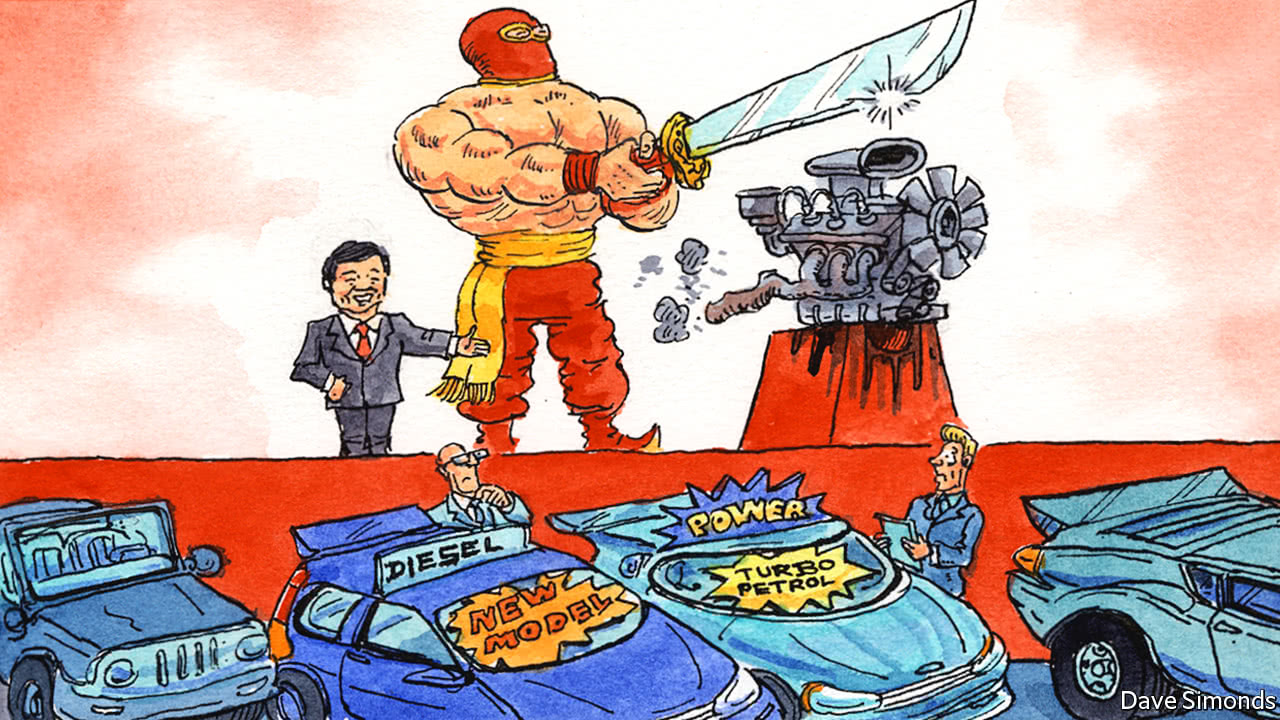
“A DEFINING moment for the auto industry.” That is how usually restrained analysts at Sanford C. Bernstein, a research firm, described the news that China’s government wants to move towards a ban on gas guzzlers. On September 9th, Xin Guobin, vice minister of industry and information technology, told an automotive conference in Tianjin, a grimy industrial city near Beijing, that the government is developing a long-term plan to phase out vehicles powered by fossil fuels.
The news reverberated around car firms, for which China is the largest market. William Russo of China’s Gao Feng Advisory, a consultancy, who was previously a senior executive at Chrysler, says China is simply far too big to lose out on. “If China says no more fossil-fuel powered cars, global carmakers must follow.”
No timeline for a ban was suggested. China already has ambitious medium-term goals for automotive efficiency and climate change, including a cap on carbon emissions by 2030. Experts…Continue reading
Is Margrethe Vestager championing consumers or her political career?

EVEN her enemies admire the bloody-mindedness of Margrethe Vestager, the European commissioner in charge of competition policy. Last autumn, not long after she had ordered Apple to pay €13bn ($14.5bn) in back-taxes to Ireland, to the fury of many in America, she flew across the Atlantic on a charm offensive. The Americans were not charmed; Ms Vestager was unmoved. Buckling up for the flight home, she tweeted that she had never felt so European.
Since she assumed her current role in November 2014, Ms Vestager has had several high-profile clashes with American tech firms. In May she fined Facebook €110m for misleading EU trustbusters about its takeover of WhatsApp, a messaging service. In June a long-running investigation resulted in a €2.4bn fine on Google for using its search engine to promote its own comparison-shopping service. EU trustbusters have also charged Google with using its Android operating system to promote its mobile-phone apps and services over those of rivals. That…Continue reading
Rivalry between Apple and Samsung in smartphones will grow fiercer
NEVER shy about hype, on September 12th Apple’s boss, Tim Cook, presented the firm’s latest iPhones to a packed auditorium in its glitzy new headquarters in Cupertino. He made a grand prediction: its new, premium phone, the iPhone X (pronounced “ten”), will “set the path of technology for the next decade”. Set to be released this November, ten years after the first iPhone launched, the iPhone X has new features such as an edge-to-edge OLED screen (a thinner screen that does not use a backlight), wireless charging, facial-recognition technology and a dual-lens camera.
On the same day, Samsung, a rival smartphone-maker, held a lower-key event in Seoul. Koh Dong-jin, president of Samsung Electronics’ mobile business, announced that next year Samsung could reimagine the smartphone entirely and launch a new design with a foldable screen, which can close like a small book. On September 15th its latest premium smartphone, the Galaxy Note 8, will go on sale, boasting many of the features offered by the iPhone X.
Both are trying to convince consumers to spend around $1,000 for their new gadgets. Samsung’s new phone will cost $960; Apple’s high-end iPhone X will cost $999, 45% more than the average selling price of an iPhone in 2016. (The iPhone 8, simpler than the X and available for sale in September, will start at $699.)
Why do European companies bother to hire ex-politicians?
THIS month Gerhard Schröder starts a new job. Shareholders in Rosneft, a Russian energy giant with a market value of nearly $60bn, are set to appoint Germany’s ex-chancellor as a board director on September 29th. Russia’s government, Rosneft’s majority-owner, nominated Mr Schröder, who is pals with Vladimir Putin. Despite Western sanctions imposed on the firm after Russia’s invasion of Ukraine in 2014, Mr Schröder’s move is no surprise. He has worked for years with Gazprom, another energy arm of the Russian state, to promote a gas pipeline to western Europe.
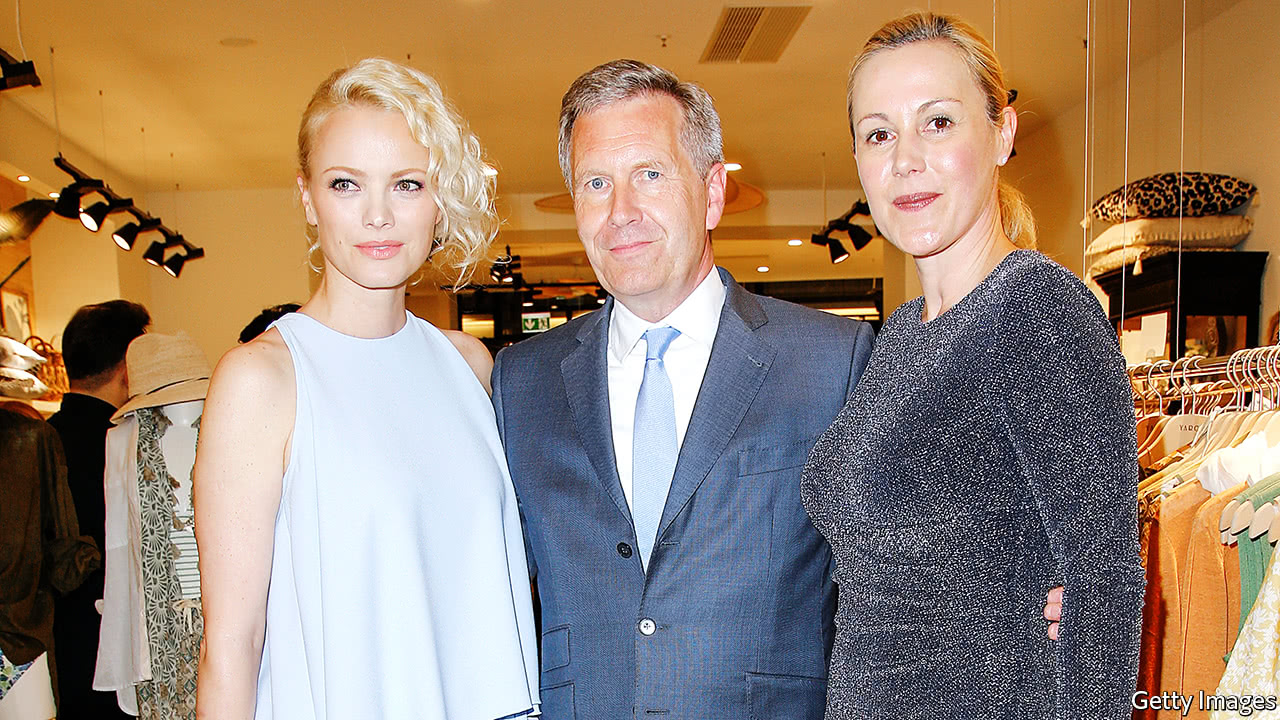
His ties to Russia win him few friends at home. His successor as Germany’s leader, Angela Merkel, calls his behaviour “not OK”. She also vows to reject offers of “any posts in industry once I am no longer chancellor”. Other politicians are happier to follow Mr Schröder’s example. It emerged last month that a former German president, Christian Wulff (pictured), is also employed by a foreign company. He advises…Continue reading
The big data breach suffered by Equifax has alarming implications

UNTIL something goes wrong, few people give much thought to the surveillance they undergo by credit-reporting agencies (CRAs). Yet these agencies’ business is deeply intrusive: quantifying character. They assign individuals credit scores based on how they previously managed debt. The scores are then sold to lenders. In America, Equifax, Experian and TransUnion, the “Big Three” CRAs, have gathered credit histories and identifying information for nearly every adult.
On September 7th Equifax admitted that something had indeed gone very wrong: hackers had gained access to personal information on about 143m people, mostly Americans. It reported that, from mid-May to July, hackers exploited a vulnerability in its website. The data compromised included Social Security numbers (SSNs), dates of birth and driving-licence numbers, and for 209,000 people, possibly their credit-card numbers as well. Equifax also noted that data about some Britons and Canadians may have been stolen.
The…Continue reading
How to protect yourself against the theft of your identity

AS IDENTITY theft has proliferated, so has the number of businesses hoping to make money selling protection against it. Companies such as LifeLock, Identity Guard and PrivacyGuard sell products similar to Equifax’s TrustedID Premier identity-theft protection. That was the service Equifax offered to every American with a Social Security number in the aftermath of its big data breach.
Those who enroll in TrustedID are promised notification if their information is offered for sale on the internet. Their credit reports with Equifax, Experian and TransUnion, the “Big Three” credit-reporting agencies (CRAs), are also monitored for suspicious activity, such as the opening of new accounts or failures to pay a bill on time. If such activity is detected, users can “freeze” their Equifax credit reports, ie, make them unavailable to lenders. And TrustedID offers $1m-worth of insurance to compensate users for losses incurred as a result of identity theft. Equifax is offering the service free…Continue reading