
Tag: Approved
An infrastructure for charging electric vehicles takes shape
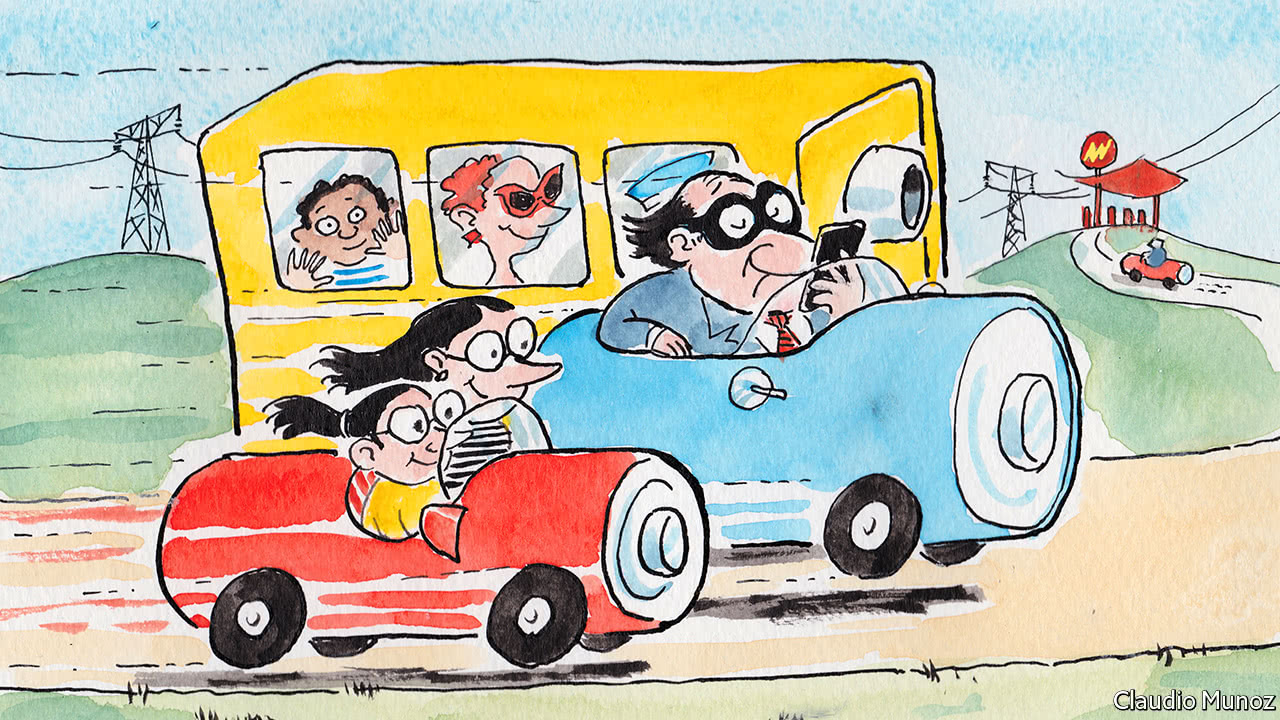
A NEW phrase, “range anxiety”—the fear that an electric vehicle (EV) will run out of power before it reaches a charging-point—entered the Oxford English Dictionary in 2013. At the time a Nissan LEAF, the world’s best-selling EV, could travel only 120km between charges. A car with a full tank of fuel will travel 650-800km between refills. A motorist relying on batteries has to find a public charger, a rare sight in 2013, or plug in at home to cover the same distance. Range anxiety has not gone away as EVs have advanced. But the problem now feels much more soluble.
Many governments are pushing hard to replace the internal combustion engine (ICE) with cleaner EVs—this summer both Britain and France said that by 2040 new cars completely reliant on petrol or diesel will be illegal. By 2050, half the cars on the road globally, a billion in total, will be battery-powered, reckons Morgan Stanley, a bank. Falling battery costs mean that the total cost of EV ownership will soon hit…Continue reading
Panipat, the global centre for recycling textiles, is fading

WHEN the doors open to the warehouse at Ambey Spinning Mills in Panipat, a city 90km from Delhi, it seems as if its contents might tumble out like those of an overstuffed cupboard. Heaps of clothes are piled to the ceiling. Ten women meticulously extract zips, chains and buttons from T-shirts, winter jackets and denims using long blades usually used to chop vegetables. Outside, a teenage boy wields a knife to bash synthetic fibre against a tree stump. In another workshop clothes are shredded, spun into yarn and woven by power looms into blankets. Bullock carts take them for further processing; they are then sent off for sale in India and beyond.
Known as the “cast-off capital”, Panipat is home to 150-200 such mills, which take in discarded clothes from Western countries and turn them into recycled cloth. The industry employs around 20,000 people and brings in annual revenues of $62m, according to Pawan Garg of All India Woollen and…Continue reading
United Technology merges with Rockwell Collins

WHEN passengers board an aircraft, only a few care whether it was built by Airbus or Boeing, two giants that make all the world’s big airliners. Fewer still would recognise the names of the thousands of suppliers that produce the 2m or so parts that go into a modern jet. Surprisingly little of the work is done by Boeing and Airbus. Boeing has outsourced 70% of the parts for its 787 aircraft. The job of assembling Airbus’s A380 superjumbo in its Toulouse factory accounts for only 4% of the work required to make it. The balance of power between aerospace firms and their suppliers is causing ructions.
Near hostilities have broken out due to a run of big mergers among parts-makers. On September 4th, United Technologies (UTC), an American conglomerate that makes Pratt & Whitney engines and other aerospace parts, announced that it had agreed to buy Rockwell Collins, an avionics firm, for $30bn. Although it is one of the biggest-ever mergers in the aerospace business, the deal…Continue reading
United Technologies merges with Rockwell Collins
WHEN passengers board an aircraft, only a few care whether it was built by Airbus or Boeing, two giants that make all the world’s big airliners. Fewer still would recognise the names of the thousands of suppliers that produce the 2m or so parts that go into a modern jet. Surprisingly little of the work is done by Boeing and Airbus. Boeing has outsourced 70% of the parts for its 787 aircraft. The job of assembling Airbus’s A380 superjumbo in its Toulouse factory accounts for only 4% of the work required to make it. The balance of power between aerospace firms and their suppliers is causing ructions.
Near hostilities have broken out due to a run of big mergers among parts-makers. On September 4th, United Technologies (UTC), an American conglomerate that makes Pratt & Whitney engines and other aerospace parts, announced that it had agreed to buy Rockwell Collins, an avionics firm, for $30bn. Although it is one of the biggest-ever mergers in the aerospace business, the deal…Continue reading
A year on, Wells Fargo cannot shake off its mis-selling scandal
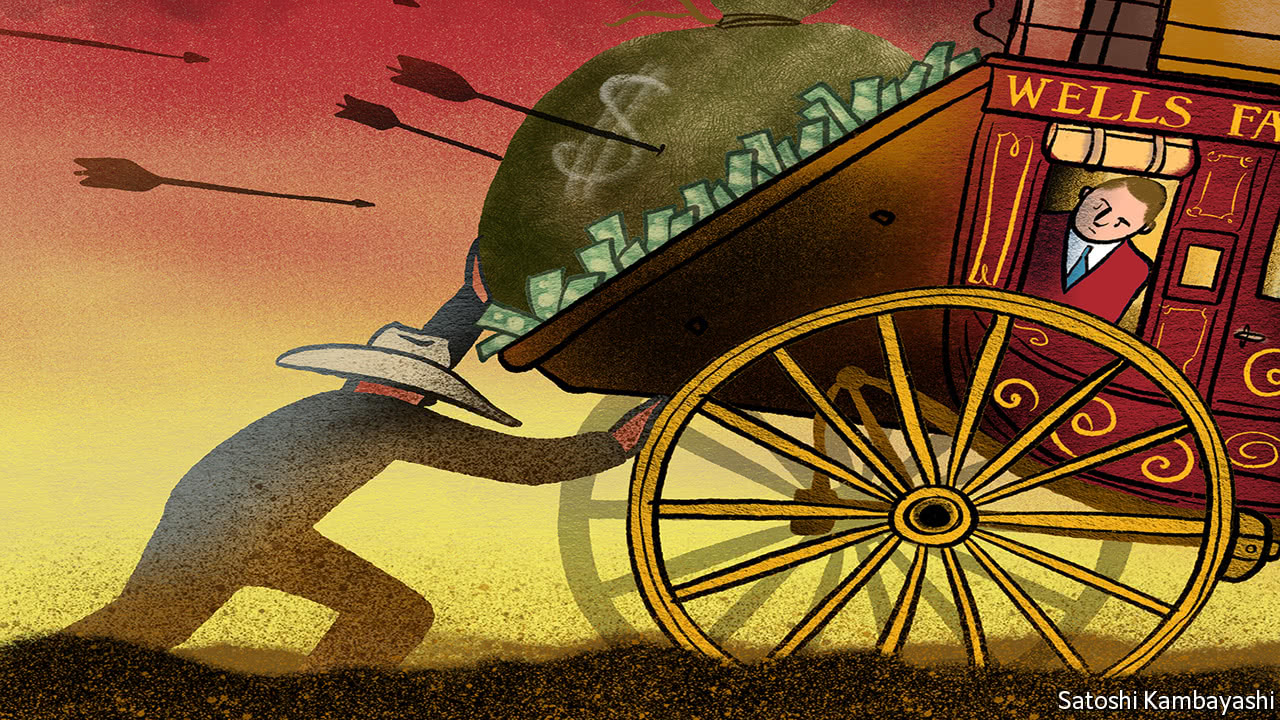
ON SEPTEMBER 8th 2016, Wells Fargo’s reputation plummeted abruptly from that of America’s finest bank to that of yet another dodgy company. It was revealed to have opened an enormous number of potentially unauthorised retail deposit, current (checking) and credit-card accounts. A year on, two questions have yet to be put to rest. How much harm did Wells do to its customers? And how much did the scandal hurt the bank itself?
Wells has not been passive in its response. It has produced report after report on its misdeeds and submitted to investigations by two federal regulators, the Consumer Financial Protection Bureau and the Office of the Comptroller of the Currency. It has purged its chief executive and the head of its retail bank, clawed back executive bonuses, transformed its board and simplified its formerly decentralised structure. It has created a comprehensive process for restitution and settled a class-action suit.
Yet it cannot put the scandal behind it. In July it…Continue reading
Hurricane Harvey has exposed the inadequacy of flood insurance
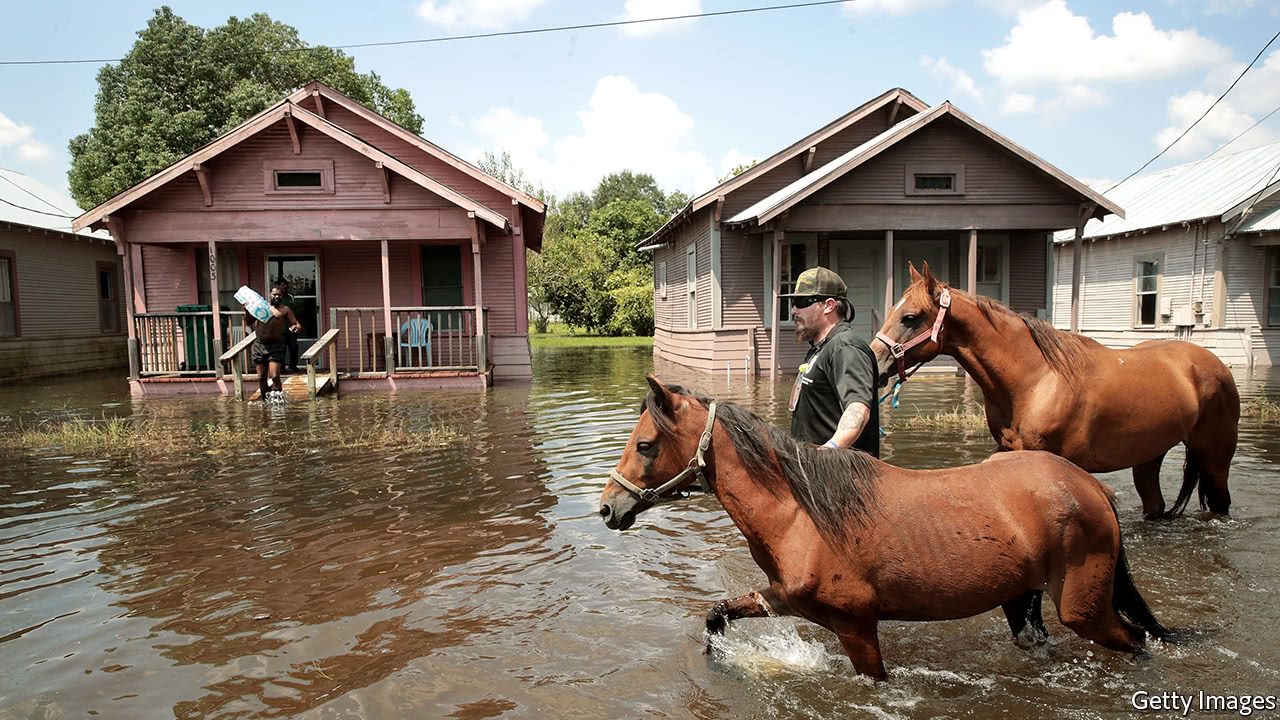
THOSE who live on America’s coasts know to prepare for wrathful hurricanes in late summer—nailing plywood to their windows as the storm approaches. America’s property insurers and reinsurers are ready, too, using sophisticated models to track storms and estimate potential losses. But wind is not the only danger from hurricanes. Ask Houstonians who saw their homes inundated by Hurricane Harvey’s 52 inches (132cm) of rain in the six days to August 30th. Or those in tthe path of Hurricane Irma, which, as The Economist went to press, was wreaking havoc across the Caribbean. But whereas wind damage is covered under most standard insurance policies in America, flood insurance is a government-run add-on that far from all homeowners buy. As a result, of over $30bn in property losses in Texas, only 40% may be insured.
The National Flood Insurance Program (NFIP) was set up in 1968, after a series of large losses led private insurers to pull back. Those living within a…Continue reading
Exchange-rate shifts have helped the global economy

STICKLERS for value have plenty of reasons to frown at financial markets. Much feels out of whack, from squashed bond yields to pricey stockmarkets. Yet currency markets, at least, seem to have shifted in line with fundamentals this year. Take the euro, for instance. Since the start of 2017 it has risen by almost 15% against the dollar, to $1.19 (see chart). That has taken it much closer to fair value by benchmarks such as purchasing-power parity (PPP), the exchange rate at which a basket of goods is worth the same in different countries. The OECD puts the euro’s PPP at $1.33. That is quite a stretch from $1.04 in January. “The elastic had to snap back,” says Kit Juckes of Société Générale, a French bank.
Of course, the euro’s revival is a result of more than its being cheap. The anxiety that elections in Europe might bring to power anti-euro populists, such as Marine Le Pen in France, has dissipated. The euro-zone economy has further strengthened, raising the prospect that monetary…Continue reading
Governments need to rethink their attitudes to debt
GOVERNMENTS do not always make the best budget managers. Assuming it avoids an accidental debt default, America will run a bigger budget deficit this year than the last, despite a booming economy. Germany runs a surplus—but scrimps on critical investments and annoys its euro-area neighbours in the process. Japan, cowering under a mammoth public-debt pile, is weighing raising its consumption tax, though the last rise strangled a tenuous economic recovery. It is awkward, therefore, that the role of fiscal policy as a recession-fighting tool is only growing. The next downturn will be a painful and dangerous learning experience for many politicians.
When that comes, at some point in the next few years, the initial policy response is easily foreseeable. Central banks, nimbler than parliaments, will again move first. But markets reckon that two years from now the Fed’s benchmark rate will remain below 2%, the Bank of England’s below 1% and the European Central Bank’s close to zero. Rates can only go so negative before people abandon the banking system for cash. So cuts to interest rates will be limited. By contrast, in the relatively mild recession of 2001 the Fed cut rates by more than six percentage points. Central-bank asset purchases will follow, assuming they are not already happening, as they might well still be in Europe and Japan. Their effects will be less…Continue reading
A new bond taps private money for aid projects in war zones

INVESTORS might be expected to run a mile from a deal on offer in a conflict-torn part of Africa. At best, it will pay an annual return of 7%; at worst, 40% of the original investment is lost. But a dozen social investors have pooled SFr26m ($27m) to finance the world’s first “humanitarian impact bond”, issued by the International Committee of the Red Cross (ICRC). It will pay for three rehabilitation centres to be built and run in the Democratic Republic of Congo, Mali and Nigeria.
The ICRC’s obligations are backed by “outcome funders”, ie, donors, mostly governments. The bond is an example of “impact investing”, in which private investors seek out social and financial returns, and of “blended finance”, in which public funds help them to do so. Variants have included a bond aimed at educating girls in India and a World Bank-led initiative to raise money to respond to pandemics. The novelty in the ICRC’s…Continue reading
Why are investors so relaxed about the tensions in Korea?
A ROGUE state has tested what may be a hydrogen bomb and has sent a missile over the territory of a neighbouring country. The American president has promised “fire and fury” if threats continue. The Security Council of the United Nations has been locked in debate. This sounds like the plot of a Hollywood thriller or a paperback potboiler in which the world is heading for conflagration.
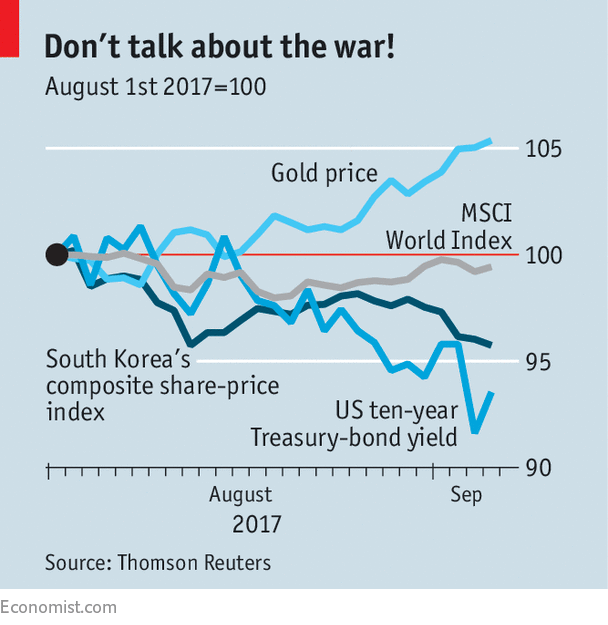
But international investors are not thrilled, and seem barely disconcerted, by the crisis on the Korean peninsula. Gold has risen a bit, the yield on Treasury bonds has dropped and the MSCI World equity index has fallen since the start of August. However, the moves have not been huge. Even the South Korean stockmarket, surely the most sensitive gauge of war risk, is well above its level at the start of the year.
What explains this remarkable insouciance? One possibility is that the markets may simply not be very good at assessing political risk. After all, investors failed to foresee either the…Continue reading