
Tag: Approved
America’s pot industry shrugs off Donald Trump’s harder line on legal drugs

THESE are high times for America’s marijuana-industrial complex. More than half the country’s states have legalised medical cannabis, often rather loosely defined. Eight have voted to legalise the drug for recreational purposes. The industry was worth about $6bn last year, a figure that is likely to rise sharply in 2018 when recreational sales begin in California.
Yet in Washington, DC, the mellow mood has been harshed. Donald Trump may have said in 1990 that “You have to legalise drugs to win that war.” But after entering politics he became more conservative. While campaigning for the presidency he called Colorado’s legal cannabis market a “real problem”. Last month his press secretary, Sean Spicer, said he expected to see “greater enforcement” of the laws that still ban cannabis at the federal level.
That worries pot peddlers. The fact that they are in breach of federal law means that in theory their profits are criminal proceeds, subject to forfeiture. In 2013 the deputy attorney-general of the day, James Cole, published a memo reassuring states that had legalised cannabis that federal agents would not interfere…Continue reading
America’s pot industry shrugs off Donald Trump’s harder line on drugs

THESE are high times for America’s marijuana industrial complex. More than half the country’s states have legalised medical cannabis, often rather loosely defined. Eight have voted to legalise the drug for recreational purposes. The industry was worth about $6bn last year, a figure that is likely to rise sharply in 2018 when recreational sales begin in California.
Yet in Washington, DC, the mellow mood has soured. Donald Trump said in 1990 that “You have to legalise drugs to win that war”, but in politics he became more conservative. Campaigning for the presidency he called Colorado’s legal cannabis market a “real problem”. His press secretary, Sean Spicer, recently said he expected to see “greater enforcement” of the laws that still ban cannabis at the federal level.
That worries pot-pedlars. The fact that they are in breach of federal law means that in theory their profits are criminal proceeds, subject to forfeiture. In 2013 the deputy attorney-general of the day, James Cole, published a memo reassuring states that had legalised cannabis that federal agents would not interfere unless the states allowed the industry…Continue reading
Can a railway legend deliver at America’s CSX?

E. HUNTER HARRISON, a veteran railway executive, tried retiring in 2010, after he made Canadian National (CN), a formerly state-owned company, the best-performing of the large railways in North America. But once he pocketed the gold watch and attended the retirement party he faced a void that raising and training horses for showjumping did not fill. By mid-2012 he was back at the helm of another railway, Canadian Pacific (CP), whose glory days were long past. Once he had turned around CP, he didn’t make the same mistake again. On January 18th the 72-year-old Tennesseean both announced his departure and entered negotiations with Florida-based CSX to become that railway’s CEO.
Just the rumour that Mr Harrison might be moving to CSX caused the share price to rise by 23% in 24 hours. It continued to rise when the negotiations became public. At last, on March 6th, CSX appointed Mr Harrison as CEO and met the condition set by Mantle Ridge, an activist hedge fund with which he has partnered, to name five new board directors. Mr Harrison made long-term shareholders in CP and CN rich, tripling profits at both during his tenures. CSX shareholders expect…Continue reading
New technologies could slash the cost of steel production

ALTHOUGH he is best known for developing a way to mass-produce steel, Henry Bessemer was a prolific British inventor. In the 1850s in Sheffield his converters blasted air through molten iron to burn away impurities, making steel the material of the industrial revolution. But Bessemer knew he could do better, and in 1865 he filed a patent to cast strips of steel directly, rather than as large ingots which then had to be expensively reheated and shaped by giant rolling machines.
Bessemer’s idea was to pour molten steel in between two counter-rotating water-cooled rollers which, like a mangle, would squeeze the metal into a sheet. It was an elegant idea that, by dint of having fewer steps, would save time and money. Yet it was tricky to pull off. Efforts to commercialise the process were abandoned.
Until now. Advances in production technology and materials science, particularly for new types of high-tech steel, mean that Bessemer’s “twin-roll” idea is being taken up successfully. An alternative system that casts liquid steel directly onto a single horizontally moving belt is also being tried. Both techniques could cut energy…Continue reading
Foreign buyers push up global house prices

MANY Americans were taken aback when news broke in January that Peter Thiel, an internet billionaire and adviser to Donald Trump, had New Zealand citizenship. For five years this backer of an “America first” president had kept his Kiwi passport quiet. Then the government released details of his $10m-lakeside estate (pictured).
A growing horde of rich foreigners see New Zealand as a safe haven. In 2016 overseas investors bought just 3% of all properties. But their purchases were concentrated at the expensive end of the market, which is growing fast: sales involving homes worth more than NZ$1m ($690,000) increased by 21%. That helped push prices in the country up by 13% over the past year, to lead The Economist’s latest tally of global house-price inflation (see table).
New Zealand is one of several countries where the impact of foreign money on housing is under scrutiny. Prices have also risen rapidly in Australia and Canada. Central bankers fret about the dangers fickle capital flows pose to financial stability. London’s mayor has ordered a study on foreign ownership in the capital after property prices…Continue reading
A deal sparks talk of car-industry mega-mergers

THE Peugeot 3008, a striking SUV, was voted European car of the year on March 6th, the eve of the opening of the Geneva motor show, an annual industry shindig. PSA Group, the maker of Peugeots and Citroëns, would doubtless view it as the second prize it scooped that day. News also came that the French carmaker was buying Opel (branded as Vauxhall in Britain), the European operation of America’s General Motors (GM). Few of the car-industry experts at the show, however, would call Opel a trophy.
The consensus was that GM was right to rid itself of a business that had lost money for 16 years straight. Opel has around 6% of the European market; that makes it too small and inefficient in a business where scale is key. It has been confined mostly to Europe for three reasons: the particular tastes of the region’s car buyers (for instance, for small diesel cars); tighter emissions regulations outside Europe; and GM’s fear of taking sales from its other brands further afield. The result has been to leave it boxed in and isolated.
Shorn of Opel, the American firm can redirect investment to China and America, where its profit margins are…Continue reading
The retreat of globalisation threatens the Dutch economy

AS ANY football fan knows, little delights the Dutch more than beating the Germans. So, as the country prepares for an election on March 15th, it should be cheering an economy that, after lagging behind Germany’s for years, is at last outpacing it. GDP grew by 2.1% last year, which was the fastest rate since 2007 and a stronger performance than its neighbours, including Germany. Unemployment has fallen to 5.3% and more people are in work than before the crisis in 2007-08.
After years of belt-tightening, households are spending again, thanks to a strong housing-market recovery and rising wages. Government finances are sound. This year the budget may be in balance—perhaps even in surplus—and public debt may drop below 60% of GDP. Yet this sunny outlook has not brightened the mood of a tetchy election campaign.
That is not so surprising. Marieke Blom, the chief economist at ING, a bank, attributes the positive forecast mostly to tough government reforms over the past few years—particularly raising the retirement age to 67 (from 2021) and reforming the financing of the health-care system. Years of reform, austerity and…Continue reading
Mining companies have dug themselves out of a hole

FOR mining investors there is something sinfully alluring about Glencore, an Anglo-Swiss metals conglomerate. It is the world’s biggest exporter of coal, a singularly unfashionable commodity. It goes where others fear to tread, such as the Democratic Republic of Congo (DRC), which has an unsavoury reputation for violence and corruption. It recently navigated sanctions against Russia to strike a deal with Rosneft, the country’s oil champion.
Yet Glencore could still acquire a halo for itself. It is one of the world’s biggest suppliers of copper and the biggest of cobalt, much of which comes from its investment in the DRC. These are vital ingredients for clean-tech products and industries, notably electric vehicles (EVs) and batteries.
The potential of “green” metals and minerals, which along with copper and cobalt include nickel, lithium and graphite, is adding to renewed excitement about investing in mining firms as they emerge from the wreckage of a $1trn splurge of over-investment during the China-led commodities supercycle, which began in the early 2000s. The most bullish argue that clean energy could be an even bigger source of…Continue reading
Green finance for dirty ships
 Smokestack lightening
SHIPPING may seem like a clean form of transport. Carrying more than 90% of the world’s trade, ocean-going vessels produce just 3% of its greenhouse-gas emissions. But the industry is dirtier than that makes it sound. By burning heavy fuel oil, just 15 of the biggest ships emit more oxides of nitrogen and sulphur—gases much worse for global warming than carbon dioxide—than all the world’s cars put together. So it is no surprise that shipowners are being forced to clean up their act. But in an industry awash in overcapacity and debt, few have access to the finance they need to improve their vessels. Innovative thinking is trying to change that.
A new report from the Carbon War Room (CWR), an international NGO, and UMAS, a consultancy, highlights the threat that new environmental regulations pose to the industry. The International Maritime Organisation, the UN’s regulatory agency for shipping, has agreed to cap emissions of sulphur from 2020. Last month the European Parliament voted to include shipping in the EU’s emissions-trading scheme from 2021. Without any retrofitting of ships to meet the…Continue reading
Economists argue about the impact of Chinese imports on America
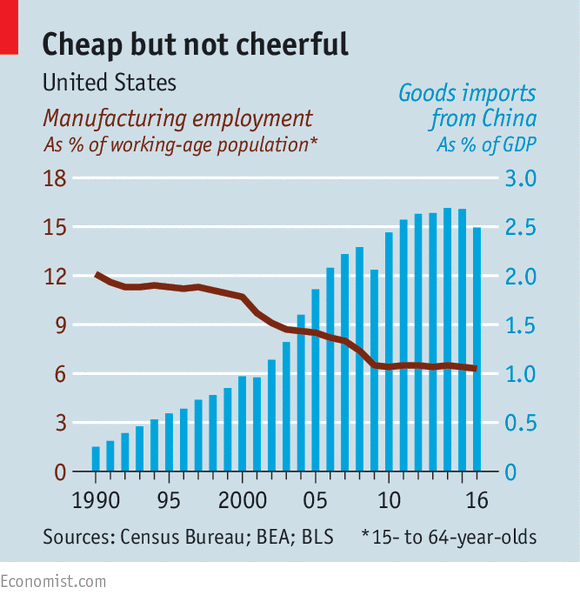
COMPETITION from Chinese imports may have cost some Americans jobs, but economists have done pretty well out of it. Since 2013 David Autor, David Dorn and Gordon Hanson have published nine separate studies digging into the costs of trade. They have found that, of the fall in manufacturing jobs between 1990 and 2007, one-quarter could be attributed to a surge in imports from China. Other sectors failed to soak up the extra workers. Their research also suggested that the China shock has cut the supply of marriageable men and opened the door of the White House to Donald Trump.
In recent weeks a dispute has erupted over their results. Jonathan Rothwell, an economist at Gallup, a pollster, alleged “serious flaws” in one paper, prompting a fierce eight-page response from the authors, and an acrimonious public tiff.
The row centres on how the effect of the China shock is measured. The trio wanted to isolate the effects of extra Chinese supply, rather than of something happening in America, so they checked that imports of particular Chinese products were surging in other rich countries, too. They then compared places in America…Continue reading