
Tag: Finance and economics
Puerto Rico declares bankruptcy at last

THE government of Puerto Rico said in 2015 that the island could not pay its debts. Yet it was only on May 3rd that it kicked off the biggest bankruptcy case in America’s history. Public-sector debts total almost $74bn (around 100% of GNP). The drawn-out fiscal crisis has both imperilled Puerto Rico’s economy and upended the island’s politics.
Something akin to bankruptcy is possible only because of a federal law passed in 2016. Until then, the island’s legal status as a territory afforded it no escape from its debts (were Puerto Rico a state, its public utilities could have declared bankruptcy). The law established a “financial oversight board”, appointed in Washington, with the task of reaching a deal with bondholders. But it also allowed for bankruptcy-like proceedings should negotiations fail.
A two-thirds majority of bondholders would have forced all of them to accept a reduction in the value of their debt. Yet agreement was always unlikely. Puerto Rica’s constitution says payments to holders of so-called “general obligation” bonds have priority over all other expenditure. But another group of creditors have first dibs on revenue from the sales…Continue reading
Price-bots can collude against consumers

MARTHA’S VINEYARD, an island off the coast of Massachusetts, is a favourite summer retreat for well-to-do Americans. A few years ago, visitors noticed that petrol prices were considerably higher than in nearby Cape Cod. Even those with deep pockets hate to be ripped off. A price-fixing suit was brought against four of the island’s petrol stations. The judges found no evidence of a conspiracy to raise prices, but they did note that the market was conducive to “tacit collusion” between retailers. In such circumstances, rival firms tend to come to an implicit understanding that boosts profits at the expense of consumers.
No one went to jail. Whereas explicit collusion over prices is illegal, tacit collusion is not—though trustbusters attempt to forestall it by, for instance, blocking mergers that leave markets at the mercy of a handful of suppliers. But what if the conditions that foster such tacit collusion were to become widespread? A recent book* by Ariel Ezrachi and Maurice Stucke, two experts on competition policy, argues this is all too likely. As more and more purchases are made online, sellers rely increasingly on sophisticated algorithms to set prices. And…Continue reading
Euro-area GDP growth outpaces America’s
THE enduring appeal of GDP is that it offers, or seems to, a summary statistic that tells people how well an economy is doing. On that basis, the euro-area economy is in fine fettle, indeed it is improving at a faster rate than America’s. Figures released today show that GDP in the currency zone rose by 0.5% in the first quarter of 2017, an annualised rate of around 2%. That is quite a bit faster than the 0.7% rate reported in the same period for America’s GDP.
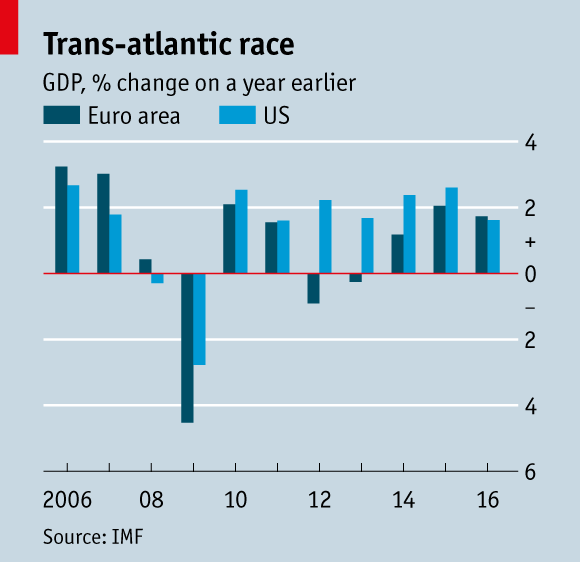
These figures probably overstate the gap between the two economies. In recent years, first-quarter estimates of GDP growth in…Continue reading
The market in Initial Coin Offerings risks becoming a bubble

WOULD you care to invest in Gnosis, a prediction market where users can bet on outcomes of events such as elections? Or in ZrCoin, a project to produce zirconium dioxide, used to make heat-resistant alloys? How about an “immersive reality experience” called “Back to Earth”?
These are just three of a new wave of what are called Initial Coin Offerings (ICOs). Nearly $250m has already been invested in such offerings, of which $107m alone has flowed in this year, according to Smith+Crown, a research firm. But it was in April that ICOs, or “token sales”, as insiders prefer to call them, really took off. On April 24th Gnosis collected more than $12m in under 15 minutes, valuing the project, in theory, at nearly $300m.
ICO “coins” are essentially digital coupons, tokens issued on an indelible distributed ledger, or blockchain, of the kind that underpins bitcoin, a crypto-currency. That means they can easily be traded, although unlike shares they do not confer ownership rights. Instead, they often serve as the currency for the project they finance: to pay users for a correct prediction, as does Gnosis; or for the content users contribute. Investors hope that…Continue reading
Credit Suisse unveils another change of course

EUROPE’S most troubled big banks may at last be on the road to recovery. Not only is economic growth perking up; uncomfortable decisions, put off too long, are also being taken. In recent months UniCredit, Italy’s largest lender, has written down bad debt by €8.1bn ($8.7bn) and tapped shareholders for €13bn. Deutsche Bank, Germany’s biggest, has raised €8bn in equity and decided to keep a retail business it had hoped to sell. On April 27th it reported first-quarter net income of €575m, up from €236m a year earlier, although revenue fell.
Like Deutsche, Credit Suisse is freer to make plans after a recent settlement with American authorities over mis-selling mortgage-backed securities before the financial crisis. On April 26th Switzerland’s second-biggest bank reported first-quarter net income of SFr596m ($594m), far better than forecast, reversing a SFr302m loss a year before. Along with most of Wall Street, which published earnings earlier in the month, and Deutsche it benefited from a good quarter for fixed-income trading. It expects to wind up a unit in which it has dumped unwanted assets by the end of 2018, a year ahead of schedule.
Credit…Continue reading
The threat of war can bring much-needed investment

PONDER the dire state of infrastructure in America and some other advanced economies, and their governments’ fecklessness boggles the mind. Time was when they were able to make badly needed investments; the roads and the universities were a priority. What changed? Not for nothing do pundits cite the hustling governments of China and Singapore as evidence that liberal democracies are no longer fit for purpose. But democracy is not the problem; rather, governments may lack motivation in what is, despite appearances, an unusually peaceful world.
War is hell; the less of it the better. Yet it has also been a near-constant feature of human history, and a constant stimulus to political evolution. Defence is a textbook example of a public good. Security benefits all residents of a country, and cannot be denied to citizens who prefer not to pay for it. There is little incentive for private forces to provide defence—unless by doing so they can take over the right to extract compensation from the society they protect. Throughout history, the legitimate government is the one that can best defend its people.
As populations have grown and technology has advanced, the job of…Continue reading
Exchange-traded funds become too specialised

THERE comes a time when every financial innovation is taken a bit too far—when, in television terms, it “jumps the shark” and sacrifices plausibility in search of popularity. That may have happened in the exchange-traded fund (ETF) industry. The latest ETF to be launched is a fund that invests in the shares of ETF providers.
The notion has a certain logic. The ETF industry has been growing fast, thanks to its ability to offer investors a diversified portfolio at low cost. The assets under management in these funds passed $3trn last year, up from $715bn in 2008. Some investors might well want to take advantage of that rapid expansion.
But by no stretch of the imagination would this be a well-diversified portfolio; it would be a focused bet on the financial sector. And many of the companies in the portfolio, such as BlackRock, a huge fund manager, and NASDAQ, a stock exchange, are involved in a lot more than just ETFs. Even if the ETF industry keeps growing, the bet could still go wrong.
The new fund (with the catchy title of the ETF Industry Exposure and Financial Services ETF) is just the latest example of the industry’s drive to specialisation. The…Continue reading
Protecting American steel from imports makes no sense
AS AN example of all that is wrong with Donald Trump’s view of trade, the probe he has ordered into the steel industry is particularly hard to beat. If it results, as seems to be the plan, in blanket punitive tariffs slapped on steel imports, the consequences would be dire: the American economy would be hurt by a rise in the price of an essential material; it would invite retaliation that would cost American jobs, not save them; and the underlying problem—massive global steel overcapacity—would persist.
For Trumpists, steel is an emblem of their country’s descent from greatness. Ever since the 1960s, when production peaked at 168m tonnes a year, the industry has been in decline. Today it makes half as much as 50 years ago and employs just a third of the workers. Steelmakers have long blamed foreign rivals for their woes and lobbied hard for protection. So Mr Trump is not the first president to try to shield the industry from foreign competition. In the 1980s Ronald Reagan signed a series of agreements to limit imports. In 2002 George W. Bush imposed tariffs of up to 30%. Back then the bogeymen were steelmakers in Europe and Japan; now it is China, where a glut of steel has squashed prices.
Cheap steel, however, is a boon to many producers as well as to consumers. Higher prices would hit firms that use the metal, such as carmakers. Mr Bush’s…Continue reading
The Trump administration starts to turn up the heat on trade

“WELL, I’m mostly there on most items,” said Donald Trump of his 100-day plan. As far as trade policy is concerned, his self-assessment would indeed be true—if tweets and executive orders ratcheting up tensions in a growing number of trade disputes constituted progress.
However, although Mr Trump has withdrawn America from the Trans-Pacific Partnership (TPP), a 12-country trade deal, he has neither labelled China a currency manipulator nor made progress in renegotiating the North American Free-Trade Agreement (NAFTA). On April 26th his administration denied reports that it was poised to trigger America’s withdrawal from the agreement. No new “America-first” trade deals have emerged, and his trade-related executive orders have requested reports or investigations. Mr Trump has created more work for pencil-pushers than for exporters.
The slow pace might reflect the obvious ideological infighting within his team, a desire for evidence before acting or the realisation that Congress, which sees trade policy as within its remit, must be kept on side. Congress officially delegates responsibility for trade to the United States Trade Representative. But it…Continue reading
Managing financial risk on London’s massive Crossrail project

THE eastbound platform on the Elizabeth line at Farringdon Station in central London is 30 metres below ground. Its length is as striking as its depth. At more than 200 metres, it is almost twice as long as the typical platform on the Tube. When service begins in December 2018, it will increase rail capacity in central London by 10%, thanks to the longer trains. Travellers nearest to the terminal stations at Reading and Heathrow, to the west of the city, and Shenfield and Abbey Wood, to the east, have a shot at the acme of commuter luxury: a seat.
Crossrail, as the £14.8bn ($19bn) infrastructure project is known, is on track to deliver other small miracles. With 85% of the work completed, the project is on-budget and on-time, in spite of its size and complexity. The programme required ten new stations, some with passenger tunnels linking them to existing Tube lines. The Elizabeth line itself will snake through 13 miles (21km) of twinned tunnels, including a section under the Thames. Tunnelling is a risky business. You never can tell if you’ll run into a hold-up. The Crossrail dig has yielded 10,000 items of interest to archaeologists. At Farringdon the diggers found 25…Continue reading