
Tag: Incoming
Investment by women, and in them, is growing

MARCH 8th, International Women’s Day, always brings a flood of reports about gender inequalities in everything from health outcomes to pay and promotion. But one gap is gradually narrowing: that in wealth. As money managers seek to attract and serve rich women, and as those women express their values through their portfolios, the impact will be felt within the investment industry and beyond.
According to the Boston Consulting Group, between 2010 and 2015 private wealth held by women grew from $34trn to $51trn. Women’s wealth also rose as a share of all private wealth, though less spectacularly, from 28% to 30%. By 2020 they are expected to hold $72trn, 32% of the total. And most of the private wealth that changes hands in the coming decades is likely to go to women.
One reason for women’s growing wealth is that far more of them are in well-paid work than before. In America, women’s rate of participation in the labour market rose from 34% in 1950 to 57% in 2016. Another is that women are…Continue reading
An attempt to revise the Dodd-Frank Act reaches a milestone

AFTER 25 hearings, thousands of pages of comments and many unworkable bipartisan working groups, America’s Senate has finally produced a possible consensus bill to tweak the Dodd-Frank Act, the vast swathe of banking regulation passed soon after the 2008-09 financial crisis. On March 6th, in a technical move that counts as significant progress in Washington’s creaky bureaucracy, 16 Democrats and one independent joined Republicans in voting to allow several hours of debate before passing the bill on to the Senate leadership.
Amendments may yet be added and the entire edifice could fracture, but the vote, after years of effort, suggests a bill might now pass. If it does, it would then have to be reconciled with a different bill passed by the House of Representatives. But this now seems possible as well, if only because the alternative would be no amendment to Dodd-Frank at all.
One certainty is that, whatever the bill’s fate, there will be disappointment. Bernie Sanders, a socialist who ran for the Democratic Party’s…Continue reading
Are China’s state giants reformable?

AMONG investors it is fashionable to say that China’s state-owned enterprises (SOEs) do not matter much any more and that entrepreneurs now power the world’s second-largest economy. But China’s SOEs are still hard to avoid. They account for 40% of its stockmarket and a third of its investment, and they dominate heavy industry. On the global stage, SOEs’ appetites sway commodity prices and many are expanding abroad.
These empires of men and machines account for 45 cents of every dollar of debt in China, so their health determines whether the country’s financial system will escape a crisis or blow up. And SOEs have become a loaded gun on the negotiating table between China and America. Treasury officials argue that China has broken the promises it made upon joining the World Trade Organisation in 2001 about further liberalising its economy. According to one negotiator, it is “abusing the system” by subsidising SOEs which in turn rig markets, dump cheap exports abroad and deter foreign…Continue reading
German cars have the most to lose from changes facing the auto industry

GERMAN carmakers have much in common with the self-confident roadhogs who favour their vehicles. The cars they produce, with sleek design, doors that close with a satisfying thunk and roomy interiors swagged with leather and technology, are the dominant force at the upper end of the car market worldwide. At home, too, they are the purring engine of the economy; carmaking is by far Germany’s biggest industrial sector.
But cars are changing. Electric power and autonomous vehicles will alter radically the way they are used (see special report). The difficulty in adapting threatens not only future revenues and profits at the big three—Daimler, BMW and Volkswagen (VW)–but also Germany’s status as a mean economic machine.
For now they are ahead. Brands built on unmatched quality mean four-fifths of the world’s premium cars have…Continue reading
China starts unwinding Anbang, its would-be financial giant

“WHEN it comes to the meaning of life, we will all return to zero one day.” So philosophised Wu Xiaohui, a Chinese tycoon, as he reflected on his success in 2015. Little did he realise how soon his words would be proved true. He founded his firm, Anbang, as a small car-insurance company just over a decade ago. By 2017 it ranked among the world’s biggest insurers, with some $300bn of assets, including stakes in hotels and financial firms in America, Europe and Asia. But then, even more vertiginous than its ascent, came its fall. On February 23rd China’s government said it had taken over Anbang and would prosecute Mr Wu for economic crimes.
Rarely in corporate history has a giant grown and collapsed so quickly. But Anbang’s tale is also interesting for what it reveals about China’s economic landscape. It is the clearest demonstration that regulators are serious about defusing debt risks that have built up in recent years. And it reveals the murky…Continue reading
The markets deliver a shock to complacent investors

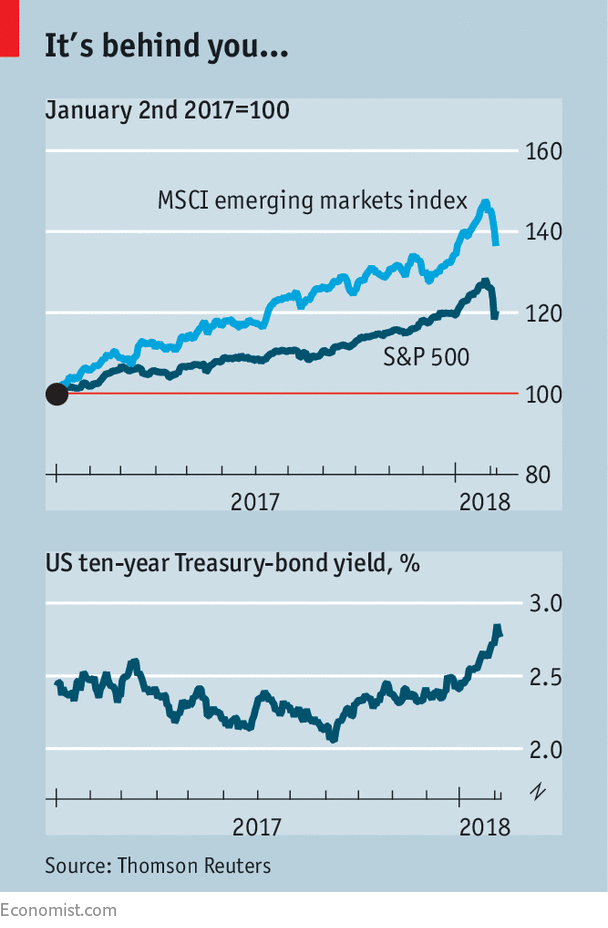
EVERY good horror-film director knows the secret of the “jump scare”. Just when the hero or heroine feels safe, the monster appears from nowhere to startle them. The latest stockmarket shock could have been directed by Alfred Hitchcock. The sharp falls that took place on February 2nd and 5th followed a long period where the only direction for share prices appeared to be upwards.
In fact the American market had risen so far, so fast that the decline only took share prices back to where they were at the start of the year (see chart). And although a 1,175-point fall in the Dow Jones Industrial Average on February 5th was the biggest ever in absolute terms, it was still smallish beer in proportionate terms, at just 4.6%. The 508-point fall in the Dow in October 1987 knocked nearly 23% off the market.
Bets on low market volatility went spectacularly wrong
THE Cboe Volatility Index, or Vix, known as the “fear gauge”, spikes when markets are most jittery. When Sandy Rattray, now at Man Group, an asset manager, worked on the Vix in the early 2000s, he and his team considered launching an exchange-traded product (ETP) linked to it, but concluded that it would be a “horror show” because of poor returns. Now, however, Vix-linked ETPs are a big industry, with around $8bn in assets. Formerly niche investments, they served vastly to exacerbate this week’s market turmoil, which saw the Vix’s largest ever one-day move, when it more than doubled on February 5th.
The Vix was always intended as a basis for financial products as well as a gauge. Vix futures were launched in 2004 and options in 2006. “Long” Vix products, which Mr Rattray looked into, seek to mirror the index . The problem is that this means buying futures contracts, with buyers having to pay a constant premium over spot prices. So these ETPs tend to lose money over time, punctuated (but not fully made up for) by gains when the Vix spikes. The largest “long” fund, VXX, issued by Barclays, has lost over 99.9% since its launch in 2009.
So other ETPs were developed to “short”—ie, bet against—the Vix index. Until this week, they were doing handsomely. Amid a long spell of subdued volatility, investors piled in. In January, assets in…Continue reading
Central banks should gamble on productivity-improving technology
IN 1996 Alan Greenspan began asking why the flashy information technology spreading across America seemed not to be lifting productivity. He was not the first to wonder. A decade earlier Robert Solow, a Nobel prizewinner, famously remarked that computers were everywhere but in the statistics. But Mr Greenspan was uniquely positioned, as the chairman of the Federal Reserve, to experiment on the American economy. As the unemployment rate dropped to levels that might normally trigger a phalanx of interest-rate rises, Mr Greenspan’s Fed moved cautiously, betting that efficiencies from new IT would keep price pressures in check. The result was the longest period of rapid growth since the early 1960s. Despite his success, few central bankers seem eager to repeat the experiment and many remain blinkered to issues other than inflation and employment. That is unfortunate. A little faith in technology could go a long way.
Central bankers are not known to be a visionary bunch. Turning new ideas into more…Continue reading
Ever better and cheaper, face-recognition technology is spreading

TOURING the headquarters of Megvii in Beijing is like visiting Big Brother’s engine room. A video camera in the firm’s lobby recognises visitors in the blink of an eye. Other such devices are deployed around the office. Some of the images they capture are shown on a wall of video called “Skynet”, after the artificial-intelligence (AI) system in the “Terminator” films. One feed shows a group of employees waiting in front of an elevator with a white frame around every face and the name of each person next to it. Quizzed on the Orwellian overtones of the set-up, Yin Qi, the startup’s chief executive, simply remarks that “this helps catch bad guys.”
Even if Mr Yin wanted to ponder the implications of the technology, he would not have the time. Megvii is busy building what he describes as a “brain” for visual computing. The firm has come a long way since its founding in 2011 (its name stands for “mega vision”). More than 300,000 companies and individuals around the…Continue reading
Price-bots can collude against consumers

MARTHA’S VINEYARD, an island off the coast of Massachusetts, is a favourite summer retreat for well-to-do Americans. A few years ago, visitors noticed that petrol prices were considerably higher than in nearby Cape Cod. Even those with deep pockets hate to be ripped off. A price-fixing suit was brought against four of the island’s petrol stations. The judges found no evidence of a conspiracy to raise prices, but they did note that the market was conducive to “tacit collusion” between retailers. In such circumstances, rival firms tend to come to an implicit understanding that boosts profits at the expense of consumers.
No one went to jail. Whereas explicit collusion over prices is illegal, tacit collusion is not—though trustbusters attempt to forestall it by, for instance, blocking mergers that leave markets at the mercy of a handful of suppliers. But what if the conditions that foster such tacit collusion were to become widespread? A recent book* by Ariel Ezrachi and Maurice Stucke, two experts on competition policy, argues this is all too likely. As more and more purchases are made online, sellers rely increasingly on sophisticated algorithms to set prices. And…Continue reading