
Tag: Finance and economics
The history of growth should be all about recessions

“THROUGHOUT history, poverty is the normal condition of man,” wrote Robert Heinlein, a science-fiction writer. Until the 18th century, global GDP per person was stuck between $725 and $1,100, around the same income level as the World Bank’s current poverty line of $1.90 a day. But global income levels per person have since accelerated, from around $1,100 in 1800 to $3,600 in 1950, and over $10,000 today.
Economists have long tried to explain this sudden surge in output. Most theories have focused on the factors driving long-term economic growth such as the quantity and productivity of labour and capital. But a new paper* takes a different tack: faster growth is not due to bigger booms, but to less shrinking in recessions. Stephen Broadberry of Oxford University and John Wallis of the University of Maryland have taken data for 18 countries in Europe and the New World, some from as far back as the 13th century. To their surprise, they found that growth during years of economic expansion has fallen in the recent era—from 3.88% between 1820 and 1870 to 3.06% since 1950—even though average growth across all years in those two periods increased from 1.4% to…Continue reading
Payday lending is declining

IN MAY 2013 Gloria James borrowed $200 from Loan Till Payday, a lender near her home in Wilmington, Delaware. Rather than take out a one- or two-month loan for a $100 fee, as she had done several times before, she was offered a one-year loan that would set her back $1,620 in interest, equivalent to an annual rate of 838%. Ms James, a housekeeper making $12 an hour, agreed to the high-interest loan but quickly fell behind on her payments. After filing a lawsuit in federal court, a Delaware judge ruled that the loan in question was not only illegal but “unconscionable”.
Her story is remarkably common. Americans who live pay cheque to pay cheque have few places to turn when they are in financial distress. Many rely on high-interest payday loans to stay afloat. But government efforts to crack down on the $40bn industry may be having an effect.
Roughly 2.5m American households, about one in 50, use payday loans each year, according to government statistics. The typical loan is $350, lasts two weeks, and costs $15 for each $100 borrowed. Although payday loans are marketed as a source of short-term cash to be used in financial emergencies, they are often used to…Continue reading
Ireland’s food industries would be worst hit by a hard Brexit

IN 1962 Tony O’Reilly, head of the Irish Dairy Board, had an idea that would help transform Ireland’s economy. He wanted to create a premium brand for Irish butter to break into the growing British market. The new product, named Kerrygold and backed with a large marketing budget, was sold in half-pound packs in a parchment wrapping so shoppers could inspect the butter’s quality. Its success was an inspiration to other exporters and changed perceptions of Irish business.
Half a century on, the Irish economy has been transformed into a global trading hub. Some 90% of its exports are shipped by multinational companies. Many of these are American giants such as Intel, a chipmaker, and Pfizer, a drugs firm. But some are home-grown food firms, such as Kerry Group. Observers speak of a dual economy: a “modern” capital-intensive part, powered by foreign direct investment (FDI), usually from America; and a “traditional” jobs-intensive food business, which still looks to the British market. The prospect of Brexit is pulling these two parts of the economy in opposing directions.
For decades Ireland has appealed to foreign companies as a low-tax,…Continue reading
The president of the Richmond Fed resigns
 Lacker has sad finish
FOR almost five years inquiries have sought to establish how Medley Global Advisors, a research firm, revealed details of Federal Reserve minutes a day before they were publicly released in October 2012. On April 4th the saga took a sudden twist when Jeffrey Lacker, president of the Richmond Fed (and hence a member of the committee that sets interest rates), quit over the leak.
Mr Lacker spoke to Medley the day before it published its note, in which it revealed that there was “intense debate” within the Fed over the third stage of its quantitative-easing programme, that the central bank was poised to buy more Treasury bonds at a later date, and that the Fed had mulled a promise not to raise interest rates until unemployment fell below 6.5%. (Both the bond-buying and the promise did later happen.) According to Mr Lacker, who was the meeting’s sole dissenter, when Medley mentioned confidential information on the call he “did not refuse or express his inability to comment and the interview continued”. This, he said, “could have been taken…as an acknowledgment or confirmation of the information.”
During an…Continue reading
How Chávez and Maduro have impoverished Venezuela

IT IS hard to convey the severity of Venezuela’s unfolding crisis. Its extent is astounding: the economy shrank by 10% last year, and will be 23% smaller than in 2013 by the end of this year, according to IMF forecasts. Inflation may exceed 1,600% this year. The human details are more poignant: over the past year around three-quarters of Venezuelans have lost weight, averaging 8.7kg per person, because of a scarcity of food. No war, foreign or civil, is to blame for this catastrophe. Venezuela did this to itself. And its woes are deepening, as the regime of President Nicolás Maduro lurches towards dictatorship. Fifty years ago, Venezuela was an example to the rest of Latin America, a relatively stable democracy and not much poorer than Britain. How did this tragedy occur?
Venezuela’s economy is built on oil—its leaders boast it has the world’s largest proven reserves—and it is tempting to blame fickle crude prices for its woes. Oil accounts for more than 90% of Venezuelan exports. It helps to fund the government budget and provides the foreign exchange that the country needs to import consumer goods. Nearly everything of consequence in the economy,…Continue reading
Donald Trump’s review of trade deficits is a blast from the past

“WE are in a trade war,” said Wilbur Ross, Donald Trump’s commerce secretary, on March 31st. That day Mr Trump duly loosed off a couple of warning shots, announcing two trade-related executive orders. (He forgot to sign them in the ceremony itself.) As tactics go, this was hardly shock and awe. Rather, it was supposed to suggest that nastier weaponry is on the way.
The first executive order was aimed at making trade rulebreakers “face the consequences”. Some bits were vague: officials have 90 days to develop and implement a plan to combat customs violations. Others seemed trivial. The government has lost $2.3bn of revenue over 14 years from importers going bankrupt before paying duties; almost half of this relates to imports of fresh garlic and preserved mushrooms.
The second executive order seemed more in keeping with Mr Trump’s (trade) warmongering. Officials have 90 days to produce an “omnibus” report, naming the trading partners with which America had a “significant” trade deficit in goods in 2016 and shaming them if the reasons for that deficit are “unfair”. Based on what it finds, Mr Trump promised to “take necessary and lawful…Continue reading
Japan's labour market is tight. So why aren’t wages rising?

TRIMLY DRESSED deliverymen, polite and punctual, are ubiquitous in Japan. So it was shocking to see one of them kicking his parcels and hurling his trolley outside a block of Tokyo flats after apparently finding no one at home. Captured on a camera phone last December, this incident of “parcel rage” went viral, forcing Sagawa Express, one of Japan’s biggest delivery companies, to say sorry to its customers. Many Japanese will have felt sympathy, though, for the video’s frazzled star.
Over 10% of the country’s firms admit that some workers frequently put in more than 100 hours of overtime in a month. A manager at a nuclear plant in Fukui prefecture worked twice that long in February 2016 before killing himself two months later. The problem is especially acute in low-skilled service industries. Over the past two decades, e-commerce has vastly increased the number of parcels handled by firms like Sagawa. Last year, one employee committed suicide after being violently bullied by his boss.
In a survey in 2015 by the Japan Institute of Labour Policy and Training, some workers blamed their own lack of ability for why they put in so many extra hours. Others…Continue reading
America’s disproportionate weight in global stockmarket indices

THE aims of a stockmarket index are threefold. First, to reflect what is actually going on in the market; second, to create a benchmark against which professional fund managers can be judged; and third, to allow investors to assemble well-diversified, low-cost portfolios. On all three counts, there are reasons to worry about the MSCI All-World Country Index, one of the most widely used gauges of the global stockmarket.
That is because the American market has a weighting of 54% in the index, as high as it has ever been (it reached the same level in 2002). In other words, anyone using the index to monitor the market is seeing a picture heavily distorted by Wall Street. The relative performance of international fund managers against the index will largely depend on how much exposure to America they are willing to take on. And anyone buying a tracking fund is making a big bet on the American market. Things are even worse if investors track the MSCI World Index, which covers only developed markets. In that benchmark, America’s weight is 60.5%.
Banks’ equity-research operations are in decline
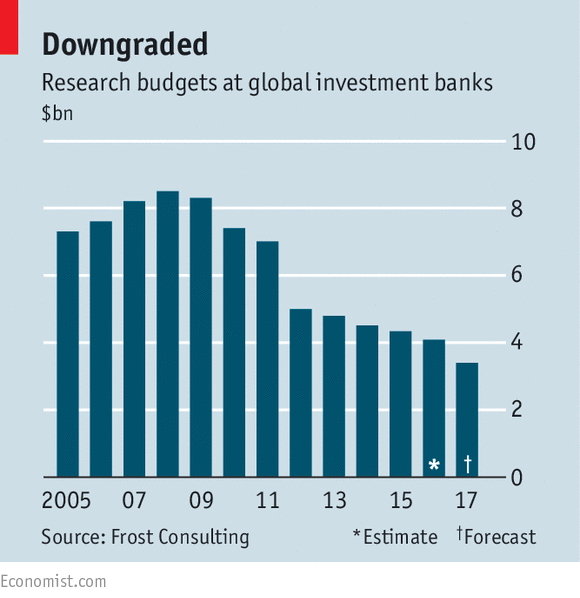
EQUITY research, the business of providing analysis of companies’ financial performance, may be a stodgy industry but it is not a simple one. Regulators fret about the sector’s Byzantine payment structure: investment banks dominate the market, but do not charge for it. They dole it out free to clients in the hope of future trading business. The understandable fear is that this set-up produces conflicts. Banks may be wary of issuing reports critical of companies; fund managers may end up choosing banks because of their research rather than the efficiency of their brokerage services. New regulations will overturn this model entirely.
MiFID 2, an ambitious set of European financial rules coming into effect next January, will force asset managers to disclose how much they spend on research. So banks will have to “unbundle” their services, billing clients for research and trading separately. Although the rules are being introduced by European regulators, banks across the world will have to change their pricing practices to comply.
These rules will be hugely, and beneficially, disruptive to a grossly inefficient industry. At present, banks blast…Continue reading
Lacklustre power demand in Asia throws a cloud over coal

THE Hazelwood power station in Australia’s state of Victoria started generating electricity 52 years ago. The stark symbol of an era when coal was king, Hazelwood was one of Australia’s dirtiest: its fuel was the Latrobe valley’s brown coal, a bigger polluter than the black sort. The station was due finally to close on March 31st. Days earlier, chimney stacks were demolished at Munmorah, a black-coal station north of Sydney, already closed. Australia has shut ten coal-fired power stations over the past seven years, yet coal still generates about three-quarters of its electricity.
This fits a pattern across much of Asia, which accounts for two-thirds of the world’s coal demand. The biggest economies besides Japan, which hopes to replace nuclear with “clean” coal, are either closing down old plants or rethinking plans to build new ones. This is casting a deepening cloud over the coal industry.
Two reasons explain the looming overcapacity in countries ranging from China and India to Australia (South-East Asia remains hooked on coal). Firstly, electricity demand is stagnant, falling or growing less strongly than expected, which has put considerable financial…Continue reading