
Tag: Finance and economics
Indonesia’s tax amnesty passes its deadline

LAST year Indonesia’s finance minister, Sri Mulyani Indrawati, invited chief executives, directors and shareholders from the country’s leading industries to banquets at her ministry. As they munched, she would give presentations setting out who among them had—and, by omission, who had not—signed up to the government’s tax amnesty. “This may be the most expensive dinner in your lifetime,” the 54-year-old economist recalls telling them.
Indonesia’s tax amnesty, which began in July 2016, ended on March 31st. More than 800,000 evaders declared 4,700trn rupiah ($350bn) in assets previously hidden from the authorities. That is a staggering sum, equivalent to 40% of Indonesia’s GDP and 90% of the money supply, and revealing of the epic scale of tax-dodging.
The willingness of tax cheats to come clean partly reflects the generous terms on offer. Assets declared in the first three months were taxed at just 2-4%, compared with the individual income-tax rate of up to 30%. Those declared in the next three months were taxed at 3-6%, and those in the final three months at 5-10%. The government collected additional revenue of 125trn rupiah, equivalent to less than…Continue reading
The life and times of an Italian non-performing loan

MARIO (not his real name) from the pretty Italian city of Vicenza opened an account at a local bank in 1992. It afforded him an overdraft of the equivalent of €10,000. He needed it to pay the bills of his wholesale textiles company. Over the years his firm’s cash problems worsened. In 2013, after Mario had exceeded his overdraft limit by €7,000 ($9,300), the bank gave him an unsecured loan of €50,000.
The first repayment was due in January 2014, yet by June Mario had filed for voluntary bankruptcy. The bank—now owed €70,300—presented itself to the court as a creditor. It entered into an arrangement, but in December sold the loan for 5% of its book value to Banca IFIS, an Italian lender building a portfolio of soured debts. Banca IFIS employed an external debt collector and by the following April, Mario had repaid €17,000. Having made a tidy profit on its investment, Banca IFIS told the bankruptcy court the debt had been cleared.
It seems puzzling that Mario was granted a loan after being overdrawn for so long. Andrea Clamer, head of Banca IFIS’s bad-loans division, says such mysteries are central to understanding Italy’s bad-loan…Continue reading
An improbable global shortage: sand

INDIA’S “sand mafia” is doing a roaring trade. The Times of India estimates that the illicit market for sand is worth around 150bn rupees ($2.3bn) a year; at one site in Tamil Nadu alone, 50,000 lorryloads are mined every day and smuggled to nearby states. Gangs around the country frequently turn to violence as they vie to continue cashing in on a building boom.
Much of the modern global economy depends on sand. Most of it pours into the construction industry, where it is used to make concrete and asphalt. A smaller quantity of fine-grade sand is used to produce glass and electronics, and, particularly in America, to extract oil from shale in the fracking industry. No wonder, then, that sand and gravel are the most extracted materials in the world. A 2014 report by the United Nations Environment Programme (UNEP) estimates they account for up to 85% by weight of everything mined globally each year.
With house-building in the West yet to recover fully from the 2007-08 crisis, Asia has been, by far, the main source of demand. Figures from the Freedonia Group, a market-research firm, suggest that, of the 13.7bn tonnes of sand mined…Continue reading
Stockmarkets give up some of their Trump bump
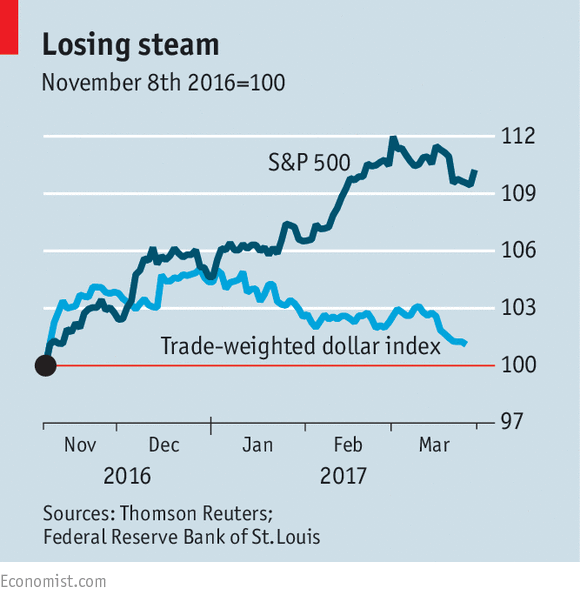
HONEYMOONS don’t last for ever. Having been a reluctant bride to President Donald Trump when courted in the run-up to November’s election, the American stockmarket quickly melted into a mood of romantic euphoria. Shares rose by 12% between election day and March 1st (see chart). But in recent days, sentiment has dimmed. There is talk of the “Trump-disappointment trade”.
For the markets to experience some kind of sell-off is hardly a surprise. The S&P 500 index had gone more than 100 days without a 1% decline, the longest such streak since 1995. And the setback should not be exaggerated. The S&P 500 remains well above its pre-election level, compared with the dollar, which has given up around half its gains. The ten-year Treasury-bond yield, which hit 2.62% on March 13th, has dropped back to 2.38%.
The immediate cause of the retreat seemed to be the failure of Mr Trump to repeal his predecessor’s health-care bill. That logic was hardly a great advertisement for capitalism, implying that the fewer Americans had access to health insurance, the happier investors would be. But the broader rationale seemed to be that, if the Republicans…Continue reading
Will robots displace humans as motorised vehicles replaced horses?

IN THE early 20th century the future seemed bright for horse employment. Within 50 years cars and tractors made short work of equine livelihoods. Some futurists see a cautionary tale for humanity in the fate of the horse: it was economically indispensable until it wasn’t. The common retort to such concerns is that humans are far more cognitively adaptable than beasts of burden. Yet as robots grow more nimble, humans look increasingly vulnerable. A new working paper concludes that between 1990 and 2007, each industrial robot added per thousand workers reduced employment in America by nearly six workers. Humanity may not be sent out to pasture, but the parallel with horses is still uncomfortably close.
Robots are just one small part of the technological wave squeezing people. The International Federation of Robotics defines industrial robots as machines that are automatically controlled and re-programmable; single-purpose equipment does not count. The worldwide population of such creatures is below 2m; America has slightly less than two robots per 1,000 workers (Europe has a bit more than two). But their numbers are growing, as is the range of tasks they…Continue reading
Will robots displace humans as motorised vehicles ousted horses?

IN THE early 20th century the future seemed bright for horse employment. Within 50 years cars and tractors made short work of equine livelihoods. Some futurists see a cautionary tale for humanity in the fate of the horse: it was economically indispensable until it wasn’t. The common retort to such concerns is that humans are far more cognitively adaptable than beasts of burden. Yet as robots grow more nimble, humans look increasingly vulnerable. A new working paper concludes that, between 1990 and 2007, each industrial robot added per thousand workers reduced employment in America by nearly six workers. Humanity may not be sent out to pasture, but the parallel with horses is still uncomfortably close.
Robots are just one small part of the technological wave squeezing people. The International Federation of Robotics defines industrial robots as machines that are automatically controlled and re-programmable; single-purpose equipment does not count. The worldwide population of such creatures is below 2m; America has slightly fewer than two robots per 1,000 workers (Europe has a bit more than two). But their numbers are growing, as is the range of tasks they can tackle, so…Continue reading
An earthquake in European banking

IN BRITAIN alone millions of people make formal complaints each year about their banks. For them, Sebastian Siemiatkowski, founder of Klarna, a Swedish payments startup, brings good news. New European rules, he says, will open the door to a host of innovative services that analyse transactions, so “an app could tell you there’s a cheaper mortgage available and start the switching process for you.” Apps could warn account-holders if they spend more than a predetermined amount or are about to become overdrawn, or even nudge them to save more. Customers need barely ever interact with their bank.
To date, despite dire warnings, European retail banking has been remarkably unscathed by technology-driven disruption. Customers stay loyal, and banks still do the most of the lending. Financial-technology (“fintech”) companies are beginning to mount a challenge, most conspicuously in the online-payments industry in northern Europe: Sofort, iDEAL and other fintech firms conduct over half of online transactions in Germany and the Netherlands, for example. But their reach is more limited elsewhere in Europe. Physical payments are still overwhelmingly made with cash or bank…Continue reading
The Trump administration will review all of America’s trade deals

ACCORDING to a document crafted by the Trump administration, a model trade agreement has 24 elements. Second on the list is “trade-deficit reduction”, giving a hint as to why Mr Trump wants to review America’s existing agreements. In January Sean Spicer, his press secretary, said the administration would “re-examine all of the current trade deals.” A presidential order to do just that is reported to be in the offing.
America boasts 14 bilateral and regional free-trade agreements (FTAs). Mr Trump seems to blame these agreements for America’s large trade deficit. Most economists disagree, seeing it as reflecting macroeconomic imbalances. The FTAs are in any case with countries representing just two-fifths of America’s two-way trade in goods, and less than 10% of its goods-trade deficit (see chart). Most (77%) of America’s deficit stems from trade with China, the European Union and Japan. None has an American FTA.
A focus on trade deficits means that tiddly deals such as those with Jordan and Oman will not face much heat. NAFTA (an agreement with Mexico and Canada), and KORUS (South Korea), will face more scrutiny because of chunky…Continue reading
The unusual gap between American and European bond yields

AMERICA may be the world’s largest economy, but these days its government pays more than many others to borrow money. Its ten-year bond yields are higher than those in Britain, France, Singapore and even Italy.
The gap between American and German ten-year yields has been above two percentage points. For much of the past 25 years, it was very rare for the difference to exceed a single percentage point. On occasions, American yields fell below German levels (see chart).
Go back a generation and you might have expected the country with the higher bond yields to be the one with the weaker currency; investors would demand a higher yield to compensate for the risk of future depreciation. But that is not the case today. The dollar has been strong, relative to the euro, and many people expect it to strengthen further. Indeed, the higher yield on American government debt is one reason why investors might want to buy the dollar.
Instead, the gap may reflect differences in both monetary and fiscal policy. In America the Federal Reserve stopped buying Treasury bonds a while ago and has raised interest rates three times since December 2015; the European…Continue reading
China’s growing clout in international economic affairs
THE IMF “systematically impoverishes foreigners”, and the World Bank’s advice has “negative value to its best clients”. These harsh words were voiced not by lefty critics of the Washington Consensus, but by two men (David Malpass and Adam Lerrick, respectively) whom Donald Trump has picked to lead his Treasury’s dealings with the rest of the world, including the international financial institutions (IFIs), such as the World Bank and IMF, and the G20 group of leading economies.
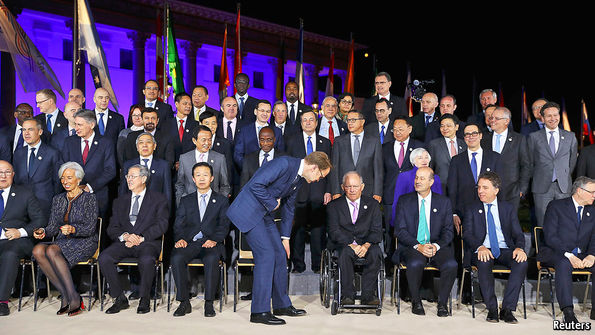
Their future boss, Steven Mnuchin, America’s treasury secretary, is not much more reassuring to the global financial establishment. At his first G20 meeting, in Baden-Baden in Germany on March 17th-18th (pictured), he vetoed a long-standing pledge to “resist all forms of protectionism”. It had often been breached. But hypocrisy is the tribute vice pays to virtue.
To veterans of international economic affairs, this combative stance is baffling. America’s government now seems to disdain a set of institutions it nurtured into life—institutions that are more commonly criticised for following America’s will too closely. “The United States is just handing the leadership over…Continue reading