
Tag: Finance and economics
The coming revolution in insurance

IN THE stormy and ever-changing world of global finance, insurance has remained a relatively placid backwater. With the notable exception of AIG, an American insurer bailed out by the taxpayer in 2008, the industry rode out the financial crisis largely unscathed. Now, however, insurers face unprecedented competitive pressure owing to technological change. This pressure is demanding not just adaptation, but transformation.
The essential product of insurance—protection, usually in the form of money, when things go wrong—has few obvious substitutes. Insurers have built huge customer bases as a result. Investment revenue has provided a reliable boost to profits. This easy life led to a complacent refusal to modernise. The industry is still astonishingly reliant on human labour. Underwriters look at data but plenty still rely on human judgment to evaluate risks and set premiums. Claims are often reviewed manually.
The march of automation and technology is an opportunity for new entrants. Although starting a new soup-to-nuts insurer from scratch is rare (see
The end of “secular stagnation”?
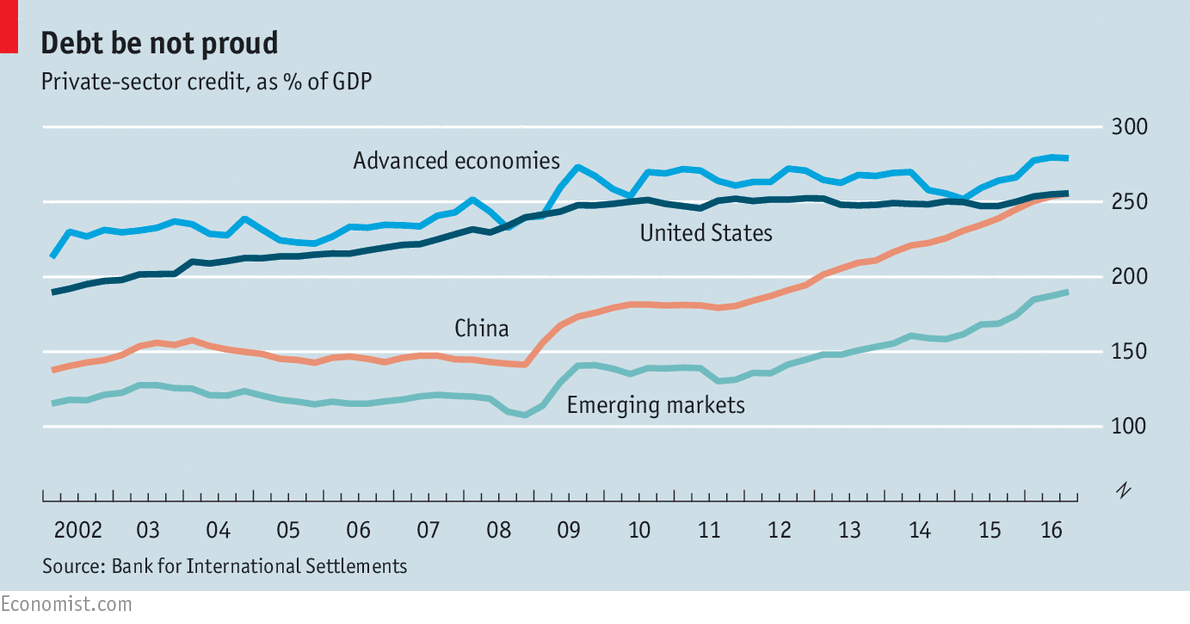
IN PERIODS of economic stress all sorts of theories are entertained about the nature of the problem. When better times return, some theories fade from memory. Others linger, however. During the economic mess of the past decade, economists frightened themselves with tales of “secular stagnation”: a nasty condition that dooms its victims to chronically weak growth. Now that the economic outlook is brightening a bit—deflation has been dispatched, and for most advanced economies 2017 is forecast to bring a third consecutive year of economic growth—it is tempting to laugh off the idea of secular stagnation as a bit of crisis-induced hysteria. Tempting, but also premature.
In a time of secular stagnation, the normal relationship between saving and investment goes haywire. People save some portion of their income each year. Because one person’s spending is another’s income, such saving can drain away demand and lead to recession, unless the funds set aside by savers are reinjected into the economy through lending to those looking to invest: as when banks lend savers’ deposits to businesses, for example. Central banks help manage this…Continue reading
The Trump administration’s trade strategy is dangerously outdated
 The trade guns of Navarro
ON THE campaign trail, Donald Trump’s trade policy was an alarming mixture of coruscating complaints and fierce threats of protectionist retaliation. But the world has been in the dark about how much of this rhetoric his administration might turn into reality. A flicker of light came on March 1st as the administration’s trade-strategy document was presented to Congress. Washington wonks see the hand of Peter Navarro, Mr Trump’s trade adviser and author of a book (and film) called “Death by China”. Robert Lighthizer, the nominee for the United States Trade Representative (USTR), has not yet been confirmed.
Little is new in the document’s promises of “ new and better trade deals” or of strict enforcement of American trade laws. But a preference for bilateral trade deals over multilateral ones is a change of tack. And the tone is certainly confrontational: “It is time for a more aggressive approach.” The document also gives an indication of how a Trump administration might take a trade fight to China: by using sections 201 and 301 of the Trade Act of 1974.
The first weapon,…Continue reading
China and currency manipulation

SINCE his election as president, Donald Trump has not softened his criticism of China over its alleged meddling to control the value of its currency, the yuan. On the contrary, he has called China “the grand champion” of currency manipulators. The kindest interpretation of this is that Mr Trump is out of date, as his own government could tell him.
America’s Treasury makes a six-monthly assessment of the foreign-exchange policies of its big trading partners. The criteria it uses to identify currency manipulators are regarded by many economists as inadequate. They do not include, for example, the domestic purchasing power of a currency. Nevertheless, even by those flawed criteria, China is far from the champion. Indeed it seems to have quit the tournament altogether.
The Treasury uses three measures: whether the country runs a sizeable surplus in trade with America; whether its current-account surplus exceeds 3% of GDP; and whether it spends more than 2% a year to buy foreign assets to suppress the value of its currency. Over the past year, no country has checked all three boxes. China, in the latest report, only met…Continue reading
A planned merger of LSE and Deutsche Börse unravels

IT HAD been billed as a bridge between Europe’s two main financial hubs. It has become, however, a symbol of their growing competition—and of the uncertainty into which Brexit has plunged the EU’s markets. A planned merger between Deutsche Börse (DB) and the London Stock Exchange (LSE), both listed companies, seems on the verge of collapse. This week the LSE rejected the latest demand of the European Commission (EC) to sell parts of its business to allay competition concerns.
The €29bn ($30bn) merger was first announced a year ago and is the companies’ third attempt to join forces since 2000. It brings together the operators of the British, German and Italian stock exchanges, as well as some of the largest clearing-houses in Europe. Before it would approve the deal, the EC launched an investigation into its impact on competition. Last September it identified a number of concerns, including about the derivatives market once the clearing-houses merged. In early February the LSE sought to ease that concern by confirming the sale of its Paris-based clearing unit, LCH.
Not good enough, the EC countered a few weeks later: the sale…Continue reading
India’s twin balance-sheet problem

IF INDIA is indeed the world’s fastest-growing big economy, as its government once again claimed this week, no one told its bankers and business leaders. In a nation of 1.3bn steadily growing at around 7% a year, the mood in corner offices ought to be jubilant. Instead, firms are busy cutting back investment as if mired in recession. Bank lending to industry, growth in which once reached 30% a year, is shrinking for the first time in over two decades (see chart). If this is world-beating growth, what might a slowdown look like?

India’s macroeconomy chugs along (though the quality of government statistics remains questionable), but its corporate sector is ailing. The sudden and chaotic “demonetisation” of 86% of bank notes in November hardly helped. But the origins of India’s troubles go much deeper. After India dodged the worst of the financial crisis a decade ago, a flurry of investment was made on over-optimistic…Continue reading
An impossible mind: the late Kenneth Arrow

SOME great economists are Aristotelians, discerning the logic of markets from tangible examples around them. Others are Platonists, using their powers of reasoning to grasp ideal economic forms, of which actually existing markets are but flickering shadows. Kenneth Arrow, who died on February 21st aged 95, was both. His ideas gave economics some of its most compelling abstractions and most fruitful applications.
The abstractions won him the Nobel prize at the age of 51. (He remains the youngest winner and the most cited by others in their prize lectures.) He established the conditions under which prices might successfully co-ordinate production and exchange, eliminating shortages and surpluses. Adam Smith provided the best metaphor for this underappreciated feat: the “invisible hand”, guiding resources to their best uses. Ken Arrow and his co-author, Gérard Debreu, provided the best algebra.
To economists versed in mathematics, a well co-ordinated economy is like a system of simultaneous equations, which all hold true at the same time. The solution to these equations is a set of prices that equates demand and supply for scarce commodities…Continue reading
Competition for private-equity deals heats up

TIME was, the private-equity industry felt spoiled for choice. The difficulty was choosing deals, not finding them. Yet according to numbers from Dealogic, a data provider, that have been crunched by Bain & Company, a consultancy, private-equity houses are now losing out in mergers and acquisitions (M&A) to non-financial companies. In 2016 private equity’s global share of all deals dipped to 4.2%, the lowest level since the depths of the post-crisis recession in 2009. This was down from 5.4% as recently as 2014 and an all-time high of 7.9% in 2006. The same trend is evident in Europe and in America, private equity’s two biggest markets (see chart).
Yet the pressure on private-equity firms to deploy their capital has never been greater. The industry has raised well over $500bn from investors in each of the past four years, the longest such streak ever. The amount of uninvested cash they are sitting on (“dry powder”) reached a record $1.47trn at the end of 2016. Of that, $534bn was specifically earmarked for buy-outs. Investors, who pay fees as a percentage of the capital they have committed, even when it is still uninvested,…Continue reading
Second-degree moral hazard

MORAL hazard is a problem that crops up often in economics. People behave differently if they do not face the full costs or risks of their actions: deposit insurance makes customers less careful about picking their bank, for example.
Moral hazard can also be second-hand. Take medicine. A patient with private insurance may be happy to sit through extra tests, and a doctor may be happy to order them. Doctors might be more reluctant to order tests if they know that the patient would bear the full cost.
A newly published paper* sets out to test this secondary problem by examining a common-enough situation—taking a taxi ride in a strange city. The authors, a trio of academics at the University of Innsbruck, sent researchers on 400 taxi rides, covering 11 different routes, in Athens, Greece. In all cases, the researchers indicated they were not familiar with the city. But in half the cases, the researchers indicated that their employers would be reimbursing them for the journey. The researchers in the latter group were 17% more likely to be overcharged for their trip and paid a fare that was, on average, 7% higher.
The most common form of…Continue reading
Interest rates and investment returns

IF THERE is one aspect of the current era sure to obsess the financial historians of tomorrow, it is the unprecedentedly low level of interest rates. Never before have deposit rates or bond yields been so depressed in nominal terms, with some governments even able to borrow at negative rates. It is taking a long time for investors to adjust their assumptions accordingly.
Real interest rates (ie, allowing for inflation) are also low. As measured by inflation-linked bonds, they are around -1% in big rich economies. In their latest annual report for Credit Suisse on global investment returns, Elroy Dimson of Cambridge University and Paul Marsh and Mike Staunton of the London Business School look at the relationship between real interest rates and future investment returns. Very low real rates have in the past been associated with poor future equity returns (see chart).
That may come as a nasty shock for state and local-government pension funds in America. They have to assume a future rate of return on their investments when calculating how much they need to contribute to their plans each year. Most opt for 7-8%, a level that has…Continue reading