
Tag: Finance and economics
Investors in America’s housing-finance giants lose in court

ONE unresolved issue from the financial crisis is the future of Fannie Mae and Freddie Mac, the two firms that stand behind much of America’s housing market. Fannie and Freddie purchase mortgages, bundle them into securities and sell them on to investors with a guarantee. When America’s housing market collapsed a decade ago, the government had to bail them out. Its treatment of the firms since then has created a titanic legal struggle. Shareholders have cried foul. On February 21st, a federal appeals court upheld a ruling in the government’s favour.
At issue is the Obama administration’s decision in 2012 to hoover up all of Fannie and Freddie’s profits. Until then, it had received a fixed dividend on its investment. The timing of the shift was striking—just before a surge in the firms’ profitability. Since 2008 the Treasury has sucked in about $250bn from the firms, 30% more than the cost of the bail-out.
The change enraged hedge funds who had bought Fannie and Freddie’s shares and found themselves expropriated. The investors’ lawsuit held that the government overstepped its authority by seizing all profits. A federal court…Continue reading
The sanctity of trade statistics
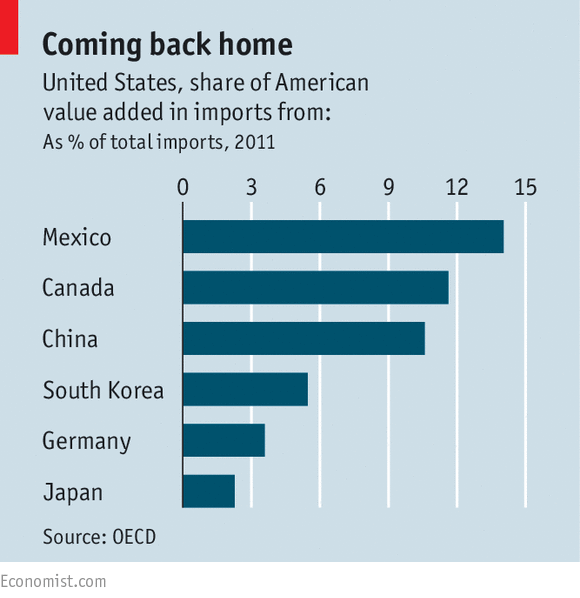
MIGHT Donald Trump’s promise to shake up America’s trade policy extend to its statistics? According to a report in the Wall Street Journal, discussions are afoot on changing the way trade figures are tallied. The Bureau of Economic Analysis, the country’s main statistical body, calls this “completely inaccurate”. But in trade as elsewhere, the new administration seems prone to using statistics as a drunk uses a lamppost—for support rather than illumination.
The proposal reportedly involves stripping out some of America’s exports from the gross numbers. America sold $1.5trn of goods abroad in 2016, but of that $0.2trn were re-exports that left the country much as they had arrived. This type of trade has been growing, reflecting America’s role as a hub for North American trade. As a share of its combined exports to Mexico and Canada, re-exports rose from 12% to 20% between 2002 and 2016. Truckers and shippers benefit from this kind of trade. But critics see it as “padding”, obscuring gloomier trends in “made in America” exports.
Stripping out re-exports makes no sense when thinking…Continue reading
Europe’s securitisation market remains stunted
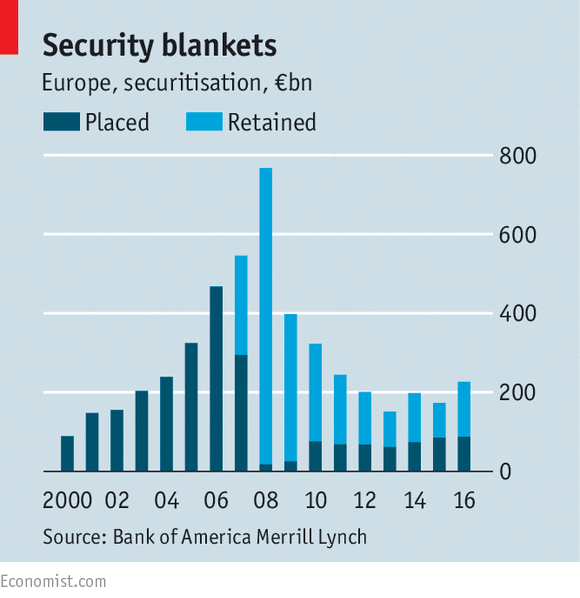
SECURITISATION, the bundling and repackaging of income streams as tradable securities, goes in and out of fashion. America is still dealing with the fallout from the disaster in one part of the market—sub-prime mortgages—in 2008-09 (see article). In Europe, the swings in popularity have been just as marked. During the crisis, European securitised assets were hit by only small losses but the market suffered from guilt by association. It has since enjoyed a limited renaissance.
Leading the revival, oddly, are European regulators. They have sought not just to rehabilitate, but indeed actively to promote such “structured” finance. As early as 2013 the European Central Bank (ECB) was effusive not only about securitisation’s ability to spread risks, but also about its ability to channel funding to the economy, including small and medium-sized enterprises (SMEs). The ECB and the Bank of England even published a rare joint paper in 2014 making the case for a “better-functioning…Continue reading
Why national budgets need to take gender into account
 A good investment
LIKE many rich-country governments, Britain’s prides itself on pursuing policies that promote sexual equality. However, it fails to live up to its word, argues the Women’s Budget Group, a feminist think-tank that has been scrutinising Britain’s economic policy since 1989. A report in 2016 from the House of Commons Library, an impartial research service, suggests that in 2010-15 women bore the cost of 85% of savings to the Treasury worth £23bn ($29bn) from austerity measures, specifically cuts in welfare benefits and in direct taxes. Because women earn less, rely more on benefits, and are much more likely than men to be single parents, the cuts affected them disproportionately.
The government does not set out to discriminate, says Diane Elson, the budget group’s former chair. Rather, it overlooks its own bias because it does not take the trouble to assess how policies affect women. Government budgets are supposed to be “gender-neutral”; in fact they are gender-ignorant. Ms Elson is one of the originators of a technique called “gender budgeting”—in which governments analyse fiscal policy in…Continue reading
In fintech, China shows the way

CHINESE banks are not far removed from the age of the abacus. In the 1980s they used these ancient counting boards for much of their business. In the 1990s many bank employees had to pass a basic abacus test. Today the occasional click-clack, click-clack can still be heard in villages as tellers slide their abacus beads up and down the rack.
But these days the abacus is mainly a symbol, more likely to be used in the branding of China’s online-finance companies than as a calculating tool. At least three internet lenders have paid homage to it in their names: Abacus Loans, Small Abacus and Modern Abacus. The prominence, so recently, of the abacus is testament to how backward Chinese banking was a short time ago. The rise of the online lenders shows how quickly change has come.
By just about any measure of size, China is the world’s leader in fintech (short for “financial technology”, and referring here to internet-based banking and investment). It is far and away the biggest market for digital payments, accounting for nearly half of the global total. It is dominant in online lending, occupying three-quarters of the global market. A…Continue reading
Why taxing robots is not a good idea

BILL GATES is an unlikely Luddite, however much Microsoft may have provoked people to take a hammer to their computers. Yet in a recent interview with Quartz, an online publication, he expressed scepticism about society’s ability to manage rapid automation. To forestall a social crisis, he mused, governments should consider a tax on robots; if automation slows as a result, so much the better. It is an intriguing if impracticable idea, which reveals a lot about the challenge of automation.
In some distant future robots with their own consciousnesses, nest-eggs and accountants might pay income taxes like the rest of us (presumably with as much enthusiasm). That is not what Mr Gates has in mind. He argues that today’s robots should be taxed—either their installation, or the profits firms enjoy by saving on the costs of the human labour displaced. The money generated could be used to retrain workers, and perhaps to finance an expansion of health care and education, which provide lots of hard-to-automate jobs in teaching or caring for the old and sick.
A robot is a capital investment, like a blast furnace or a…Continue reading
Asia’s exports rebound
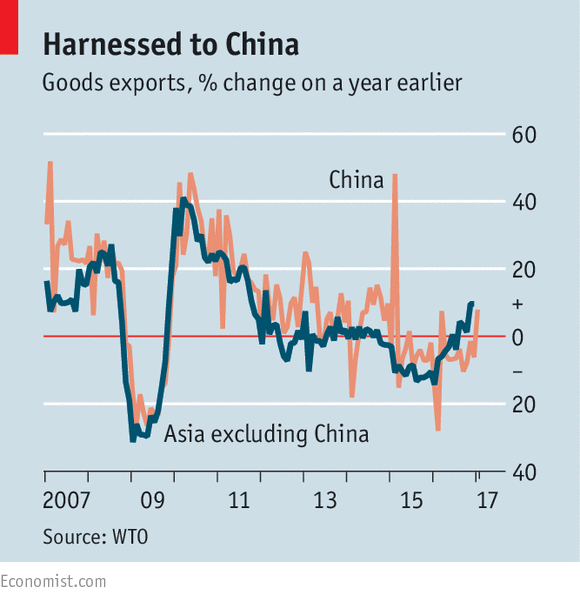
IT IS easy to be downcast about the state of global trade. It has faced stiff headwinds in recent years: in 2016, for the first time in 15 years, it grew more slowly than the world economy. Regional and global trade deals are going nowhere, slowly. And America’s new president has promised to protect his country from trade-inflicted “carnage”.
Amid all this gloom, optimism seems foolhardy. But in Asia’s export dynamos, trade is picking up steam. In January, Chinese exports rose year-on-year for the first time in ten months; South Korean shipments have increased for three months in a row. Surveys reveal strong export pipelines in Japan, Singapore and Taiwan. Healthy order books for Asia’s manufacturers normally bode well for global trade and indeed the global economy. It is too soon to declare a definitive upturn in global trade, but it looks like more than a blip (see chart).
The simplest explanation for the rebound is that global demand is itself on solid ground. Global growth is still slower than before the financial crisis of 2008, but is heading in the right direction. Both the IMF and the World Bank think it will…Continue reading
A bullish case for copper

DURING the commodity “supercycle”, prices largely marched up and down in unison, fuelled by the strength (or weakness) of demand in China. Since last year commodities have again been on a tear, but for more idiosyncratic reasons. In the case of copper, strikes and supply disruptions in two of the world’s largest mines have helped push prices this week to their highest level in 20 months. This fits into a narrative of longer-term potential supply shortages that has investors licking their lips over prospects for the red metal.
A strike that began on February 9th at Escondida in Chile, the world’s largest copper mine, has been compounded by a dispute between operators of Grasberg, another huge copper mine, located in the Indonesian province of Papua, and the government. That led to a halt in copper-concentrate production there, too, on February 10th. The two account for 9% of mined copper supply.

Robert…Continue reading
A new paper finds China more unequal than France but less so than America
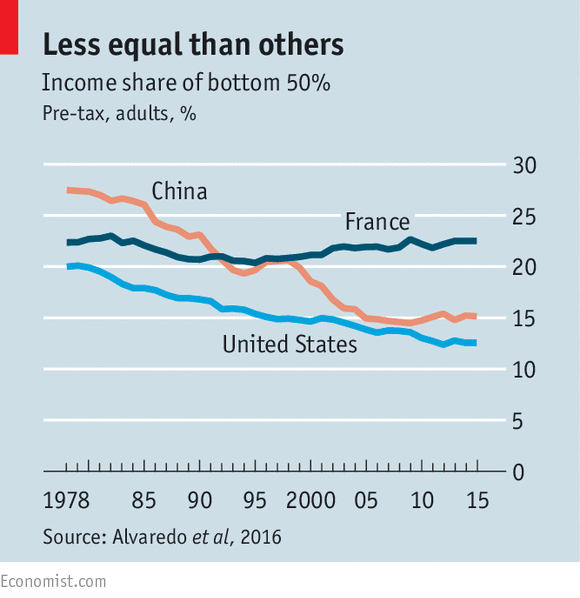
JUST as China’s GDP has converged towards America’s, levels of inequality have also been catching up. That is one of the conclusions of research* from five authors, including Thomas Piketty, a French economist famous for his work on wealth and inequality. Their new paper compares the evolution of inequality in China, America and France over four decades.
Inequality has soared since China opened the door to private enterprise and growth took off. In 1978 the highest-earning tenth in China received just over a quarter of overall income before tax, significantly below the proportion in America and France at the time. By 2015, however, those top 10% of Chinese earners were paid two-fifths of total income—above the share in France, but still just below that in America (47%). Wealth, too, is concentrated in fewer hands: the richest 10% own nearly 70% of private wealth in China, up from 40% in 1995 (and not far below the American level of nearly 80%).
Rises at the top mean that the share of pre-tax income going to the poorest half of the Chinese population has shrunk dramatically and is now, at 15%, not much higher than the…Continue reading
Carbon tariffs and the EU’s steel industry
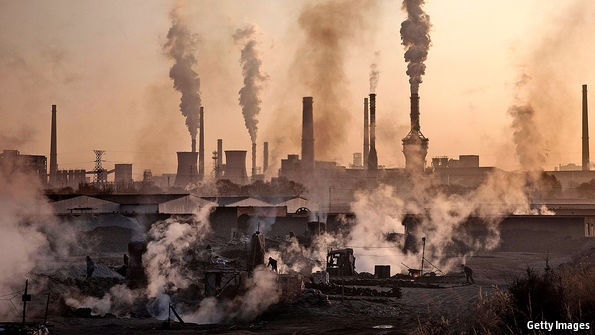 Fuel for a dirty war
THE European Union wants to slash greenhouse-gas emissions to 80% below 1990 levels by 2050. It is on course to cut just half that amount. To get back on track, on February 15th, the European Parliament voted for a plan to raise the cost for firms to produce carbon. It has prompted growing calls for the bloc to tax the carbon emissions embodied in the EU’s imports. At best, such a levy will barely curb emissions. At worst, it could cause a trade war.
The EU’s latest reforms try to put up the price of carbon by cutting the emissions allowances firms are granted. They include the EU’s first border tax on carbon, levied on cement imports. Steel firms, also heavy users of carbon, say their exclusion from this scheme is unfair. This week Lakshmi Mittal, the CEO of ArcelorMittal, the world’s biggest steelmaker, offered his support for the tax. Similar proposals in America are also gaining support. This month a group including two Republican former treasury secretaries, James Baker and George Shultz, proposed a similar carbon tax on all imports at the border.
Boosters say such proposals remove…Continue reading