
Tag: Finance and economics
How to measure North Korea’s economy
 An area of darkness
FACTS about the North Korean economy are not so much alternative as non-existent. The country has never published a statistical yearbook. If it did, no one would believe it. Nicholas Eberstadt of the American Enterprise Institute, a think-tank, calls analysis of its economy “essentially pre-quantitative”.
The most-cited estimate of the size of the economy comes from South Korea’s central bank. Its methodology is opaque but is based, at least in part, on the South Korean intelligence agency’s estimates of the North’s physical output, which is then translated to South Korean prices. But it is hard to estimate market valuations for goods that are not traded on the market, and physical goods make up only a fraction of overall economic output. Another technique is to “mirror” statistics from the country’s trading partners. But most North Korean trade is with China, where statistics are unreliable.
The advent of satellite imaging has helped, providing researchers with better estimates of manufacturing output, coal production and urbanisation. Yet another strategy is to work out…Continue reading
Brexit: the New Zealand precedent
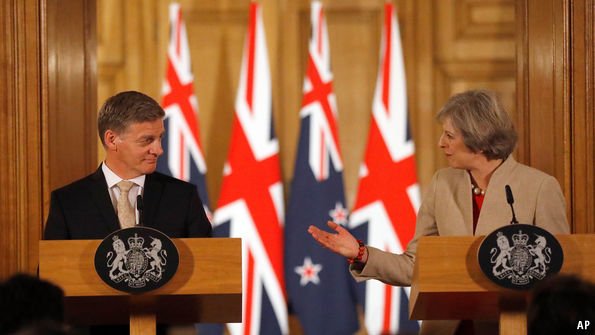
THE future of British trade after Brexit is shrouded in uncertainty. It is an unprecedented process, so it is hard to know where to look for clues as to how it may work out. One possibility is a country whose trading patterns were perhaps more disrupted than any other’s by Britain’s accession to the European Economic Community (EEC) in 1973: New Zealand.
Just as Brexit is likely to mean the end of British access to the single market, so “Brentry” ended New Zealand’s preferential access to the “mother country”. In 1961, when Britain first announced its intention to join the EEC, it took about half of New Zealand’s exports—a similar proportion to the EU’s share of British exports today.
New Zealand’s prime minister at the time, Keith Holyoake, warned his British counterpart, Harold Macmillan, that, without safeguards for its exports, New Zealand would be “ruined”. After years of negotiations, a transitional deal in 1971 agreed quotas for New Zealand butter, cheese and lamb over a five-year period, which helped to ease the shift away from Britain. Similarly—if in a much shorter time-span—Britain’s prime…Continue reading
The elderly, cognitive decline and banking

“THE older the wiser” may ring true for much of life, but not for our ability to handle money. Studies suggest financial decision-making ability tends to reach its peak in a person’s mid-50s, after when deterioration sets in. “Age-friendly” banks are beginning to learn how to protect vulnerable older customers.
The most dramatic forms of age-related mental deterioration are neurodegenerative diseases, like Alzheimer’s. But even “normal” ageing can cause cognitive change. Financial-management skills are often early casualties, because they demand both knowledge and judgment.
Older people are more likely to struggle with day-to-day banking and are more susceptible to poor investment decisions. They are also more vulnerable to fraud or to financial exploitation, often by relatives. In 2010 the over-65s in America made up 13% of the population but had over a third of the wealth. British pensioners became especially vulnerable when reforms in April 2015 allowed them to withdraw savings previously locked up. Newspapers fretted that people would splurge their pensions on Lamborghinis. A greater concern should have been that they…Continue reading
Bubbles are rarer than you think

BUBBLES put the fun into financial history. Who can resist stories about Dutch tulips that were worth more than country estates or the floating of an “undertaking of great advantage but no one to know what it is”?
Ever since the financial crisis of 2007-08, economists have debated whether bubbles can be identified, or indeed stopped, before they can cause widespread damage. That is easier said than done: even tulipmania may have been caused by a quirk in the wording of contracts that meant speculators would, at worst, walk away with only a tiny loss.
For many investors, the more important question is whether it is possible to avoid being sucked into a bubble at the top, and suffering declines like the 80% drop experienced by the NASDAQ 100 index of technology stocks between March 2000 and August 2002. Two essays in a new book*, from the CFA Institute Research Foundation and the Cambridge Judge Business School, indicate just how difficult market timing can be.
The first, from William Goetzmann of Yale School of Management, looks at the history of 21 stockmarkets since 1900. Mr Goetzmann defines a bubble as a doubling in a…Continue reading
Emerging markets’ Trump tantrum abates, except in Turkey

THE Syrian consulate in Istanbul’s elegant Nisantasi quarter is a busy spot. Men huddle outside in the cold, waiting for their turn to slip through the building’s ornate doors. The rest of the neighbourhood is, however, unusually subdued. A string of terrorist attacks in the city and an attempted coup in July, followed by a purge of suspected sympathisers, has dampened spirits. “After a bomb goes off, no one goes out. A week is lost,” says one shopkeeper.
Besides war next door and terror at home, Turkey’s economy has been rocked by political upheaval farther afield: the lira has plummeted by over 15% against the dollar since America’s election on November 8th. Many tenants cannot now afford Nisantasi’s rents, often priced in foreign currency. Even the childhood home of Orhan Pamuk, Turkey’s best-known novelist (pictured), has a “for rent” sign on the door.
Back in November, Turkey had a lot of company in its economic misery. Other emerging markets also reacted badly to America’s election result, prompting talk of a “Trump tantrum” to match the “taper tantrum” after May 2013, when America’s Federal Reserve began…Continue reading
India floats the idea of a universal basic income
 Basic needs
NOVEMBER 8th was not just the day of Donald Trump’s election. It was also when Indians found out most banknotes would lose all value unless promptly exchanged. Ever since, many have expected their patience in enduring the ensuing chaos to be rewarded in some way. Might scrapped cash unredeemed by presumed tax-dodgers be recycled into a lump-sum payment to each and every citizen? Or would the annual budget, presented on February 1st, be full of giveaways ahead of a string of state elections? In the event, the budget was restrained to the point of dullness. But the government’s closely-watched “economic survey”, released the previous day, hinted at a much bigger giveaway in the works: a universal basic income (UBI) payable to every single Indian.
The idea of a cash payment made to citizens irrespective of their wealth is centuries old. It has become newly fashionable in some rich countries, among both left-wing thinkers (who like its redistributive aspects) and their right-wing foes (who think it results in a less meddlesome state). The idea has had its fans in India: a small UBI scheme was launched as a pilot…Continue reading
The custodian-bank business

NO ACTOR has ever sat nude in a bathtub to explain the intricacies of the bank-custody business, as Margot Robbie did for mortgage-backed securities in “The Big Short”, a successful film. The blame lies with the custody business’s virtues, not its flaws.
Instead of the 2% fees Ms Robbie mentions for offloading rubbishy securities onto suckers, bank-custody fees are tallied in hundredths of a percentage point. Custody bankers are generally neither glamorous nor crooked. They are accountants and software engineers catering to well-informed clients: the owners and managers of huge amounts of financial assets. The services they offer include: holding, valuing and transferring securities; receiving interest and dividends; and providing notice of corporate actions. The business grows with the financial markets, but more slowly. Years of almost seamless and scandal-free performance have made the business well-nigh invisible. But not quite.
Custody has habitually been “sticky”: the loss of a large account is unusual. But on January 25th BlackRock, a gargantuan asset manager, announced that it was moving custody assets worth $1trn from State…Continue reading
What if interest expenses were no longer tax-deductible?
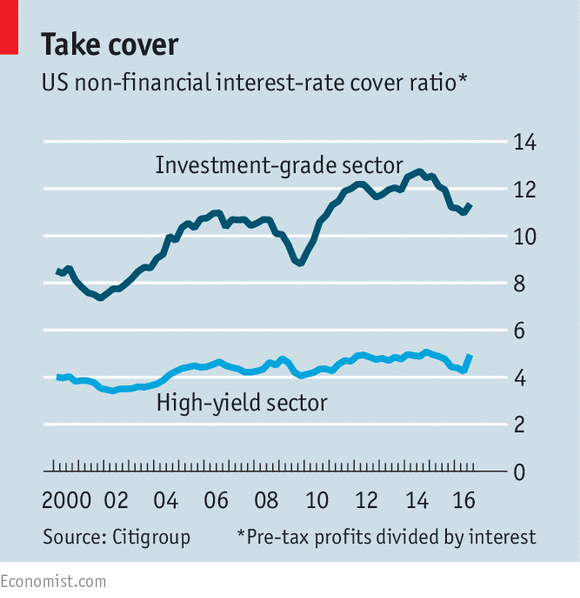
ONE reason why the American equity market has rallied since the election of Donald Trump is the hope that taxes on corporate profits will be cut. But that measure has to be paid for, and analysts are only just starting to figure out where the burden might fall.
The initial focus has been on the idea of border-adjustment taxes. But another way of raising revenue is to remove companies’ right to deduct their interest expenses from their taxable income. That proviso has been in place since 1918, when it was introduced to help firms struggling with the impact of the first world war—evidence that tax breaks, once granted, are hard to remove.
Allowing interest payments, but not dividends, to be deducted from corporate profits before tax is paid is a huge distortion to the system. It is a perk worth around 11% of the value of corporate assets. It has tended to encourage companies to take on more debt. By doing so, it may make the economy more risky at the margin: in a recession, highly-indebted companies are likely to go bust more quickly, whereas companies with lots of equity capital can ride out the storm. As a result, this…Continue reading
“Alt-beta” funds offer hedge-fund-like investments more cheaply

INVESTORS love to complain about hedge funds, which have delivered measly returns for the past several years and are notorious for their high fees. Yet so far, most have stuck with them. One reason is that the hedge funds’ mission—to provide returns uncorrelated with overall market performance—has been hard to replicate. But a fast-growing hedge-fund-like product, known as the “alternative beta” fund, allows investors much cheaper access to a similar style of investment.
“Alt-beta”, as it is usually called, is a bit of a misnomer. The word “beta” is typically used to mean broad market returns, which can be bought into through index-tracking funds. “Alpha” is the term used to describe the premium added by a skilled fund manager. The idea driving both “alt-beta” funds and longer-established “smart-beta” ones, is that, just as “beta” can be distinguished from “alpha”, so returns can be ascribed to identifiable, predictable factors. One example is the “value” effect: ie, that undervalued companies tend to outperform the market.
Smart-beta and alt-beta funds are close cousins, but differ in their…Continue reading
Ethiopia’s state-of-the-art commodity exchange

ON THE walls of the Ethiopia Commodity Exchange (ECX) in Addis Ababa, the capital, hang glossy black-and-white photographs of provincial market towns and rustic life. For the merchants and brokers striding across its high-tech trading floor they serve as a reminder that the ECX, sub-Saharan Africa’s most modern commodity exchange outside Johannesburg, exists for a simple, practical purpose: to transform Ethiopian agriculture.
It has some way to go. By connecting smallholder farmers to global markets, the exchange, launched with a fanfare in 2008, was supposed to help reduce hunger. The hope was it would reduce price volatility and incentivise farmers to plant crops. But staple foods such as haricot beans today account for less than 10% of its trade. Its annual turnover—worth about $1bn—is dominated instead by two export crops, coffee and sesame seeds. In 2015, despite a dire drought, Ethiopia did avoid famine, but the ECX played little role: its maize and wheat contracts had lapsed by then because of concerns that exports would jeopardise domestic food supplies. Cutting out middlemen seems not to have done much for smallholders: studies suggest…Continue reading