
Tag: Finance and economics
Brexit poses a threat to Ireland’s aircraft-leasing business

THE glass office blocks of Dublin’s docklands still stand proud; the banks that built them no longer do. The financial crisis of 2008 took down Ireland’s six biggest lenders. Within five years Dublin slid from being rated by Z/Yen, a London-based business think-tank, as the world’s tenth-best financial centre to its 70th. Britain’s readiness to leave Europe’s single market has since sparked hopes Dublin’s fortunes could be revived. An English-speaking base from which to keep doing business inside the EU may appeal to London’s bankers. But worries are growing that the impact will not be all good for Dublin.
To see why, look at aircraft finance, perhaps the city’s most successful industry. The topic of Brexit dominated the chatter at the world’s two biggest air-finance conferences, both held in Dublin this month. Drawing more than 4,500 airline bigwigs, lessors and bankers, such gatherings are usually preoccupied by issues such as aeroplane prices and the aviation cycle. This year geopolitics predominated. “In Ireland we’re surrounded by Trump to the west and Brexit to the east,” one industry veteran sighed in…Continue reading
The definition of “maximum employment” needs updating
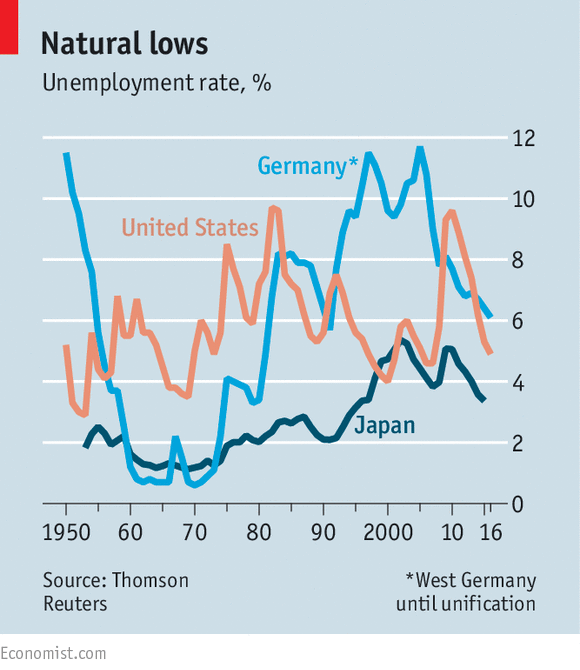
“IT IS fair to say the economy is near maximum employment,” said Janet Yellen, chairman of the Federal Reserve, in recent comments preparing markets for rate rises to come. But “maximum employment”, like pornography, is in the eye of the beholder. American adults, of whom only about 69% have a job, seem less than maximally employed. In previous eras, governments of countries scarred by economic hardship set themselves the goal of “full” employment. Today, the target is termed “maximum”. But it is the same concept. It needs a bit of updating.
Ms Yellen has a particular definition of maximum employment in mind, built on the economic experience of the past half-century. In the 1960s and 1970s a consensus (or, at least, what passes for one in macroeconomics) emerged that government efforts to boost demand could push unemployment only so low. Below that “natural rate”, it would soon start climbing again and inflation would accelerate. So now central bankers take a guess at the natural rate and at how quickly unemployment that is “too low” will spark inflation. Maximum employment, in their view, is the sweet spot: the…Continue reading
Are eight men as wealthy as half the world’s population?

EVERY ten minutes, black Volkswagen shuttle vans ferry delegates from their hotels in Davos, Switzerland, to this year’s World Economic Forum, held from January 17th to 20th. If you could squeeze the world’s eight richest men into one of these vans, they might feel cramped. But they could comfort themselves with an extraordinary statistic: according to Oxfam, a charity, they own as much wealth ($426bn) as half the world’s population combined ($409bn).
To make this striking calculation, the charity draws on data from Forbes magazine, which lists the wealth of the billionaires, and Credit Suisse, which estimates the smaller holdings of everyone else, thanks to painstaking work by three scholars of wealth, Anthony Shorrocks, Jim Davies and Rodrigo Lluberas.
Pedants can nonetheless criticise Oxfam’s headline-grabbing comparison for its handling of debt, the dollar, labour and data. The world’s least wealthy include over 420m adults whose debts exceed their assets, leaving them with negative net worth. Most of this net debt is owed by people in high-income countries. There are, for example, over 21m Americans…Continue reading
Regulatory settlements raise questions about America’s financial markets

THIS week, Credit Suisse and Deutsche Bank became the latest banking giants to finalise multi-billion dollar settlements with American authorities over misdeeds in the mortgage market in the run-up to the financial crisis. But other, less publicised settlements have hissed out of the waning Obama administration like a series of slow punctures: with Moody’s, a leading credit-rating agency; with Citadel Securities, a critical component of America’s equity-trading system; and with the Port Authority of New York and New Jersey. High-profile defendants all, but the most striking characteristic of the deals is how gently their tyres were let down.
The Moody’s deal, about high ratings accorded securities that crashed during the crisis, was announced late on January 13th, the Friday before a holiday weekend. The other cases were resolved almost as discreetly. Admittedly the amounts involved were comparatively small (Moody’s will pay $864m, Citadel $23m, and the Port Authority a mere $400,000). But the cases were bigger than the numbers suggest.
The Moody’s settlement will inflame suspicions that Wall Street is infested with conflicts…Continue reading
Indonesia, one of five “fragile” emerging markets, looks stronger now

IN RECENT weeks signs have appeared in the poky arrivals hall at Soekarno-Hatta airport in Jakarta, Indonesia’s capital, exhorting visitors to shun the dollar in the name of national sovereignty. “Use rupiah for all transactions in Indonesia!” travellers are told, as they wait, interminably, at the luggage carousels. That reflects old suspicions of foreign interference in the economy, South-East Asia’s largest, coupled with newer concerns about the currency’s vulnerability to capital flight.
In 2013, when the Federal Reserve’s “tapering” of its asset purchases led to a 21% slide in the rupiah against the dollar, Indonesia was seen as one of the “fragile five” emerging markets. Of late, anxieties have resurfaced. On December 14th the Fed raised interest rates for the first time in a year. More rises are expected this year. Higher yields in advanced economies draw capital from emerging markets, putting pressure on their currencies. The rupiah fell by 3.7% against the dollar in November, the steepest monthly decline for more than a year, as part of a wider sell-off of emerging-market currencies.
This partly explains why…Continue reading
Italy presents the European Union’s new bank-rescue rules with their first big test
ANOTHER blow to national pride: on January 13th DBRS, a Canadian rating agency, downgraded Italy’s sovereign debt, stripping the country of its last A rating. Government bond-yields rose; so will the cost of funding for Italian banks. Erik Nielsen, chief economist of UniCredit, Italy’s biggest lender, calls the extra €5bn ($5.3bn) or so banks will have to put up as collateral for their loans from the European Central Bank (ECB) “immaterial”. Still, it is a burden they could do without.
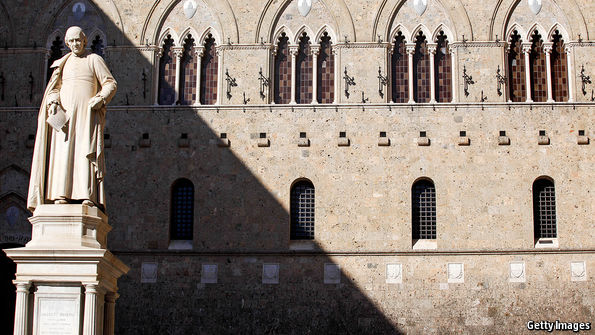
Weighing heaviest on bankers’ minds is a planned state rescue of Monte dei Paschi di Siena, now Italy’s fourth-largest lender. A private recapitalisation scheme collapsed in December, prompting it to seek government help. Days earlier, anticipating the plan’s demise, the state had created a €20bn fund to support ailing banks.
Next month Monte dei Paschi’s chief executive, Marco Morelli, will present a new business plan. On January 18th he confirmed to a Senate committee that 500 branches and 2,450 jobs will go within three years. Soon the bank is expected to issue a state-backed bond, for perhaps €1.5bn, to shore up liquidity; it…Continue reading
The repair job at Cyprus’s biggest lender

THE banking woes of Italy, the euro area’s third-biggest member, pale next to those that, four years ago, plagued Cyprus, its second-smallest. Now there is cause for cautious optimism. This month Bank of Cyprus, the biggest local lender, finished repaying €11.4bn ($12.2bn) of emergency liquidity assistance from the country’s central bank. It followed that by returning to the bond markets, raising €250m in a sale of unsecured notes, albeit with a stiff 9.25% coupon.
Even better, on January 19th Bank of Cyprus listed on the London Stock Exchange. This, says John Hourican, the chief executive, fulfils a promise to investors in 2014, when the bank raised €1bn of equity, to list on “a liquid, index-driven European exchange”. It is quitting the Athens bourse, now that it “no longer has any business of significance in Greece.” (Its listing in Nicosia remains.) It has also rid itself of operations in Romania, Russia, Serbia and Ukraine. Although its return on equity is still meagre, just 2.7% in the third quarter, its ratio of equity to risk-weighted assets, a key gauge of strength, is respectable enough, at…Continue reading
Industrial policies mean cosseting losers as well as picking winners

EQUITY markets have shrugged off the Brexit and Trump votes. Indices in London and New York have reached new highs. But individual stocks and industries have had the odd wobble, not least when they have been the subject of a hostile tweet from the incoming president. “You’ve been fired at” may turn out to be a dominant meme of the next four years.
Indeed, what seems to be emerging on both sides of the Atlantic is a new version of industrial policy, in which Brexit negotiations, tax laws and trade talks are used as a way to favour some industries and punish others. And that ought to be cause for real investor concern.
The standard criticism of industrial policy is that it is all about “picking winners”. But the real problem is that it is more about protecting the position of established corporations—cosseting losers, in other words.
Which companies are most likely to get protected? The obvious answer is incumbent groups that possess lobbying clout. Many companies have expressed concern about Brexit, but it is to Nissan, a Japanese car giant, that the British government has made an undisclosed commitment. Startups are unlikely…Continue reading
How the City of London hopes to navigate a hard Brexit

THERESA MAY’S speech on January 17th set Britain definitively on a path to a “hard” Brexit, in which it will leave not just the EU but the European single market. This was not what the City of London wanted to hear. The prime minister did at least pick out finance, along with carmaking, as an industry for which “elements of current single-market arrangements” might remain in place as part of a future trade deal. The City is holding out hope that a bespoke deal built on the existing legal concept of “equivalence” could still accord it a fair degree of access to Europe.
“Passporting”, which allows financial firms in one EU member state automatically to serve customers in the other 27 without setting up local operations, was always going to be difficult after Brexit. Outside the single market, says Damian Carolan of Allen & Overy, a law firm, the “passport as we know it is dead.” Already, two big banks, HSBC and UBS, this week each confirmed plans to move 1,000 jobs from London.
Financial companies all have to firm up their contingency plans. For the City, these focus on so-called “equivalence” provisions, allowing third-country financial…Continue reading
Republican tax-reform plans face many hurdles, including Donald Trump

AMONG other things, the start of Donald Trump’s presidency this week heralds a collision between campaigning rhetoric and legislative and economic reality. What follows will be a learning experience for all, it is fair to say. Though not perhaps the most consequential of the looming reality checks, the outcome of a brewing debate over a proposed border-adjusted tax plan could prove a taste of things to come. As Mr Trump and his Congress work to make policy, there are many ways for things to go awry.
Both Mr Trump and congressional Republicans are keen to cut taxes on corporations. America’s inefficient corporate-tax system has remarkably high rates but leaks like a sieve, yielding a pitiful tax take (see chart). As a solution, Mr Trump favours a large cut in the corporate-tax rate, from 35% to 15%, and a chance for companies to repatriate foreign profits at a tax rate of 10%. Paul Ryan, Speaker of the House of Representatives and chief Republican policy wonk, has something very different in mind.
At present American firms are assessed for tax on their global income. This encourages multinationals either to use clever…Continue reading