
Tag: Finance and economics
Why even win-win trade deals are tough

IN THE wee hours of December 7th 2013, after weeks of haggling, exhausted trade representatives stood to applaud. Agreement had been reached on the first trade deal in the history of the World Trade Organisation (WTO). No longer could it be accused of being a talking shop, crimped by consensus. “For the first time in our history, the WTO has truly delivered,” said Roberto Azevêdo, the body’s chief. The deal is tantalisingly close to coming into force, needing just two more national ratifications. Chad, Jordan, Kuwait and Rwanda are competing to take it over the line.
In theory, the Trade Facilitation Agreement (TFA) is a beacon of hope on the trade landscape. It was unanimously agreed to by rich and poor countries. If fully implemented, it could have an even bigger impact than slashing all tariffs. It is an example of a win-win deal, in which peer pressure pokes governments into making life easier and more prosperous.
The agreement shies away from slashing subsidies or toppling tariffs, and instead hacks at the thicket of regulatory trade barriers. The red tape is stickiest in poorer countries; in sub-Saharan Africa…Continue reading
In defence of NAFTA

THE North American Free Trade Agreement (NAFTA) has long been a populist punchbag. In the American presidential campaign of 1992, Ross Perot—an oddball Texas billionaire and independent candidate—claimed to hear a “giant sucking sound” as Mexico prepared to hoover up American jobs. Since its enactment, right-wing conspiracy theorists have speculated that NAFTA is merely a first step towards “North American Union”, and the swapping of the almighty dollar for the “amero”. Donald Trump, who plans to renegotiate (or scrap) the deal, mined a rich vein of anti-NAFTA sentiment during his campaign, calling it “the single worst trade deal ever approved in this country”. Even NAFTA’s cheerleaders (a more reticent bunch) might concede that the deal has fallen short of their expectations. But it is in none of the signatories’ interests to rip it up or roll it back.
America and Canada opened talks on a free-trade area with Mexico in 1990, shortly after securing their own bilateral deal, and it was bringing in Mexico that proved so contentious in America. When NAFTA took effect in 1994, it eliminated tariffs on more than half of its…Continue reading
India flirts with a UBI
 Basic needs
NOVEMBER 8th was not just the day of Donald Trump’s election. It was also when Indians found out most banknotes would lose all value unless promptly exchanged. Ever since, many have expected their patience in enduring the ensuing chaos to be rewarded in some way. Might scrapped cash unredeemed by presumed tax-dodgers be recycled into a lump-sum payment to each and every citizen? Or would the annual budget, presented on February 1st, be full of giveaways ahead of a string of state elections? In the event, the budget was restrained to the point of dullness. But the government’s closely-watched “economic survey”, released the previous day, hinted at a much bigger giveaway in the works: a universal basic income (UBI) payable to every single Indian.
The idea of a cash payment made to citizens irrespective of their wealth is centuries old. It has become newly fashionable in some rich countries, among both left-wing thinkers (who like its redistributive aspects) and their right-wing foes (who think it results in a less meddlesome state). The idea has had its fans in India: a small UBI scheme was launched as a…Continue reading
A big Chinese province admits faking its economic data

AT THE start of 2014 a senior official in the statistics bureau of Liaoning, an industrial province in north-eastern China, told his army of boffins to cultivate a spirit of innovation in their work. “Liberate your minds,” he exhorted an annual planning meeting. They took him at his word. In one of the biggest scandals to rock the murky world of Chinese economic data, the government admitted this month that Liaoning had faked its fiscal data from 2011 to 2014, inflating revenues by about 20%.
For those inclined to distrust all Chinese numbers, the announcement was simple vindication. But a closer look paints a different picture: of central authorities wanting to get a better read on the economy but being impeded at the local level—and by one of the usual suspects at that.
In manipulating statistics, Liaoning has form. When Li Keqiang, now prime minister, was Communist Party chief of the province in the 2000s, he confided to America’s ambassador to China that its GDP figures were “man-made” and unreliable. Mr Li’s comments have often been cited by critics of Chinese data, though his concerns focused just on…Continue reading
Warren Buffett extends his dominance of retroactive reinsurance
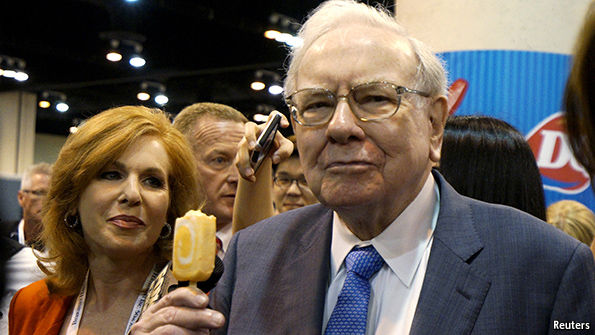
IT IS a niche market, but a big one, and it is increasingly dominated by Warren Buffett’s Berkshire Hathaway. On January 20th its reinsurance subsidiary, National Indemnity Company (NICO), agreed with American International Group (AIG), a big insurer, to acquire excess losses on old insurance policies. In one of the largest such “retroactive reinsurance” deals ever announced, NICO will be on the hook for four-fifths of all losses above $25bn, up to $20bn, in exchange for a payment of $9.8bn now. The deal comes just a few weeks after a similar deal giving up to $1.5bn of coverage to Hartford, another American insurance giant.
For much of the 15 years since the term retroactive reinsurance came into use, Berkshire, through NICO, has been at the forefront. The structure allows insurers to rid themselves of so-called “long-tail” exposures, ie, claims that may come in years or decades after policies were written. Often, they cover long-term environmental risks like pollution, or asbestos-related disease, where workers may fall ill many years after exposure. In the largest previous deal in 2006 NICO provided reinsurance coverage worth $7bn for…Continue reading
America, China and the risk of a trade war
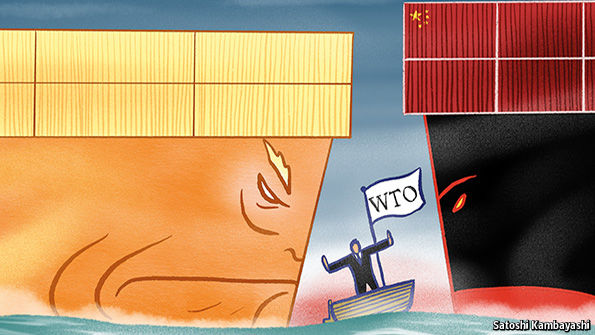
DONALD TRUMP’S quest to protect American workers from cheating foreigners has begun. But in his first flurry of policy tweets and executive orders, China, his favourite bogeyman, was conspicuously absent. On the campaign trail he deplored China’s currency manipulation, accused it of flouting global trade rules and threatened a 45% tariff on its exports, all to cheering crowds. Now, the world is waiting to see how much of this he meant.
The promise to label China a currency manipulator has not been repeated. An optimistic interpretation is that Mr Trump has realised that the promise was based on an “alternative” fact. China is no longer squashing its currency to gain a competitive edge, but is instead propping it up. A pessimistic one is that Steven Mnuchin, his treasury secretary, who would do the labelling, is not yet confirmed by the Senate.
Mr Trump certainly has the power to wreak trade havoc. A big blanket tariff would slice through supply chains, hurt American consumers and fly in the face of the global system of trade rules overseen by the World Trade Organisation (WTO). But, rather than blow up the world’s trading system, Mr Trump…Continue reading
Visas as aid
 Better in America
TWO years ago, Jon Hegeman, a farmer from Alabama, was struggling to expand his business. He could offer unglamorous but steady work. Potting plants and shifting them to a greenhouse paid $10.59 an hour. He couldn’t find workers; he even tried recruiting from a youth-detention programme.
Mr Hegeman stumbled on a solution when he met Sarah Williamson, of Protect the People (PTP), a charity for people affected by humanitarian disasters. With the International Organisation for Migration, PTP was trying a novel way of helping Haiti after its devastating earthquake in 2010: by taking Haitians to work temporarily in America. The idea appealed to Mr Hegeman, born to missionary parents on the same island (but in the Dominican Republic). With the agencies’ help, eight workers arrived in September 2015.
A new study by Michael Clemens and Hannah Postel of the Centre for Global Development compares those Haitians who secured visas through the project with unsuccessful applicants left behind. The benefits were mind-boggling: the temporary migrants earned a monthly income 1,400% higher than those back in…Continue reading
A fintech startup tries to shake up American student loans

IN AN old factory building in lower Manhattan a fintech startup is seeking answers to a question that has tormented teachers and students for decades: what is the value of a given course, teacher or institution? Climb Credit, with just two dozen employees, provides student loans. The programmes it finances bring returns far higher than can be expected from even highly rated universities.
Climb does not claim to nurture billionaires, nor to care much about any of the intangible benefits of education. Rather, it focuses on sharp, quantifiable increases in earnings. The average size of its loans is $10,000 and it normally finances programmes of less than a year. The subjects range from coding to web design, from underwater welding to programming robots for carmakers (which has the highest rate of return). Some students have scant formal education; others advanced degrees. The rate of return they get is calculated as the uplift in earnings after the course of study, minus its cost (which includes that of servicing the loan, and takes account of the absence of earnings during the course).
Climb’s results so far are hardly conclusive. It has…Continue reading
Financial markets diverge as central banks start to turn off the taps
INVESTORS are learning to let go of Daddy’s hand. Monetary policy has been very supportive of asset markets over the past eight years but the direction of policy is tilting slowly.
The Federal Reserve has increased rates twice already and is expected to push through another three increases this year. The Bank of England has indicated that the next move in rates could be up or down, but that the former looks more likely, especially as inflation is on the rise. The European Central Bank is scheduled to reduce the amount of bond purchases it makes after the end of March. Only the Bank of Japan seems committed to keeping the monetary taps on “full”.
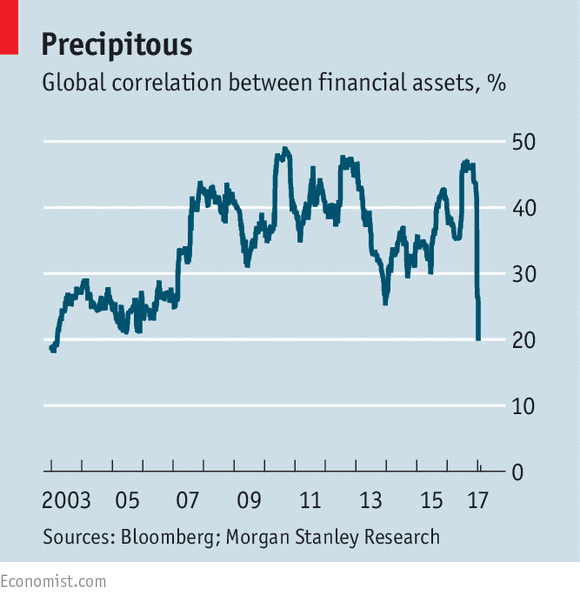
The market impact is already visible. Morgan Stanley says there has been a “crash” in the tendency for assets to correlate with each other in recent months (see chart). Its measure incorporates correlations between different markets (equities and corporate bonds, for example), and between different regions.
The recent fall in correlations takes the measure back to where it was in the run-up to the 2007-08 financial crisis. During and after the crisis, correlations rose…Continue reading
Winners and losers in a China-America trade war
ECONOMIC Armageddon became a bit more likely when Donald Trump took office on January 20th, given his threats to impose a 45% tariff on Chinese imports. “No one will emerge as a winner in a trade war,” Xi Jinping, China’s president, intoned just days earlier. He was not quite right. In any catastrophe, a few survive; some even thrive.

Tariffs that high would serve as a tax on American shoppers buying phones, computers and clothes (see chart). They might not dent their wallets too much—a study found that in 2010 goods and services from China made up less than 3% of consumer spending. Poorer Americans would be hit harder, however, as they spend a higher share of their income on tradable goods.
American importers would suffer from a tariff. Importers of electronics and clothing enjoy higher retail and wholesale margins than other importers. A tariff would eat into them. Their competitors, relying on domestic suppliers, could benefit and raise prices.
A squeeze on trade between America and China would be painful but not catastrophic for China’s economy. It has weaned itself off export-led growth. Analysts from…Continue reading